Difference Between Toaster and Griller: A Comprehensive Guide
Analytical comparison of toaster vs griller: performance, features, price ranges, and use cases to help homeowners choose the best appliance for browning, reheating, and cooking.


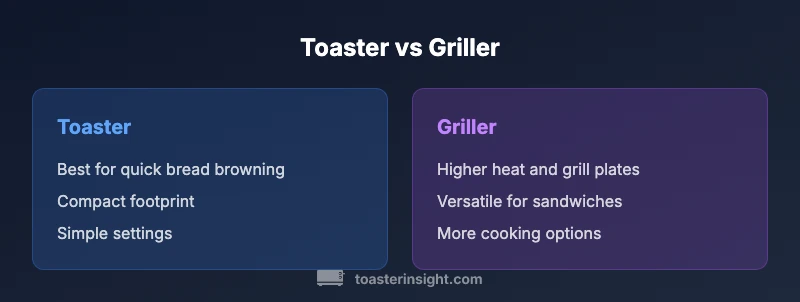
The difference between toaster and griller primarily hinges on design intent and cooking versatility. A toaster focuses on quick bread browning and simple reheating, using compact slots and basic controls. A griller offers higher heat, grill plates, and broader culinary capabilities for sandwiches, melts, and small meals. If you prioritize speed for toast, choose a toaster; if you want grill-style versatility, opt for a griller.
What is a toaster?
According to ToasterInsight, the difference between toaster and griller often begins with design intent: a toaster is built primarily for bread-focused browning and quick reheating, while a griller expands into higher-heat cooking with grill plates and sandwich functionality. A toaster typically uses separate slots and a simple set of browning controls, optimized for speed and consistency in toasting. It excels at single-purpose tasks and has a compact footprint that fits easily on most countertops.
In practice, a toaster emphasizes convenience and speed for breakfast routines, while a griller aims to cover a broader set of meals. When evaluating either appliance, pay attention to slot width, heat settings, and the availability of features like defrost, reheat, and bagel modes. For households with limited space, a compact toaster can handle daily toast and bagels with minimal fuss, but you may outgrow it if you regularly prepare grilled sandwiches or chicken paninis. Through this lens, the difference between toaster and griller becomes a matter of scope and intended use.
What is a griller?
A griller is designed to deliver higher heat and broader cooking capability than a basic toaster. It often includes grill plates or removable plates that mimic outdoor grilling, enabling searing marks on sandwiches, vegetables, and even small cuts of meat. Some models integrate a toaster-oven function, but the core idea remains: more surface area and more control over heat means more cooking versatility. For serious cooks, a griller can replace several small appliances, while for others it remains a secondary tool for specific tasks like grilled cheese or panini press-style meals. In short, if you need more than browning bread, a griller is your candidate.
Core differences at the element level
The core difference between toaster and griller starts with how heat is generated and directed toward food. Toasters typically use radiant elements positioned behind the bread slots, sometimes with a reflective surface to promote even browning. The result is fast, bread-focused toasting with predictable browning levels that align with preset or manually selected browning settings. Griller designs elevate temperature control by adding dual heating elements, grill plates, and in many cases a separate grill surface. Some models incorporate convection fans that circulate hot air, improving evenness across larger or irregular foods. The combination of higher maximum temperatures and a wider cooking surface means grills can sear, melt cheese more uniformly, and handle paninis or vegetables in a single session. However, that extra capability comes with a longer heat-up time and more complex cleanup. The practical takeaway is that the difference between toaster and griller at the element level is about breadth of heat application: a toaster focuses heat narrowly for bread, while a griller broadens heat across plate surfaces for more diverse culinary tasks.
Cooking versatility: bread, sandwiches, and beyond
Toasters are optimized for bread-centric tasks: browning slices, defrosting frozen bagels, and reheating small portions quickly. Griller-equipped devices, by contrast, invite a wider repertoire: pressed sandwiches, grilled vegetables, and even thin proteins, depending on the model. For example, a griller may offer adjustable grill plate temperature, a dedicated sandwich mode, and the ability to flip or rotate foods to achieve grill marks. Yet not all grillers are created equal; some models provide a panini-style press, removable plates for easy cleaning, and adjustable racks for delicate items. The difference between toaster and griller here lies in task variety. If your cooking needs include searing or creating restaurant-style melts, a griller offers distinct advantages; if your meals revolve around bread and simple reheat, a toaster is typically sufficient.
Performance and consistency: browning control and heat distribution
Uniform browning is a critical performance metric for both appliances. In a toaster, browning consistency depends on slot size, heat source distribution, and the firmware's ability to balance heat across the bread surface. Griller performance improves when the unit uses independent zones or plates with controlled contact pressure, producing more even surfaces and melted cheese that distributes heat more evenly. In everyday use, we note that toasters excel at speed: you can start toasting bread in the morning and have breakfast ready in minutes. Grillers may require a longer warm-up but can offer more reliable results when cooking on non-bread surfaces. The practical takeaway is to map your typical meals to these capabilities: daily breakfast tasks align with toasters; weekend lunches or dinners with grilled sandwiches and small dishes align with grillers.
Size, footprint, and capacity considerations
Counter space is a practical constraint for many households. Traditional toasters are compact, with narrow footprints that suit small kitchens. Griller devices range from compact toaster-griller hybrids to larger countertop units with multiple functions and larger cooking surfaces. When evaluating footprint, consider clearance around the unit, the height of stacked shelves, and the depth of the appliance. If you routinely prepare large bagels or thick slices, slot width becomes a deciding factor. For households with limited space, a toaster with generous slot width and bagel mode may suffice, while those who want grilling capability might opt for a compact griller or a combined toaster-oven.
Energy use and efficiency: power draw and standby consumption
Energy efficiency is a meaningful consideration, especially in kitchens with multiple appliances. Both toasters and grillers fall into the mid-range energy class for small appliances, with electricity usage tied to wattage, cycle length, and standby features. When you compare the difference between toaster and griller, the emphasis should be on practical usage patterns: do you run long grilling cycles or quick bursts of toast? Look for features that reduce standby draw, auto shutoff, and energy-saving preheating. In general, a well-tuned toaster or griller can deliver high performance without drastically increasing energy costs, but choosing the right size helps avoid wasteful standby or extended warm-up times.
Cleaning, maintenance, and durability
Maintenance is often overlooked in buying decisions. Toasters require relatively simple cleaning: empty crumb trays, wipe the exterior, and ensure that no crumbs jam the slots. Griller units can be more demanding due to grill plates, removable drip trays, and more exposed interior surfaces. Regular cleaning after use, drying removable parts, and seasoning grill plates (where applicable) prolongs life and maintains performance. Durability is also a factor: higher-end grillers may employ metal construction and reinforced hinges designed for frequent use, while basic toasters emphasize lightweight plastics for cost effectiveness. The bottom line is: if you cook messy foods or plan to grill repetitively, your cleaning routine will influence long-term satisfaction with either appliance.
Price, warranty, and value proposition
Price is a practical determinant in any kitchen tool decision. Toasters sit on the lower end of the price spectrum, with mid-range models offering more precise browning controls and feature sets. Griller devices usually command higher price points due to larger heating surfaces, more complex mechanisms, and broader capabilities. Since price does not always reflect performance, compare models using the same feature set and check warranty terms. A longer warranty can be a meaningful signal of durability, especially for devices with moving parts like grill plates. In forming a value judgment, balance upfront cost with long-term utility, frequency of use, and potential replacement costs if the device wears out promptly.
How to choose: decision framework and scenario guides
Develop a decision framework based on your typical meals, kitchen space, and budget. Start by listing your must-have tasks: toast every morning, grilled cheese, reheating leftovers, or panini presses. If bread-focused tasks dominate and you value speed, a toaster with generous slot width and reliable browning may be sufficient. If you regularly cook beyond toast — sandwiches, vegetables, and small proteins — a griller or a toaster-oven hybrid can provide more versatility. Consider where you store the appliance and how easy it is to clean. Use a simple scoring rubric: assign weight to key features (space, heat control, accessories) and compare devices by how well they satisfy each criterion. The practical takeaway is: match the appliance to your most frequent tasks, not just the trend toward new features.
Common misconceptions debunked
There are several myths about toasters and grillers that can trip up buyers. Some assume that a more expensive unit automatically outperforms a cheaper one in every task; in reality, performance often depends on the specific feature set and how you use the appliance. Others believe that grillers always require extensive cleanup, but many modern models feature removable plates and easy-clean drip trays. Finally, the idea that a toaster-oven hybrid is always the best compromise is not universal; for compact kitchens, a dedicated toaster or a compact griller may better fit your routine depending on your breakfast and lunch habits.
Real-world kitchen takeaways and scenarios
In a typical household, the choice between a toaster and a griller should align with daily routines. If your mornings are dominated by toast, bagels, and quick defrosted slices, a reliable toaster with a bagel setting is often the most efficient choice. If you frequently prepare paninis, grilled vegetables, or melted cheese dishes, a griller or toaster-oven hybrid provides tangible value and reduces the need for multiple devices. Brand reliability matters; prioritize models with durable construction and accessible parts. As you consider upgrades, test heat consistency across several cycles and evaluate the ease of cleaning after a grilled meal. These real-world checks help ensure the appliance you buy fits your kitchen and cooking style in the long run.
Comparison
| Feature | Toaster | Griller |
|---|---|---|
| Power/Heat Range | Low to medium heat | Medium to high heat with grill plates |
| Versatility | Bread-centric tasks | Bread-focused with limited extras |
| Size/Capacity | Compact, narrow slots | Larger surface, wider plates |
| Maintenance | Easy cleanup, crumb tray | More components to clean, removable plates |
| Price Range | Budget-friendly to mid-range | Mid-range to premium |
| Best For | Fast toast and simple reheats | Grilled sandwiches and broader cooking |
Positives
- Faster browning for common breakfasts
- Compact footprint for small kitchens
- Simple controls and low learning curve
- Lower upfront cost for basic models
Drawbacks
- Limited cooking versatility outside bread tasks
- Smaller food capacity and fewer accessories
- Cleaning can be trickier with grill plates (higher-end models)
Choose a griller if you prioritize cooking versatility and grill-style results; opt for a toaster if you need quick, simple browning and a compact footprint.
Grilllers excel at broader cooking tasks and can replace multiple devices in some kitchens. Toasters shine for speed, simplicity, and tiny counter space. Your choice should reflect how often you cook beyond toast and how much space you’re willing to dedicate.
Your Questions Answered
What is the main difference between toaster and griller?
The main difference is scope: a toaster is optimized for bread browning and quick reheating, while a griller adds higher heat and grill surfaces for sandwiches, melts, and more diverse cooking. Your decision should hinge on whether you need bread-focused speed or broader cooking capability.
Toasters are for quick toast; grillers handle broader cooking tasks like melts and grilled items.
Can you use a toaster to grill a sandwich?
Some toasters with wide slots or specialized modes can handle simple grilled sandwiches, but results are often uneven. For consistent grilled sandwiches, a griller or toaster-oven is typically better.
A basic toaster can do a sandwich, but a griller gives you better heat and grill marks.
Are toaster and griller energy efficient?
Both devices are relatively energy-efficient for small appliances; efficiency depends on wattage, cycle length, and usage. Look for auto shutoff and energy-saving features to minimize standby draw.
They’re generally efficient, but choose a model with good heat control and auto shutoff.
Is a toaster-oven a better middle ground?
A toaster-oven can be a practical middle ground, combining bread browning with light baking and toasting beyond plain toast. It’s especially useful in small kitchens where space is limited.
Yes, if you want both toasting and light baking in one unit.
What features should I look for in a griller?
Look for adjustable temperature, removable grill plates, even heat distribution, easy cleaning, and enough surface area for your typical meals. A panini press feature can be a bonus for versatility.
Check heat control, plate design, and cleanup options.
How should I clean a toaster or griller?
Unplug the unit and empty crumb trays regularly. Wipe the exterior and wipe down removable grill plates after cooling. For grillers, ensure plates are dry before reassembly to prevent corrosion.
Keep crumbs out of the slots and wash removable parts as directed by the manual.
Key Takeaways
- Match device choice to your most frequent meals
- Prioritize heat control and plate design for even browning
- Consider counter space and ease of cleaning
- Weight long-term value against upfront cost
- Check warranty and removable components for durability