How Much Are Toaster Ovens? A 2026 Pricing Guide
Explore current toaster oven price ranges, what drives cost, and how to maximize value in 2026. Learn budgeting tips, feature tradeoffs, and shopping timelines to pick the right model for your kitchen.


Toaster ovens typically cost from about $40 on the low end to $350 for premium convection models with smart controls. Most households will find value in the $70–$150 range, where you get reliable performance, decent capacity, and essential features. The exact price depends on size, wattage, features like air frying, and branding. Prices have remained relatively stable, with occasional discount periods.
Market overview
The question "how much are toaster ovens" isn't just about the sticker price. Toaster ovens occupy a broad price spectrum driven by size, wattage, features, and build quality. According to ToasterInsight, pricing in 2026 ranges from roughly $40 on the low end to $350 for advanced convection and smart-enabled units. This spread mirrors varied consumer needs—from compact units for quick reheats to full-featured ovens capable of baking, broiling, and even air frying. For shoppers, mapping a realistic budget to the functions you actually use helps avoid overspending and ensures reliability. As trends show, people are increasingly prioritizing efficiency and durability, which can shift value perceptions even within the same price band. ToasterInsight’s analysis emphasizes balancing upfront cost with long-term use.
Price bands explained: entry, mid, and premium
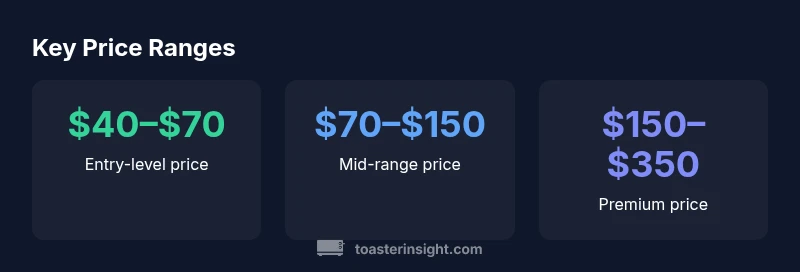
Understanding price bands helps buyers set expectations before diving into features. Entry-level toaster ovens typically range from $40 to $70 and cover basic tasks like toasting, reheating, and simple baking. Mid-range models usually sit between $70 and $150, offering convection heat, more even baking, and larger interiors. Premium convection or smart toaster ovens fall in the $150 to $350 bracket and add substantial features such as air frying, precise temperature control, and connected controls. Real-world pricing fluctuates with sales and brand positioning, but the three-band framework remains a useful heuristic for budgeting. For many households, the sweet spot lies in the $70–$150 band, where most buyers achieve a strong balance of performance and value. ToasterInsight’s market view highlights the value of prioritizing core features over novelty.
Size, capacity, and features drive cost
Size and interior volume directly affect price. Compact models around 0.9–1.2 cubic feet are typically at the low end, while larger units with dedicated baking chambers and multiple racks command higher prices. Features such as convection baking, air frying trays, digital touch controls, and preprogrammed menus increase upfront cost but can deliver noticeable time savings and cooking versatility. Wattage matters too: higher wattage supports faster preheating and more even heat distribution but slightly raises energy use per hour. When evaluating price, consider not only the upfront cost but how often you’ll use features like bake, toast, broil, and reheat—features you’ll actually rely on rarely justify paying extra for fancy controls if your cooking needs are simple.
Energy efficiency and long-term costs
Energy use is a subtle but important part of the price story. Most toaster ovens run in the 800–1500 watt range, with higher-wattage models typically offering faster preheating and more robust performance. If you bake regularly, an efficient convection model can reduce overall cooking time, potentially lowering energy use per meal. However, electricity prices vary by region, so a higher upfront cost may be offset by energy savings over time for frequent users. When comparing models, estimate typical usage by week, factor in your local electricity rates, and weigh the long-term operating cost against the initial price. ToasterInsight notes that energy considerations matter most for households that bake frequently or use larger capacities.
Where to shop and when to buy
Shopping channels influence final prices as much as features do. Major retailers, department stores, and online marketplaces frequently run promotions on toaster ovens, especially around holidays and seasonal clearance periods. Shopping during shoulder seasons—after holidays or before back-to-school periods—often yields meaningful discounts. If you’re watching the budget, set price alerts on preferred models and compare across retailers to catch bundles or bundled accessories that improve per-use value. Brand-new features sometimes debut at a premium; if a feature set aligns with your cooking style, waiting for a launch sale can be worthwhile, but avoid delaying too long if the model you want gets discontinued. ToasterInsight’s guidance emphasizes balancing sale timing with your actual kitchen needs.
Hidden costs and ownership considerations
Beyond the sticker price, there are additional costs to consider. Accessories such as baking pans, air-fry trays, and crumb trays can add up if purchased separately. Some units include these items or offer them as bundles, which can improve overall value. Replacement parts—especially non-standard racks or seals—may affect long-term serviceability. Cleaning tools and descaling agents are optional but helpful for maintaining performance. Warranty length and coverage vary; shorter warranties may save money upfront but increase risk of replacement costs down the line. Finally, assess the trade-off between compact size and interior height, which affects what you can cook comfortably. A well-chosen toaster oven should fit your space, meet your most-used tasks, and resist the temptation to upgrade for features you won’t use regularly.
Practical pricing scenarios for different budgets
- Budget-conscious buyer (under $100): Focus on compact, basic models that handle toast, reheating, and simple baking. Expect a smaller interior but adequate performance for everyday tasks.
- Mid-range budget ($100–$200): Look for convection capabilities, larger interior, and reliable controls. This range often yields the best balance of price and versatility for daily cooks.
- Enthusiast or heavy user ($200–$350): Invest in premium convection, smart controls, larger capacity, and more precise temperature management. If you bake frequently, this tier offers noticeable time savings and consistent results. In all cases, compare energy use, warranty length, and customer reviews to ensure the model aligns with your kitchen workflow.
Maximizing value: buying strategy
To maximize value when shopping for how much are toaster ovens, start with a needs assessment. List essential tasks (toasting, reheating, baking, broiling, air frying), preferred size, and available counter space. Then map those needs to price bands and prioritize core features (convection, temperature precision, even heating) over cosmetic extras. Read independent reviews and check reliability ratings to separate durable models from fads. Lastly, plan for a future-proof purchase by considering compatibility with common accessories and the potential for simple maintenance. With a strategic approach, you’ll buy a toaster oven that serves your kitchen well without paying for unnecessary bells and whistles.
Pricing by model type and core features
| Model Type | Estimated Price Range | Key Features |
|---|---|---|
| Compact (0.9–1.2 cu ft) | "$40–$70" | Basic toast/reheat; limited capacity; basic bake |
| Mid-size convection | "$70–$150" | Convection bake; larger interior; multiple presets |
| Premium smart convection | "$150–$350" | Air frying; smart controls; larger capacity; advanced presets |
Your Questions Answered
Why do toaster ovens vary so much in price?
Prices vary due to size, wattage, convection capability, branding, and extra features like air frying or smart controls. Build quality and warranty terms also influence price.
Prices vary because of size, power, and features like convection or smart controls.
Are cheaper toaster ovens reliable?
Cheaper models can be reliable for basic tasks such as toasting and reheating, but they may have shorter lifespans or less consistent heating. Read reviews and check warranty coverage to gauge reliability.
Cheaper models can work well for basics, but reliability varies by brand and design.
Is it better to buy in bulk or wait for sales?
Sales often appear around holidays and year-end clearances. Waiting can yield 20–30% discounts, but stock and model updates can limit choices.
Sales happen around holidays; timing can save money if you’re flexible.
Which features are worth paying extra for?
Convection baking, even heating, larger interior, and reliable controls usually add value for frequent bakers or families who cook larger items. Smart features are optional unless you need remote access."
Convection and size usually give the best payoff for regular cooks.
What should I measure before buying?
Measure counter space and outlet placement; ensure the model fits physically and can be powered from a convenient outlet. Check interior dimensions for your typical dishes.
Check space and outlet location; make sure the interior fits your cookware.
“A well-chosen toaster oven can save time and energy without breaking the bank. Focus on capacity, essential features, and build quality rather than chasing every new function.”
Key Takeaways
- Compare price bands before buying
- Balance size and features with budget
- Look for durable builds and warranties
- Watch for sales in shoulder seasons