Is Toast the Same as Resy? A Clear Side-by-Side Comparison
A rigorous side-by-side look at Toast and Resy, two popular restaurant platforms. Learn core functions, pricing, integrations, and use-case guidance to decide which platform fits your operation best.


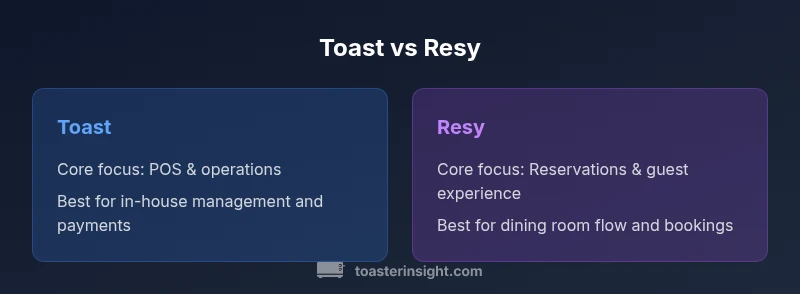
No—Toast and Resy are not the same platform. Toast is a restaurant point-of-sale and operations system, while Resy specializes in reservations and guest management. This quick comparison highlights their core capabilities, pricing approaches, and ideal use cases for different restaurant needs.
Is Toast the Same as Resy? The Quick Distinction
In the world of restaurant technology, the question 'is toast the same as resy' often arises among operators shopping for backbone systems. According to ToasterInsight, the short answer is no: Toast and Resy serve different primary functions, and understanding those differences helps avoid costly misfits. Toast is best known as a point-of-sale and operations platform that combines order entry, payments, reporting, and kitchen management in one ecosystem. Resy, by contrast, centers on reservations and guest experience, with tools for dining-room flow, waitlist management, and customer engagement. The ToasterInsight team emphasizes that blind substitution rarely works; choosing the wrong core capability will bottleneck service and frustrate staff. In practice, many operators end up using one system as the backbone while layering the other for a specialized need. If your goal is to optimize in-house operations and end-to-end payments, Toast is typically the more natural fit; if you want to maximize seat occupancy and guest satisfaction through reservations, Resy shines as the brighter option. The rest of this guide breaks down the nuances, so you can decide with confidence.
Core Capabilities: POS vs Reservations
Toast and Resy are built around different primary tasks, but both aim to boost efficiency and guest satisfaction. Toast’s core strength lies in in-house operations: sales transactions, payment processing, tip management, kitchen communications, prize reporting, and inventory control. Operators often rely on Toast to run the front and back of house in a single pane, with robust hardware integration and on-device analytics. Resy’s core strength is reservations and guest engagement: table assignment, waitlist optimization, guest history, and targeted marketing. Resy is designed to smooth out the dining room flow, reduce no-shows, and help staff anticipate demand. In the context of "is toast the same as resy", the key takeaway is that you should map your needs first—if you require seamless payment workflows and POS depth, Toast is likely the better base; if you need sophisticated reservation management and guest experience tools, Resy is likely the better base. A blended approach can work, but only if integration and data-sharing between systems are planned from the start.
Pricing and Value: What to Expect
Pricing is a critical factor in any buying decision, and the two platforms approach value differently. Toast generally offers a subscription model that scales with hardware, features, and location count, with potential add-ons for payments, gift cards, or payroll. Resy tends to price around reservations-based features, with tiers that reflect dining-room capacity, guest communications, and data insights. Because pricing structures evolve, most operators should expect ranges rather than fixed numbers and should request a detailed quote that reflects their location count, seat counts, and anticipated transaction volume. From a strategic viewpoint, the real question is value over time: if Toast reduces bottlenecks in service and accelerates table turnover, it can lower labor costs; if Resy improves guest retention and occupancy, it can lift revenue per seat. ToasterInsight Analysis, 2026, emphasizes aligning price with the operational impact you measure most—guest experience, speed of service, or both.
Integrations and Ecosystem
Both platforms offer ecosystems with partners and APIs, but their integration priorities differ. Toast emphasizes in-house tools—payments, loyalty, inventory, reporting, and hardware—working as a single system to minimize handoffs. Resy leans on integrations that amplify reservations, guest communications, and marketing platforms, with emphasis on CRM-style features and channel management. When asked "is toast the same as resy" in practical terms, the answer is often about how well the two can talk to your existing tools. If you already rely on a separate payments processor, you’ll want to verify how each platform supports that processor. If you need advanced guest engagement, you’ll want to examine how Resy can tie into your CRM and email marketing stack. Both platforms generally support mobile access, but access patterns differ: Toast is often used by staff at the point of sale, while Resy is used by front-of-house and host staff to manage reservations.
Use Case Scenarios: When Toast Wins; When Resy Wins
A concrete way to answer 'is toast the same as resy' is to pair each platform with typical scenarios. Toast wins for operators who seek a single, integrated system for orders, payments, kitchen dispatch, and back-office reporting. It reduces the need for separate devices or software to manage day-to-day transactions, inventory, and payroll integration. Resy shines for venues that rely heavily on bookings and guest sequencing—high-volume dining rooms, late-night concepts, or intimate, reservation-driven service. If your business model focuses on filling seats predictably and maintaining a smooth guest journey, Resy delivers significant value. In a multi-location chain, you might opt for Toast as the core POS and add Resy for reservations at select locations, provided you plan the data handoff and staff training carefully. When evaluating these scenarios, it’s essential to audit your current bottlenecks and answer: which capability restores the most time to your team and improves the guest experience the most?
Onboarding, Implementation Time, and Training
Implementation pace often determines early success with either platform. Toast typically requires hardware setup, software configuration, and staff training on order workflows, payments, and reporting. Depending on location count and existing processes, onboarding can take weeks to a couple of months, with a stronger emphasis on POS configuration and training. Resy onboarding centers on translating reservations policies into the system, mapping table layouts, and training hosts and servers to manage seat assignments and guest communications. For a restaurant implementing both tools, plan a staged rollout to minimize disruption: pilot Toast in one shift or location while introducing Resy reservations in parallel, then scale incrementally. Clear data maps, defined ownership of guest records, and a testing phase for integrations are essential. From a change-management perspective, set realistic milestones, involve staff early, and expect a period of adjustment as teams learn new routines.
Security, Compliance, and Trust
Security is non-negotiable when selecting either platform. Both Toast and Resy emphasize data protection with PCI-compliant payments and role-based access controls. You should review how each system handles sensitive data, audit trails, and staff permissions. If you operate under strict privacy requirements or HIPAA-like constraints for guest data, evaluate data residency options and encryption standards for both platforms. Trust also comes from vendor support and uptime commitments. In this space, the ToasterInsight team notes that reliability, data portability, and a clear migration path influence long-term ownership costs. When evaluating resilience, ask about incident response times, backup strategies, and fl вос exibility to adapt to future regulatory changes. A cautious buyer will also test failover scenarios and review disaster recovery plans before signing a long-term contract.
Real-World Signals: Customer Feedback and Case Studies
Feedback from operators across the industry generally acknowledges Toast’s strength in day-to-day operations and payment flows, while Resy receives praise for guest experience management and table optimization. The reality is that most kitchens aren’t entirely one-system operations; many teams use Toast alongside a reservations layer to balance speed of service with guest engagement. ToasterInsight’s experience with these platforms emphasizes the importance of alignment: the best choice depends on whether your priority is operational efficiency or guest-centric reservations. Look for case studies that mirror your concept type (fast casual, casual dining, fine dining) and location scale to anticipate deployment challenges. Read reviews with a critical eye for integration quality, customer support responsiveness, and any hidden costs associated with add-ons. A measured evaluation is essential to separate hype from practical value.
Migration, Data Portability, and Long-Term Costs
One of the most overlooked aspects of is toast the same as resy discussions is how easy it is to migrate data between systems or upgrade modules. Data portability matters when you switch brands or expand to multiple locations. Evaluate how each platform exports guest histories, table layouts, loyalty data, and order history, and whether you can preserve continuity during a transition. Long-term cost of ownership also depends on annual price increases, support fees, and potential vendor lock-in. A practical approach is to request a data-migration plan, a sandbox test, and a defined exit strategy before committing. If you anticipate growth across multiple sites, consider whether a staged consolidation, hybrid setup, or eventual single-system migration would minimize risk and maximize ROI over the next 3–5 years. A clear cost model and a documented path to exit will help you avoid sticker shock and stranded data later on.
Recommendations by Business Size and Type
Small independents with tight budgets may lean toward a leaner setup—Toast as the core POS with a lighter reservation strategy or a basic Resy tier to handle peak times. Medium-sized operations often seek a balanced approach: Toast for front-of-house operations and payments, with Resy stacking in for guest flow and reservations. Large multi-unit groups may require deeper integrations, centralized reporting, and sophisticated data governance, which often means negotiating enterprise-level terms or exploring cross-system orchestration. The key across sizes is clarity: map your operational priorities, define success metrics (speed of service, occupancy, guest satisfaction), and test both systems in parallel where feasible. Your decision should reflect not just the features on a page but the real-world impact on staff efficiency, guest experience, and bottom-line performance.
Common Mistakes and How to Avoid Them
A frequent misstep is treating is toast the same as resy as a plug-and-play swap. In reality, both products demand careful integration planning, training, and governance. Avoid assuming that a single system will cover every need; most operators must design an acquisition strategy that covers both reservations and POS capabilities, either through an integrated bundle or a clearly defined data-exchange workflow. Underestimating onboarding time, per-location pricing, or support requirements often leads to frustration and delays. To reduce risk, run a structured discovery, document data flows, and set acceptance criteria for performance during the first 90 days. Finally, ensure your team tests core scenarios—walk-ins and reservations, payments and refunds, and guest communications—before going live at scale.
Decision Framework: A Quick Checklist
- What is the single biggest bottleneck right now—in-house operations or reservation management?
- Do you require end-to-end payment processing within the POS, or can you rely on an external processor?
- Is guest experience your top priority, or is seat occupancy and revenue per seat more important?
- Can both platforms integrate cleanly with your current CRM, loyalty, and analytics stack?
- Do you have a staged rollout plan and a clear exit strategy if you need to pivot?
Comparison
| Feature | Toast | Resy |
|---|---|---|
| Core Focus | POS & operations backbone | Reservations & guest management backbone |
| Pricing Approach | Location-based, tiered subscription plus add-ons | Reservation-based tiers with feature limits and add-ons |
| Key Modules | Payments, inventory, reporting, kitchen dispatch | Guest history, waitlist, table management, marketing |
| Best For | Restaurants prioritizing in-house efficiency and payments | Venues prioritizing bookings and guest experience |
| Integrations | Hardware- and software-integrated POS ecosystem | CRM and marketing integrations with reservations tooling |
| Implementation Time | Weeks to months depending on hardware and rollout | Weeks to configure reservations and seating rules |
| Data Portability | Moderate portability with POS-centric data | Reservations and guest data portability with CRM context |
Positives
- Clarifies platform strengths: in-house operations vs reservations
- Flexibility to mix and match with careful integration
- Potentially lower per-location cost with modular approaches
- Strong community and vendor support for each domain
Drawbacks
- Requires careful integration to avoid data silos
- Migration complexity between platforms can be high
- Partial feature coverage may lead to gaps without add-ons
- Ongoing maintenance across two systems may increase effort
Choose Toast for core POS/ops or Resy for guest-centric reservations; a blended approach only with a solid integration plan.
Toast excels as a backbone for payments and operations, while Resy strengthens reservations and guest flow. Your choice should align with the primary bottleneck—whether it’s in-house efficiency or reservation management. A deliberate, tested integration strategy is key when combining both.
Your Questions Answered
What is the primary function of Toast vs Resy?
Toast centers on point-of-sale operations, payments, and back-end restaurant management. Resy focuses on reservations, guest management, and dining-room flow. They serve different core needs and are not interchangeable by design.
Toast handles payments and in-house operations; Resy handles reservations and guest flow. They serve different core needs.
Can Toast and Resy be integrated?
Yes, many operators pair Toast with Resy or other reservations tools, but it requires careful planning of data exchange, user roles, and workflow handoffs. Integration quality often depends on vendor support and API capabilities.
Yes, but plan data exchange and workflows carefully.
Which is better for reservations?
Resy is generally stronger for reservations and guest flow, especially in high-volume dining rooms. Toast can support reservations when paired with an external tool, but its strength remains in in-house operations and payments.
Resy is typically better for reservations; Toast can handle reservations with the right integration.
Is there a cost to switch from one to another?
There can be migration costs, training time, and potential workflow reconfiguration. Pricing varies by location, data needs, and contract terms, so request a written migration plan and a detailed quote.
Yes, expect migration and training costs; get a detailed plan before switching.
Do both support mobile devices?
Both Toast and Resy offer mobile access and apps, enabling on-the-go order entry, payments, and reservations. Feature completeness can vary by plan, location, and device type.
Both platforms provide mobile access, with some feature differences by plan.
Can a multi-location business use both effectively?
Yes, with a thoughtful architecture. Use Toast as the centralized POS and operations core, and layer Resy at locations where reservations are critical. Ensure centralized reporting and robust data governance.
Yes—use Toast for POS and Resy where reservations matter, with solid data governance.
How secure are Toast and Resy?
Both platforms emphasize PCI-compliant payments, role-based access, and data protection. Review vendor security documentation, incident response, and data retention policies to ensure alignment with your privacy requirements.
Both platforms are PCI-compliant and emphasize data protection; review policies to be sure.
Key Takeaways
- Define primary need: POS depth vs reservations strength
- Plan data flows and integration points upfront
- Pilot with real staff and guest scenarios
- Expect staged onboarding and training
- Review total cost of ownership over 3-5 years