Long Slot vs 4-Slice Toaster: A Comprehensive Comparison
A thorough, evidence-based comparison of long-slot toasters and traditional 4-slice models, covering sizing, capacity, browning control, maintenance, price, and best-use scenarios to help homeowners pick the right toaster for their bread preferences and breakfast routines.


In the long slot vs 4 slice toaster comparison, the best choice depends on your typical toast load and bread size. If you regularly toast long, artisan loaves or bagels, a long-slot model saves time and reduces crowding. For families who need fast, multiple slices, a robust 4-slice toaster is often the smarter bet.
Overview: Why size matters in toasters
Choosing between a long slot vs 4 slice toaster is more than a cosmetic difference. The size and slot configuration influence what you toast, how quickly you toast, and how much counter space you dedicate to breakfast gear. According to ToasterInsight analysis, the right choice aligns with your typical bread sizes, meal rhythms, and kitchen layout. If you frequently toast long items like baguettes, ciabatta sticks, or oversized bagels, a long-slot model can streamline mornings by letting you load everything in one pass. Conversely, households that rely on quick, multi-slice toasting for kids and adults may benefit from the predictable throughput of a standard 4-slice design. Importantly, both options share core features such as browning control, crumb management, and safety features, but the ergonomic fit and toast outcomes vary with configuration. The decision should start from your breakfast habits and the geometry of your counter space. This guide, informed by ToasterInsight, will help you weigh trade-offs and choose confidently.
Design and footprint: size, shape, and space on the counter
The physical footprint of long-slot versus 4-slice models matters for small kitchens and busy countertops. Long-slot units tend to be longer to accommodate wider toasts, while 4-slice models focus on a compact width. In the long slot vs 4 slice toaster debate, countertop clearance around the crumb tray and lever mechanisms influences placement next to cabinets and coffee stations. Look for models with front-access crumb trays and anti-slip feet to reduce wobble during daily use. The height of a long-slot toaster can vary, which affects storage above the unit. If you routinely toast tall bread or need to slide items in without tilting, a taller profile may be beneficial. In addition, cord management features can reduce desk clutter and prevent tangling behind kitchen equipment. ToasterInsight highlights that a clean, accessible design improves daily reliability and reduces maintenance friction over time.
Sizing and capacity essentials
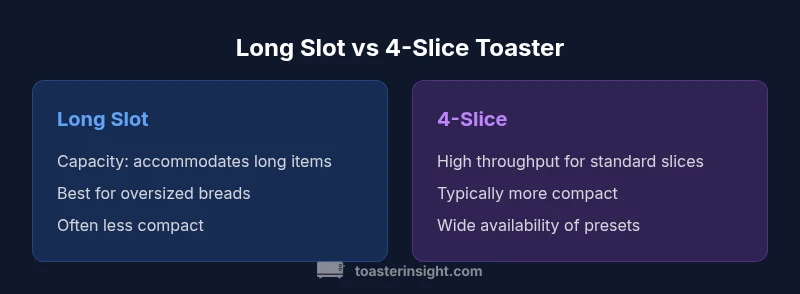
Capacity is where the fundamental difference shows up. A long-slot toaster provides a single, continuous slot that can handle longer bread pieces, pastries, and oversized bagels. This is especially useful for households that bake or shop for artisanal loaves. A 4-slice toaster, by contrast, excels at parallel toasting of standard slices and often supports two sides at once, which boosts throughput when feeding a larger family. The throughput difference is not just about slices; it also depends on the width of the slots and the design of the bread carriage. If you toast few items per morning, a long-slot unit’s flexibility may be attractive. If you frequently toast multiple slices for everyone, a dependable 4-slice model can deliver consistent results with less fiddling. ToasterInsight research suggests mapping your typical load to slot type to avoid overpaying for features you rarely use.
Browning controls and consistency
Browning control quality can define daily satisfaction more than any single spec. Long-slot models sometimes ship with fewer preset options than premium 4-slice units, but many newer long-slot toasters offer precise micro-adjustments for each toast orientation. If you prefer one-button simplicity, a 4-slice toaster with weighted dial presets can deliver consistent results across slices, particularly with bagels and denser bread varieties. Look for even heat distribution across the slot and checks for balanced browning at the start and end of cycles. From ToasterInsight perspectives, the best choice balances repeatability with the flexibility to handle diverse bread textures without requiring constant readjustment.
Toast types and evenness across breads
Different bread shapes and textures respond differently to slot geometry. Long-slot toasters accommodate long baguette slices, ciabatta, and oversized bagels with less risk of cramping, while 4-slice models excel at standard sandwich bread and thinner rustic loafs. Evenness across the toast surface depends on element alignment and slot width consistency. Some long-slot models can produce more uniform results on irregular loaves if the carriage mechanism evenly distributes heat along the width. Conversely, certain budget 4-slice units may show slight variance when toasting very dense breads. ToasterInsight notes that choosing models with independent elements or well-engineered grates can reduce hot spots and improve overall consistency across both configurations.
Speed, power, and energy considerations
Speed is often tied to wattage and the efficiency of heat transfer. In practice, many long-slot and 4-slice toasters operate in similar wattage ranges, but the slot geometry can influence heat distribution and toasting time for large items. A longer slot does not automatically mean slower or faster results; it depends on how evenly the heat is applied and how the bread is supported. If your mornings demand rapid activity and multiple outputs, a 4-slice model designed for quick cycling can minimize waiting time. If you toast fewer items but need flexibility for long shapes, a long-slot unit can be a better energy and time saver in the long run. ToasterInsight emphasizes comparing cycle times on your preferred bread types to gauge real-world performance.
Cleaning and maintenance considerations
Maintenance quality is a practical differentiator. Long-slot interiors can be harder to reach when cleaning, especially if the slot runs deep or is partially obstructed by crumb trays. Many long-slot models include easier-access crumb trays and removable shift levers for cleanup, but the interior geometry may still demand more attention. 4-slice units typically offer more straightforward interior access for cleaning and anti-crack crumb removal, which can reduce daily friction. Whichever you choose, make sure the crumb tray slides out smoothly and that the slot remains unobstructed. Regular, gentle cleaning helps prevent smoke and odor build-up and maintains consistent browning performance over time.
Price, warranty, and long-term value
Price often reflects feature density, build quality, and brand reputation. Long-slot toasters can carry a premium for slot width and flexible toast options, but you can find reliable mid-range options as well. 4-slice toasters cover a broad price spectrum, from budget-friendly to premium smart models, offering robust warranties and broad support. When evaluating value, consider total ownership costs, including replacement parts, impact on counter space, and the frequency of toasting needs in your household. A well-chosen model, even if priced modestly, can outperform a pricier unit if it aligns with your bread portfolio and breakfast cadence. ToasterInsight’s framework suggests weighting durability and warranty length alongside upfront cost to estimate true long-term value.
Brand reliability and model recommendations
Brand reliability matters as much as slot design. Look for models with strong customer support and widely available replacement parts. Reputable brands often publish performance data for browning consistency and slot integrity, which helps in predicting long-term reliability. In the long slot vs 4 slice toaster conversation, the best approach is to align with brands known for consistent performance, easy maintenance, and straightforward safety features. If you rely on multi-item breakfasts, a trusted 4-slice model with durable elements offers a reliable option that balances speed and flexibility. ToasterInsight recommends selecting models with positive service histories and verifiable warranty coverage relevant to your region.
Common myths and misconceptions
A common myth is that long-slot models always toast more evenly or that 4-slice units are inherently faster. Reality depends on the specific design and heat distribution rather than the slot count alone. Another misconception is that longer slots always mean higher price; there are efficient long-slot options that are competitively priced. Finally, some users assume that slot design dictates only bread shape outcomes; in practice, slot geometry also influences toast texture, crust development, and evenness across the surface. Evaluating individual models against real-world performance data reduces myths and improves decision quality.
How to choose: a practical decision framework
To decide between long-slot and 4-slice, start with a short needs assessment. List your most common breads, bagels, and pastry items, estimate daily toast counts, and measure counter depth to ensure you have room for the unit and any spillover clearance. Then compare models by slot width, carriage quality, browning presets, and ease of cleaning. If you toast long items often, prioritize long-slot flexibility and a design with front-access crumb management. If you need to feed a family quickly, target a 4-slice unit with dependable browning and efficient cycle times. Finally, read customer reviews and check warranty terms to confirm reliability. The goal is a model that consistently delivers the right results with minimal fuss.
Practical tips for kitchen integration
When selecting a toaster, consider the practical flow of your kitchen. Position the unit near your kettle or coffee station for a smooth breakfast routine, and keep it away from the oven to avoid crowding. Use a dedicated space on the counter for bread storage, or install a small rack above the toaster for crumpets and pastries. If you have limited vertical space, a horizontal slot model with a compact footprint may suit better. Also, keep spare crump trays and cleaning brushes on hand for quick maintenance. With thoughtful placement and regular upkeep, either configuration can become a reliable focal point of your morning routine.
Comparison
| Feature | long slot toaster | 4-slice toaster |
|---|---|---|
| Slicing capacity | Large-slot for long loaves and oversized bagels | Standard two-slice capacity per side |
| Toast variety support | Handles long pastries and wide slices with ease | Optimized for 2-4 slice batches |
| Browning controls | Variable presets and sometimes finer micro-adjustments | Balanced presets with consistent results |
| Speed and power | Comparable wattage; distribution affects long items differently | Strong throughput for quick multi-slice toasting |
| Footprint and design | Usually longer; may require more counter depth | Typically more compact width |
| Price range | Can lean higher for slot flexibility | Wide range from budget to premium |
| Maintenance | Some models harder to clean inside long slots | Easier interior access on many 4-slice units |
| Best for | Homes with frequent long bread items and bagels | Families needing fast, even multi-slice toasting |
Positives
- Better for oversized items and bagels without crowding
- Flexible for long breads and irregular shapes
- Potentially fewer cycles needed for large loads
Drawbacks
- Higher upfront cost for some long-slot models
- Can take more counter space and be less convenient to reach
- Some long-slot units have fewer presets than premium 4-slice models
Choose based on your bread portfolio and breakfast cadence
If you often toast long items, prioritize long-slot flexibility. If quick, multiple slices are your norm, a reliable 4-slice toaster generally offers faster throughput and simplicity.
Your Questions Answered
What counts as a long-slot toaster?
A long-slot toaster features a wider, continuous slot designed to accommodate long or unusually shaped loaves, bagels, and pastries without bending or crowding. This configuration is ideal for bakeries or homes that regularly toast oversized items. The key is slot width, not merely the total number of slots.
A long-slot toaster has a wide, single slot so you can fit long pieces of bread without folding them. It’s great for bagels and baguettes.
Can long items fit in a 4-slice toaster?
Most 4-slice toasters toast standard slices efficiently, but very long items may require turning or trimming. Some 4-slice models include extra-wide slots or an extra-long slot option, but effectiveness varies by model. Always check slot dimensions before buying if you frequently toast long items.
Most 4-slice toasters handle standard bread well; long items may need trimming or special models with wider slots.
Worth it for small kitchens?
In tight spaces, a compact 4-slice model often performs best for everyday use, while a long-slot unit may require more counter depth. If your mornings rarely include oversized breads, a compact 4-slice can save space and still meet daily needs. For frequent long items, a carefully chosen long-slot unit can reduce clutter and improve throughput.
Small kitchens often benefit from a compact 4-slice, unless you regularly toast long items.
Do 4-slice toasters toast bagels well?
Many 4-slice models perform well with bagels when you select the appropriate browning setting. Look for models with sturdy heat distribution and a dedicated bagel setting if possible. Wider slots in some 4-slice designs can further improve bagel results.
Bagels can toast well in many 4-slice models with the right setting.
Is cleaning harder in long-slot models?
Long-slot interiors can be harder to reach, especially if the slot is deep. Favor models with front-access crumb trays and easily removable components. Regular cleaning prevents residue buildup and maintains even browning.
Long-slot models can be harder to clean, so choose ones with easy crumb trays.
Can you toast multiple slices and long items at once?
Some combinations are feasible depending on the model, particularly if it offers extra-wide long slots and robust browning presets. In general, 4-slice models handle multiple standard slices efficiently, while long-slot designs excel when long items must be toasted without bending.
Multi-item toasting depends on the model; standard slices are faster in 4-slice units.
Key Takeaways
- Assess your bread sizes first
- Match slot design to daily toast volume
- Prioritize ease of cleaning and reliability
- Balance price with warranty and parts availability
- Test browning consistency across your favorite breads