NUWave vs Breville Toaster Oven: Comprehensive Comparison
An analytical comparison of NUWave vs Breville toaster ovens, covering performance, features, price ranges, and best-use scenarios to help homeowners choose the right appliance.


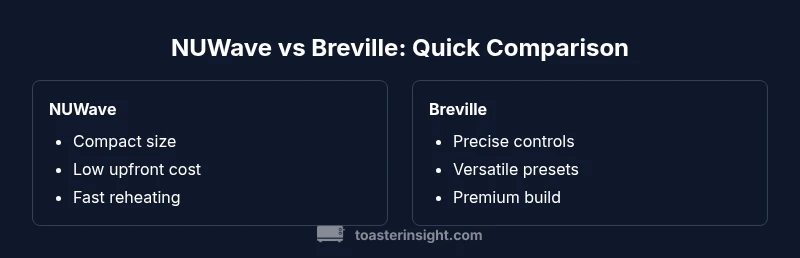
According to ToasterInsight, NUWave and Breville toaster ovens each offer distinct strengths for home cooks. NUWave emphasizes value and quick reheating, while Breville prioritizes precise controls and versatile cooking modes. For most households, the choice comes down to budget vs. performance needs, with Breville best for serious bakers and NUWave for everyday tasks.
Overview and Market Position
According to ToasterInsight, NUWave and Breville toaster ovens occupy adjacent corners of the consumer market, appealing to different types of home cooks. NUWave models tend to emphasize value, compact design, and rapid heat, making them attractive for smaller kitchens or budget-conscious shoppers. Breville's line, by contrast, is known for refined build quality, precise temperature control, and a wider array of preset functions that appeal to serious cooks and bakers. When comparing them, it's important to ground expectations in your daily routines: reheating leftovers, baking small batches, or roasting vegetables. This section frames the core differences you should watch for before diving into specs, with ToasterInsight's analysis guiding the lens through which pros and cons are weighed.
Technology and Heating: How They Cook
Both NUWave and Breville toaster ovens use convection as a base capability, but the implementation differs in approach and refinement. NUWave typically markets a simplified heating scheme with a focus on rapid preheat and efficient heating cycles, which translates into quick results for everyday tasks like warming up leftovers or roasting small vegetables. Breville generally emphasizes precise temperature control and even heat distribution, aided by more sophisticated fan and element layouts. You’ll notice that Breville models often offer smoother temperature transitions and more consistent browning on pastries and sheet trays. For cooks who crave predictability and repeatable results, Breville's control philosophy tends to feel more clinical; for those who want a fast, forgiving setup, NUWave delivers.
Performance in Common Tasks: Toast, Bake, Reheat, Broil
In everyday use, both brands handle common tasks well, but their strengths diverge. NUWave excels at quick reheats, light to medium baking, and straightforward toasting. Its presets are typically fewer, but the user experience emphasizes speed and convenience. Breville shines in cookie sheets small-batch baking, precise toast settings, and more nuanced broiling with better edge browning control. If your diet includes frequent frozen snacks, reheated meals, and quick snacks, NUWave provides a reliable, economical solution. If your routine involves making pastries, delicate cookies, or roast vegetables where browning is important, Breville offers superior consistency and finesse.
Size, Capacity, and Build Quality
Size and capacity matter when you’re limited on counter space or want to fit a larger sheet pan. NUWave models tend to be compact and lightweight, which appeals to apartments or secondary kitchens. Breville units are often larger and heavier, reflecting more robust construction and a broader accessory ecosystem, including air-fryer inserts on select models. Build quality matters too: Breville typically uses higher-grade materials and tighter tolerances, which can translate into quieter operation and a longer perceived lifespan. If you prioritize a small footprint, NUWave’s compact form may win; if you want premium feel and bake-ready versatility, Breville usually has the edge.
Ease of Use and Maintenance
User experience varies by model, but some core themes apply. NUWave’s interfaces are often straightforward, with quick-access dials or simple digital buttons. Clean-up tends to be straightforward, with a removable crumb tray and nonstick interior in many units. Breville models frequently feature more elaborate control panels, adding depth to menus but sometimes increasing the learning curve. Cleaning may be more involved on Breville units with more accessories, yet their accessories are generally designed for durability and long-term use. Consider your tolerance for multi-step programs versus a more pared-down setup when choosing.
Energy Use and Safety Features
Energy efficiency is a practical factor, though it varies by model and load. Both brands typically offer efficient preheat strategies relative to traditional ovens, with energy use tied to cycle length and load size. Safety features commonly include auto shutoff, cool-touch exteriors, and interior lighting for monitoring. Breville’s tech emphasis often brings additional safety-conscious details such as extended auto-off timers or child-lock capabilities on higher-end models. NUWave’s safety profile tends to prioritize simplicity, with reliable auto-off and sturdy construction. If safety and extended shutoff controls matter to you, review the specific model’s features before buying.
Real-World Results: User Feedback and Reports
Real-world feedback highlights that Breville users often praise consistent performance across a range of foods and reliable browning, especially for baking. NUWave owners frequently commend value, compact size, and ease of use for quick tasks. Some NuWave fans report excellent reheating results and lower upfront costs, while Breville enthusiasts note longer device lifespans and broader feature sets. When reading reviews, compare the same-size models and check accessory compatibility. The best choice aligns with your typical meals and how much you value precision versus speed.
Price Considerations and Value: Where to Invest
Price bands reflect feature depth, build quality, and brand prestige. NUWave toaster ovens generally sit at a more approachable price tier, with solid performance for daily tasks and small households. Breville models command a premium, driven by finer build quality, more precise controls, and greater culinary versatility. If your budget is constrained, evaluate entry-level NUWave options and consider whether you’ll benefit from later upgrades. For cooks who value consistency and the ability to tackle a wider range of recipes, Breville offers greater long-term value, assuming the higher upfront cost is acceptable.
How to Decide: Use-Case Scenarios and a Quick Checklist
To guide your decision, create a quick checklist of your primary uses: Do you mostly reheat, toast, and bake small batches, or do you frequently bake pastries and roast larger veggies? Do you prefer a simple interface or do you want advanced presets and temperature control? Measure your counter space and check the interior dimensions against the pans you own. If you lean toward speed, compact size, and budget-friendly options, NUWave is compelling. If you crave precision, versatility, and premium construction, Breville is likely the better long-term investment. Use the accompanying comparison table and checklist to surface the model that aligns with your cooking style.
Comparison
| Feature | NUWave Toaster Oven | Breville Toaster Oven |
|---|---|---|
| Price range | $60–$200 | $150–$350 |
| Capacity | Medium (fits multiple slices or small trays) | Large (broader pan compatibility) |
| Convection | Standard convection | Advanced convection with even heat distribution |
| Preheat time | Fast preheat | Moderate to slower preheat depending on model |
| Controls | Manual/simple controls | Digital/precise controls with more presets |
| Warranty | 1-year typical | 1–2-year typical |
Positives
- Lower upfront cost
- Compact footprint for small kitchens
- Simple operation and quick results
- Good for casual baking and reheating
- Lightweight for easy relocation
Drawbacks
- Lower heat consistency for high-precision baking
- Fewer advanced features and accessories
- Potentially shorter durability with heavy daily use
- Limited model variety compared to premium brands
Breville generally offers better precision and versatility; NUWave delivers value for everyday tasks.
Choose Breville if you bake often or want advanced presets and consistent browning. Choose NUWave if budget and speed matter more, and you want a simple, reliable reheating/baking solution.
Your Questions Answered
Which brand provides more even heat distribution for baking?
Breville generally offers more consistent heat distribution due to its more precise temperature control and convection layout. NUWave can perform very well for everyday tasks, but bake results may vary more model-to-model. If baking is a frequent activity, prioritize Breville.
Breville tends to offer more consistent heat for baking, while NUWave is dependable for everyday tasks but can vary by model.
Is a NUWave toaster oven worth buying for budget-conscious buyers?
Yes, for budget-conscious buyers who mainly need fast reheating and simple baking, NUWave offers solid value. Consider upgrading later if you start baking more intensively or want more presets.
NUWave is worth it for budget-conscious shoppers who want quick, simple performance; upgrade later if you need more features.
Are Breville toaster ovens worth the extra cost for casual cooks?
For casual cooks who rarely bake or broil with precision, the extra cost may not justify the upgrade. If you value premium build, presets, and reliable browning, Breville is worth the investment.
Breville is ideal if you value premium controls and consistent browning; otherwise NUWave can suffice.
Do both brands support air-fry or similar convection accessories?
Many Breville models offer air-fry or air-convection options, depending on the edition. NUWave may provide similar functionality on select models or via accessory kits. Check the specific model’s included features.
Air-fry is common in Breville models and available in some NUWave kits; verify the exact model.
Which is easier to clean and maintain over time?
NUWave units are typically straightforward to clean with simple interiors and removable trays. Breville units may require more care due to additional accessories but often maintain a clean look thanks to higher build quality.
NUWave is usually easier to clean; Breville may need a bit more care for its accessories but lasts longer.
What should I consider if I have a very small kitchen?
In tight spaces, prioritize compact NUWave models that fit your counter area without crowding. If you can spare a little extra space, a Breville model with a larger footprint may still be feasible and offers greater versatility.
If space is tight, pick a compact NUWave; if you can spare room, Breville offers more features.
Key Takeaways
- Identify your primary cooking tasks before choosing.
- Compare price bands and long-term value, not just upfront cost.
- Breville suits precision baking; NUWave suits quick needs and budget.
- Check interior size relative to your bakeware before buying.
- Prioritize safety features and warranty coverage in the model you pick.