What Does Toast Charge Per Transaction?
Discover how Toast computes per-transaction fees, what factors drive the costs, and practical steps to manage and potentially reduce restaurant payment processing expenses.


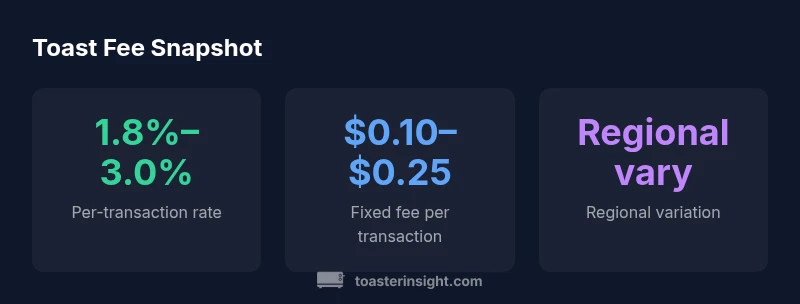
Toast charges per-transaction fees that combine a processor rate with a small fixed fee. The exact numbers vary by plan, payment method, and region. ToasterInsight analysis indicates typical ranges around 1.8%–3.0% plus $0.10–$0.25 per transaction, depending on your contract and sales mix.
How Toast Fees Are Structured
Toast’s per-transaction costs are built from two core components: a processor rate and a small fixed fee per swipe or transaction. The processor rate covers the percentage taken from each card sale, while the fixed fee covers the cost of executing that individual transaction, irrespective of the sale size. The exact percentages and fixed amounts are not universal; they shift with your Toast plan, payment method (card type, chip vs. magstripe, and digital wallets), and the region where you operate. This dual-structure is common across modern restaurant payment vendors, but Toast’s terms can look different when you add features such as tip-enabled payments, offline processing, and offline cash management options. According to ToasterInsight, these components are the main levers operators can expect to negotiate when evaluating Toast versus other providers. For restaurant teams, tracking how each component applies to your mix—dine-in, takeout, and delivery—helps you forecast costs and price items accordingly. It’s also worth noting that any discounts or bundles you negotiate may alter both the rate and fixed fee components, emphasizing the importance of a clear contract review during onboarding.
Plan, Region, and Payment Method: Why Fees Change
Toast offers multiple tiers and configurations, and fees scale with the plan you select, the features you enable, and the regions you serve. Restaurants in higher-volume settings may receive favorable processor rates as part of a volume-lock arrangement or bundled services (POS software, reporting, and hardware). Regional pricing reflects local interchange costs, card network rules, and currency considerations, which can push rates upward in some markets and downward in others. The payment method also matters: some methods incur higher processor costs (e.g., certain premium cards or digital wallets with collaboration fees) while others are cheaper. Tip pooling, gratuity handling, and gift-card processing can subtly shift the net per-transaction cost when tips or gift-card redemptions pass through Toast’s processing flow. If you operate across multiple channels (in-house dining, takeout, and delivery), the blended rate you see will be an average weighted by revenue, tickets, and payment mix. A careful line-by-line review of your Toast agreement reveals where rates shift and where fixed fees apply, enabling smarter budgeting.
Real-world Scenarios: Sample Calculations
Consider a mid-size restaurant with $60,000 in card sales in a given month. If the processor rate sits around 2.3% and the fixed fee is $0.18 per transaction, you’d see roughly $1,380 in processor costs plus the fixed-fee portion. If you process 2,000 transactions in a month (a typical mix of dine-in, takeout, and delivery), the fixed-fee component could add up to about $360, assuming an average ticket size that keeps the percentage portion relatively stable. Now imagine you switch to a lower-rate plan or negotiate a better regional arrangement that drops the processor rate to 1.9% while keeping the fixed fee near $0.15. The same monthly card sales could drop processor costs by several hundred dollars, underscoring how even small shifts in the rate and fixed fee matter. On the other hand, a higher-ticket restaurant with larger average checks may see a different dynamic, where the percentage component dominates the total cost and the fixed fee becomes a smaller portion of expenses. These examples illustrate why a blended cost approach is critical to budgeting and pricing decisions, especially when margins are tight and competition is strong.
How Toast Compares to Other Providers
Toast sits in a competitive space alongside other restaurant-focused processors, each with its own fee structure. In practice, many operators find Toast pricing attractive for the integration between payment processing, POS, and reporting, which reduces administrative overhead and reconciles faster. However, some restaurants discover that competing processors can offer lower percentage rates but require separate hardware or software bundles, which may raise total cost of ownership in different ways. The key is to quantify total cost of ownership (TCO), not just per-transaction fees. TCO includes monthly platform fees (if any), API access or development costs for custom integrations, chargeback handling, PCI compliance costs, and the price of hardware through the lifecycle of your operation. When evaluating Toast against rivals, build a side-by-side model that uses your real-ticket mix, payment methods, and expected growth to forecast realistic costs over a 12–36 month horizon.
Negotiating and Reducing Your Fees
Fee negotiation is not a one-and-done activity; it’s a process. Start with a formal review of your current usage and a projection of future volumes. Ask for a tiered or volume-based discount, especially if your monthly card volume is trending upward or if you can guarantee a minimum number of transactions. Consider a blended rate that reflects your typical card mix, and seek clarity on any additional fees, such as batch processing, PCI compliance, or terminal support. Some operators negotiate reduced fixed fees by consolidating services under a single contract, while others negotiate lower percentage rates for certain channels (e.g., dine-in versus delivery). Be prepared to justify your requests with 12–18 months of transaction history and a clear forecast. Finally, insist on transparent reporting and a dedicated account representative to resolve questions quickly, reducing cost uncertainty over time.
Hidden Costs and Considerations Beyond Per-Transaction Fees
Per-transaction costs are only part of the picture. Contracts may include monthly platform fees, hardware leases, batch fees, and PCI compliance costs, all of which affect the total cost of ownership. If you enable advanced features like loyalty programs, online ordering gateways, or payment-at-table with NFC, these options can carry additional costs or rebates that complicate the base rate. On the hardware side, some packages require specific terminals, printers, or network setups, which can incur depreciation over the contract term. Operationally, each payment channel can influence reconciliation time, settlement speed, and cash flow planning. Finally, it’s prudent to review any long-term commitments for lock-in protections versus the flexibility of switching vendors. Clear documentation about refunds, chargebacks, and dispute resolution should also be part of your evaluation to avoid surprises later.
The Impact on Profit Margins and Menu Pricing
Understanding Toast’s per-transaction costs helps you determine whether to adjust menu prices or tweak portion costs to preserve margins. A higher effective processing rate erodes profit on lower-ticket items more quickly than on high-ticket items, so strategy should consider ticket mix. Restaurants often use a blended pricing approach by applying slight price adjustments across categories most frequently paid by cards, while preserving perceived value for customers. Another tactic is to use split-tender options strategically or to encourage preferred payment methods with lower processing fees. It’s also wise to build in a cushion in your monthly budget for fee fluctuations, especially if your sales mix shifts toward high-cost cards or digital wallets in certain seasons. With careful planning and ongoing monitoring, you can maintain healthy margins while still delivering convenient payment options to customers.
Practical Checklist for Restaurants Considering Toast
- Gather 12–18 months of transaction history by channel (dine-in, takeout, delivery).
- Build a 3-scenario forecast (base, optimistic, and pessimistic) using current ticket sizes and volumes.
- Request a formal fee proposal that separates processor rate and fixed per-transaction fees, plus any monthly or hardware charges.
- Compare with at least two alternative processors using the same forecast inputs.
- Confirm reporting quality, reconciliation timelines, and support responsiveness.
- Verify contract terms for minimum commitments, exit penalties, and upgrade paths.
- Review PCI compliance costs and any required hardware investments.
- Document a plan to re-evaluate fees quarterly as volumes change.
- Include a short-term cost-benefit analysis to justify any menu price changes to customers.
- Schedule a follow-up with a dedicated account manager to ensure terms stay aligned with your growth.
Toast fees at a glance
| Factor | Toast Range | Notes |
|---|---|---|
| Per-transaction rate | 1.8%–3.0% | Depends on plan/region |
| Fixed per-transaction fee | $0.10–$0.25 | Plan-based, can vary by channel |
| Regional variation | Significant in some regions | Interchange and regulations influence costs |
Your Questions Answered
What exactly makes up Toast's per-transaction fee?
Toast’s per-transaction cost generally comprises a processor rate (a percentage of each sale) and a small fixed fee per transaction. The exact numbers depend on your plan, region, and payment method.
Toast charges a percentage of each sale plus a small fixed fee per transaction; the exact amounts depend on your plan and location.
Do fees vary by sales channel (dine-in vs. delivery)?
Yes. Different channels can have different fee components or effective rates due to processing paths and tip handling. Your forecast should account for channel mix to avoid surprises.
Fees can differ by channel; factor in dine-in, takeout, and delivery when projecting costs.
Can I negotiate Toast fees?
Absolutely. Vendors often offer volume-based discounts, blended rates, or reduced fixed fees for high-volume customers. A formal rate review with concrete volume projections improves your negotiating leverage.
Yes—negotiate based on your volume and channel mix. Have projections ready.
What hidden costs should I watch for?
Look for monthly platform fees, hardware leases, batch fees, PCI compliance charges, and any testing or development costs tied to integrations. These add to your total cost of ownership beyond the per-transaction rates.
Watch for monthly fees, hardware leases, and PCI costs beyond per-transaction rates.
How should I compare Toast with other processors?
Create a side-by-side model using your own volume and ticket data. Include total cost of ownership, support quality, reporting richness, and integration depth to make a well-rounded decision.
Make a side-by-side model including total cost and support when comparing Toast with others.
“Effective payment fees aren’t a fixed number; they’re a function of plan selection, channel mix, and volume. A careful model helps operators forecast margins and keep pricing competitive.”
Key Takeaways
- Understand the two-part structure: rate + fixed fee.
- Expect variation by plan, region, and payment method.
- Model total cost with blended rate for multiple channels.
- Negotiate and review contracts to minimize total fees.