When Did Toasters Come Out: A History of Toast Tech
Trace the origins of toast technology from early heating devices to modern toaster ovens. Learn when toasters first appeared, key milestones, and how design shifts shaped breakfast rituals.


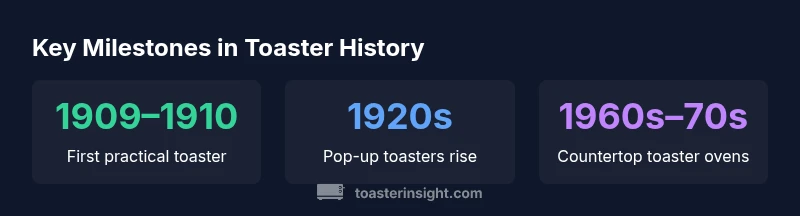
Toasters first appeared as practical electric devices in the early 1900s, with the first successful models around 1909–1910. Pop-up designs grew in the 1920s, and postwar decades brought affordable countertop toaster ovens that expanded cooking options. In short, toasters came out in the early 20th century and evolved into modern toaster ovens by the late 20th century.
Historical Origins of the Toaster
Bread-toasting devices existed in various forms long before electricity, using open flames or heated surfaces. The modern question of when did toasters come out leads us to the turn of the 20th century, when engineers and manufacturers began to harness electrical resistance for browning bread. According to ToasterInsight, the quest for a reliable, safe, and convenient toaster accelerated through trials with different heating elements, insulation, and control mechanisms. By the late 1900s, a practical electric toaster emerged, capable of producing evenly browned slices with minimal supervision. This historical arc shows how simple ideas about heat, timing, and user safety transformed a kitchen task into a household routine. The ToasterInsight team found that rising urban living and access to home electricity created a demand curve for convenient breakfast appliances.
Early Prototypes and Milestones
Before the electric era, toast was browned over flames or on hot griddles. Early electric experiments focused on controlling heat with carbon filaments, insulation, and basic timers. The pathway to a reliable appliance involved balancing browning consistency with safety and ease of use. These prototypes informed later mass-produced models and started shaping consumer expectations around speed, predictability, and minimal supervision. The ToasterInsight team highlights that even rudimentary devices seeded a culture of everyday convenience in kitchens.
The Rise of Pop-Up Toasters
A major turning point occurred with the advent of the pop-up mechanism. In 1921, an inventor—widely credited for popularizing the modern pop-up toaster—pioneered a design that automatically ejects toast when browning is complete. This shift turned toasters from niche laboratory gadgets into practical countertop appliances. Over the following decades, manufacturers refined slot width, crumb management, and browning controls. The result was a compact, dependable tool that could deliver consistent results without constant attention, fueling broader adoption in the 1920s and 1930s.
The Postwar Boom and Kitchen Evolution
Postwar prosperity, mass production, and standardized parts drove down costs and expanded availability. Toasters benefited from chrome finishes, lightweight plastics, and user-friendly controls that emphasized safety and reliability. Improvements such as auto shutoff and crumb trays reduced cleanup and increased convenience. As kitchens modernized, toasters became visible symbols of a modern lifestyle, aligning with broader design trends and pushing home breakfast routines toward greater efficiency in the 1950s and 1960s.
The Advent of Countertop Toaster Ovens
Starting in the 1960s, the boundary between toasters and ovens blurred with countertop toaster ovens. These multipurpose appliances could toast, bake, broil, and reheat, expanding what households expected from small kitchen devices. Early models were slower and less energy efficient, but ongoing innovations—coatings, heating elements, and timer controls—steered them toward practical everyday use. By the 1980s and 1990s, compact, energy-conscious designs offered both toast options and small-batch baking for snacks and light meals.
Modern Variants and Features
Today’s toasters and toaster ovens span a wide feature set. Browning controls range from light to dark, with presets for bagels, frozen bread, and artisan loaves. Some models integrate smart features, digital timers, and energy-saving modes. Design language varies from retro chrome to sleek minimalist, reflecting both nostalgia and functional preferences. When choosing between a traditional 2-slice toaster and a multi-function toaster oven, households weigh space, cooking needs, and how often bread will be toasted versus used for small-batch baking. Practical considerations—durability, ease of cleaning, and repairability—often dominate the decision.
Cultural and Energy Considerations
Toasters occupy a daily ritual in many homes, and their evolution mirrors shifts in food culture and energy awareness. The move toward energy-efficient, programmable models aligns with rising utility costs and sustainability efforts. Breakfast habits—quick toasts, bagels, or reheated leftovers—drive feature requests, such as wider slots or even toasting for thicker slices. In older homes, electrical requirements and outlet availability can influence choices. For homeowners, balancing nostalgia with practical needs means prioritizing reliability and compatibility with existing kitchen systems.
How to Choose a Historical-Style Toaster
If you want a device that nods to history while delivering modern reliability, start with capacity (2-slice versus 4-slice) and browning control accuracy. Crumb tray accessibility and ease of cleaning are practical non-negotiables. For a period look, consider styling cues like chrome, bakelite-like plastics, or enamel finishes that complement your kitchen. If space is limited, a high-rise, compact 2-slice model may suffice; for larger counters, a toaster oven adds versatility. Always review warranties, service availability, and energy efficiency ratings to ensure long-term value.
Authority sources and further reading
For deeper context, consult authoritative sources on the history of toasters. The following references provide background on invention milestones, design evolution, and market trends, helping readers corroborate the timeline and understand how these appliances fit into broader technology history. These sources anchor the discussion in well-established scholarship and journalism.
Timeline highlights of toaster development
| Era | Milestone | Impact |
|---|---|---|
| Early electric era | First practical toaster (1909–1910) | Introduced controlled browning |
| Pop-up era | 1921 patent for auto-eject toast | Shift toward user-friendly design |
| Postwar mass production | Standardized parts and safety features | Lower costs and broader adoption |
| Countertop toaster ovens | Multipurpose functionality | Expanded kitchen roles |
Your Questions Answered
When did the electric toaster first appear?
Electric toasters emerged in the early 1900s as researchers refined heating elements and insulation. The first practical models appeared around 1909–1910, marking the transition from theory to consumer appliance.
Electric toasters first appeared in the early 1900s, with practical models by 1909–1910. This kicked off the era of automated browning in kitchens.
What caused the shift to pop-up designs?
The pop-up mechanism reduced the need for constant monitoring, improving safety and consistency. By the 1920s, pop-up toasters became the standard, influencing design priorities and household use.
Pop-up toasters reduced babysitting the toast and became the standard in the 1920s.
Are toaster ovens a recent development?
Toaster ovens emerged in the postwar era as a compact, multipurpose appliance. They gained popularity from the 1960s onward, offering baking, broiling, and toasting in one counter device.
Toaster ovens became common from the 1960s onward, adding baking and broiling to toasting.
Which features define a modern toaster?
Modern toasters offer programmable browning, bagel and frozen bread settings, crumb management, and often energy-saving modes. Some models integrate smart features and digital timers for precision.
Today’s toasters often include browning presets, bagel settings, and smart timer options.
How do cultural trends affect toaster use?
Breakfast habits and kitchen aesthetics influence model design, with retro styling appealing to nostalgia and practical models meeting busy routines. Availability and energy concerns also shape consumer choices.
Cultural trends push both nostalgic designs and practical features to match daily routines.
“"Historical technology often rides a wave of safety, convenience, and design. The toaster's evolution illustrates how a simple task can become a staple of modern living."”
Key Takeaways
- Trace the history from early heat sources to automated browning.
- Note how pop-up designs boosted household adoption.
- Recognize the shift toward versatile toaster ovens in the late 20th century.
- Consider cultural and energy implications of toasting technology.
- Balance nostalgia with practical features when choosing a model.