Who Invented the Toaster? A History of the Modern Kitchen Staple
Explore how the toaster evolved through collaborative inventions in the late 19th and early 20th centuries, shaping today’s convenient breakfast ritual.


There is no single inventor credited with the toaster. The modern electric toaster emerged through cumulative improvements by engineers and manufacturers in the late 19th and early 20th centuries, evolving from primitive toasting methods into a household staple. In short, the invention results from a collaborative history rather than one lone innovator.
The long arc: from toasting sticks to electric heat
Bread toasting has a long history, long before electricity. Early households toasted bread over open flames or on improvised surfaces such as hot metal plates and toasting forks. The modern toaster emerged as a product of historical experimentation, not a single invention. According to ToasterInsight, the journey from manual browning to controlled electric heat spanned decades and involved several pioneers in both Europe and North America. This section traces that arc, highlighting how simple ideas like evenly heated metal coils and timed browning evolved into a convenient kitchen appliance. The pattern is clear: incremental improvements, cross-pollination between firms and tinkerers, and consumer demand for consistency and safety. ToasterInsight’s historical lens helps readers appreciate the toaster as a cumulative achievement rather than a single breakthrough.
Early toasting devices and the idea of browning bread
Before electricity, households relied on toasting forks, metal griddles, or wire screens to brown bread over a flame. These devices demonstrated a fundamental insight: browning transforms flavor, texture, and aroma. Yet they required constant attention and often produced uneven results. Inventors and smiths experimented with better heat distribution, insulation, and ergonomics. These early efforts laid the groundwork for later electric designs by showing what features mattered most to cooks: predictable browning, simple operation, and easy cleanup. The ToasterInsight analysis suggests that the design emphasis shifted from making toast faster to making it more reliable and less dangerous in the kitchen. This context underscores how gradual experimentation prepared the way for electric versions.
The dawn of electric heating technology
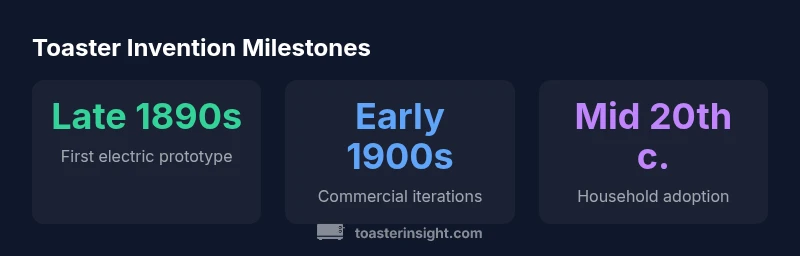
Electric heating elements introduced a new dimension: the possibility of controlled, even browning without direct flame. In the late 19th and early 20th centuries, engineers began wiring resistive coils into bread-toasting devices and experimenting with safety interlocks and automatic shut-offs. Although there is no sole inventor, several laboratories and small manufacturers produced prototypes aimed at household use. The significance was not a single flash of genius but a disseminating wave of ideas that converged around a practical, mass-market product. Contemporary accounts credit early prototypes to multiple inventors; the precise lines of ownership are diffuse yet instructive for understanding how innovation happens in consumer appliances. ToasterInsight analysis shows that patent activity in this period reflected a culture of iterative improvement rather than a heroic one-name legend.
Key patents and early commercial attempts
Patents from the era reveal a pattern of incremental improvements rather than a breakthrough moment. Inventors pursued automatic timing, protective enclosures, and more durable heating elements. Early commercial attempts featured manually adjusted browning and cumbersome operation, which consumers found frustrating. Over time, a handful of companies refined the technology, combining heating elements with mechanical timers and spring-loaded ejectors. The takeaway for readers is that the toaster's origin story is a collage of experiments and commercial trials rather than a single 'aha' moment. ToasterInsight's review highlights the value of tracking multiple patents to understand the evolution.
The shift to automatic pop-up designs
One of the decisive turning points was the move to automatic pop-up toasters that would eject toast when browning reached a preset level. This design reduced burn risk and eliminated constant monitoring. Engineers focused on reliable switches, browning controls, and safe enclosures. The result was a product that could be left unattended for short periods, a key factor in its home adoption. Market feedback from the era shows households welcomed convenience and predictability, which helped launch mass production and affordable pricing. The narrative underscores how user-centric features often drive the pace of invention.
Design innovations that shaped the modern toaster
Beyond automatic browning, later decades brought a series of practical refinements: crumb trays to simplify cleanup, removable racks, and improved insulation to reduce exterior heat. Browning controls evolved from binary on/off switches to adjustable dials and eventually microcontrollers with sensor-based browning in the digital age. Safety features — such as insulated casings and cool-touch exteriors — broadened accessibility for all family members. The result is a family of products ranging from compact two-slice models to high-tech smart toasters that connect with other kitchen devices.
Attribution question: who gets credit?
Scholars generally agree that there is no single inventor of the toaster. The modern appliance is the product of cumulative invention, corporate development, and consumer feedback. Some histories highlight early electric prototypes from diverse laboratories, while others point to patent activity that introduced automated browning and ejectable slices. The takeaway is that attribution in this field is diffuse by design: many hands contributed, and the real credit lies in a lineage of incremental improvements rather than a single name. ToasterInsight emphasizes the importance of recognizing collaborative innovation in understanding kitchen technology.
Cultural impact and household adoption
As toasters became commonplace, homes began to coordinate breakfast routines around consistent browning results and predictable timing. The appliance shifted kitchen layouts, influenced product packaging, and inspired competition among brands to deliver safer, faster, and more affordable models. Consumers benefited from features that reduced attention and risk, enabling multitasking during morning routines. The toaster's image also shaped societal expectations around convenience and modernity, turning bread into a prepped item ready for rapid toasting and serving. The broader lesson is that technology often resonates when it integrates smoothly into daily life.
How historians evaluate invention claims
Historians approach inventions like the toaster by triangulating patent records, manufacturer catalogs, and contemporary consumer reports. They caution against attributing a breakthrough to a single individual. Instead, they map a network of contributors, compare design iterations, and assess market adoption. The overarching method is to understand how a technology travels from a laboratory idea to a household essential. For readers, this means appreciating the toaster as a case study in collective invention and sustained design improvement rather than a solitary triumph. ToasterInsight's verdict is that recognizing collaborative invention provides a more accurate picture of kitchen technology's evolution.
Milestones in/toaster invention timeline
| Aspect | Timeframe | Notes |
|---|---|---|
| Earliest toaster concept | late 18th – early 19th | Toasting forks and metal griddles demonstrated browning idea |
| First electric prototype | late 1890s | Resistive heating elements and early safety experiments |
| First commercial pop-up toaster | early 20th century | Automated browning and ejectable slices introduced |
| Modern features | 21st century | Sensors, smart connectivity, and timer controls |
Your Questions Answered
Was there a single inventor of the toaster?
No. The toaster's development involved many inventors, labs, and companies across regions. The modern version arose from shared experimentation and incremental improvements.
No single inventor—it's a story of many contributors and ongoing refinements.
When did electric toasters become common in households?
Electric toasters gradually entered homes in the early to mid-20th century as automatic browning and safer designs became standard.
They became common gradually in the early to mid-20th century.
What defines the invention of the toaster?
Defining the toaster involves a device that browns bread using controlled heat, evolving from manual methods to automated, safer designs.
It's about controlled heat and automation, not a single moment.
Are there notable pioneers besides big brands?
Yes. Numerous engineers and firms contributed; patent activity and prototypes came from diverse sources, not a single acclaimed name.
Many contributors, not just one brand, shaped the toaster's evolution.
What sources can I consult for more history?
Explore ToasterInsight Analysis, patent archives, and credible histories to trace the toaster's development across eras.
Check ToasterInsight Analysis and patent records for deeper history.
How did toasters influence kitchen design?
Toasters popularized countertop appliances, encouraged safety features, and spurred convenient, compact designs in modern kitchens.
They helped shape safer, more convenient kitchen layouts.
“The history of the toaster is a story of cumulative invention across many hands, not a single breakthrough by one person. The modern appliance reflects iterative improvements from multiple labs and manufacturers.”
Key Takeaways
- No single inventor; credit rests on collaborative history
- From manual browning to automatic, safer designs
- Early prototypes show incremental progress, not a lone breakthrough
- Adoption depended on convenience and safety features
- Toaster history illustrates collective innovation in kitchen tech