Do You Need a Toaster Oven and Air Fryer? A Practical Comparison
Analytical side-by-side guide evaluating toaster ovens vs air fryers to help you decide whether you need both, or if one device can cover your daily cooking needs with space, budget, and lifestyle considerations.


The direct answer to do you need a toaster oven and air fryer depends on space, budget, and how you cook. A single device can cover many daily tasks, but two devices unlock distinct strengths—crisping and roasting—without compromising performance. If you bake or roast in bulk, a toaster oven is often your best bet; for rapid, oil-light crisping, an air fryer adds speed.
Do you need a toaster oven and air fryer: an analytical look
The question do you need a toaster oven and air fryer often comes up for homeowners and kitchen enthusiasts who want efficient, reliable tools without overloading the counter. In this section we frame the core decision: will one device meet most of your needs, or do you benefit from a two-device setup that plays to different cooking strengths? According to ToasterInsight, many households benefit from a single, well-chosen device, but others discover that having both unlocks distinct strengths—crisping and roasting—without compromising performance. The ToasterInsight team found that for a large share of daily meals, a single device can cover the majority of tasks, especially when space or budget is tight. Yet there are frequent scenarios where distinct devices outperform a combined unit, particularly when texture, portion size, or batch volume matters. As you read, note the trade-offs between capacity, speed, texture, and cleanup. This article uses a practical decision framework, aiming to help you match your kitchen habits with a device that saves time, preserves flavor, and minimizes energy use. It also considers long-term durability and the value of accessories that come with each category.
Core Differences in Design and Cooking Technology
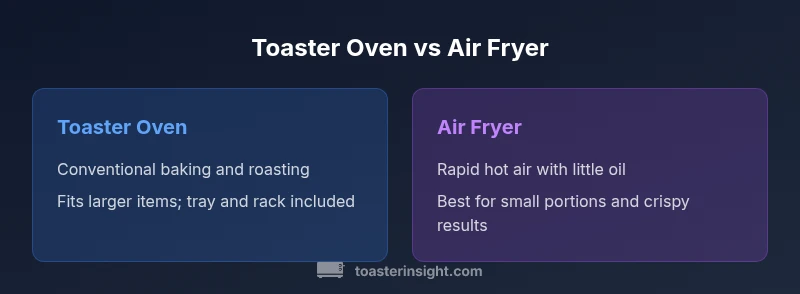
At the heart of the toaster oven vs air fryer comparison is how heat moves and how food is exposed to it. A toaster oven uses traditional heating elements on top and bottom (and often a convection fan in higher-end models) to bake, broil, or toast. An air fryer uses a compact chamber with a high-powered fan to circulate hot air rapidly, promoting browning with little or no added oil. This fundamental difference drives the outcomes: toaster ovens excel at larger items such as roasts, sheet-pan dinners, and layered casseroles; air fryers shine when you want a crunchy exterior on smaller portions or foods typically deep-fried. In practice, you’ll notice a trade-off between batch size and texture. Toaster ovens offer reliability for even heating and general cooking, while air fryers provide speed and crispness. From a maintenance perspective, both devices share removable trays and non-stick surfaces, requiring routine cleaning to avoid flavor carryover and smoke.
Size, Footprint, and Space Planning
countertop considerations matter. A toaster oven typically requires more horizontal space because of its width and depth, and many models come with a warming rack, crumb tray, and extra shelves. An air fryer often fits into a slightly narrower footprint but can be taller, especially in models with integrated handles or digital controls. For small kitchens, choose a compact toaster oven with a single rack or an air fryer that sits neatly under a cabinet. When planning, measure clearance for heat emission and ventilation. Equally important is capacity: a toaster oven often accepts a full sheet pan or multiple toast slices; an air fryer typically holds 3–5 quarts, which is perfect for single portions or a couple of servings. If you regularly cook for guests, you may value the larger cavity of a toaster oven, while if you primarily prepare single-serving crispy items, an air fryer could be more efficient.
Capabilities: Baking, Roasting, Toasting vs Crispy Frying
Toaster ovens provide flexible cooking modes: bake, broil, toast, roast, and warm. They’re excellent for cookies, casseroles, reheating leftovers, and even small pizzas. They excel at even browning when the dish benefits from an interior bake with even heat. Air fryers, by contrast, are designed to replicate fried textures with little oil by circulating hot air rapidly. They’re ideal for French fries, chicken wings, mozzarella sticks, and crispy vegetables. The key nuance is size and batch: a single air fryer is most efficient for small batches; a toaster oven can handle larger trays and multiple items simultaneously. Some models combine both functions into a single device, offering convection baking plus air frying with adjustable temperature profiles. If your cooking style includes both baked goods and fried-like snacks, consider how often you’ll use each mode to determine the right mix of capabilities.
Cooking Speed, Oil Use, and Health Considerations
Air frying can dramatically shorten cook times for small portions due to rapid air movement; it also allows you to reduce added fat, which can have health benefits for everyday meals. A toaster oven often requires longer bake times for larger items, but it provides even heat distribution across a full pan. The health angle is nuanced: air frying reduces oil absorption by design, but it doesn’t automatically make all foods healthier; the ingredient quality matters more. From a practical standpoint, air fryers excel for quick sides or snacks, while toaster ovens handle vegetables, proteins, and bakes that need volume. If you’re focused on quick weeknight meals and crisp textures with minimal oil, an air fryer stands out. If you bake desserts or roast meals that feed multiple people, a toaster oven is the better workhorse. For many households, pairing both yields complementary results rather than redundant functionality.
Price, Warranty, and Long-Term Costs
Budget considerations matter. A simple toaster oven can start at a modest price point, while mid-range and premium models add features like precise temperature control, multiple racks, and smart presets. Air fryers vary widely by size, features, and build quality, with some compact units costing less than larger, feature-rich models. Warranty terms differ by brand and model, but most common appliances offer a limited warranty of one to three years. When evaluating total cost, include energy usage over time, frequency of use, and the cost of replacement parts such as baking trays or baskets. If you foresee a lot of use in busy seasons (holidays, parties, weekly meal prep), investing in durable components can reduce long-term maintenance and replacement expenses. The takeaway is to align price with your expected utilization and to avoid paying for features you won’t use.
Energy Use and Efficiency: What the Numbers Really Mean
Energy efficiency can be a subtle metric in small appliances. Both toaster ovens and air fryers are more energy-efficient for small tasks than a full-size oven, but their per-cycle energy use depends on size, set temperature, and duration. A toaster oven with a convection setting can achieve similar browning to an air fryer at a larger capacity; the reverse can be true for smaller items that benefit from rapid air. In practice, you’ll see energy savings when you avoid preheating a large oven, or when you prepare several servings in one batch. The ToasterInsight analysis suggests a pragmatic approach: consider your typical batch size, meal patterns, and whether you heat foods from frozen or room temperature. If you frequently cook for one or two people, an air fryer’s quick turnaround can be appealing; for families that cook larger meals, a toaster oven often proves more efficient on a per-serving basis.
How to Decide Based on Your Kitchen Size, Budget, and Cooking Style
Create a decision framework that begins with your primary tasks: baking and roasting large items versus crisping small portions. If you bake frequently or host meals for several guests, a toaster oven is likely your best bet. If you crave crisp textures for snacks or single-serving meals and want quick results with minimal oil, an air fryer is a natural choice. If space and budget permit, consider a two-device setup; many households find it worth the extra footprint to unlock the distinct strengths of each. When shopping, prioritize build quality, even heating, ease of cleaning, and available accessories like racks, trays, and baskets. Don’t forget to estimate long-term costs for replacement parts. Finally, map your current kitchen workflow: where will each device live, how will you store accessories, and how often will you use them during typical weeks and special occasions.
Real-World Scenarios: Which Path Fits You Best
Scenario A: You mostly reheat leftovers and bake cookies on weekends. A toaster oven offers consistent, even heating across a full tray and handles cookies, sheet pan dinners, and casseroles. Scenario B: You snack on crispy sides, roast smaller portions with less oil, and value speed. An air fryer excels here. Scenario C: You cook both for a family and for yourself. A combined approach works well if you have the counter space; you’ll get reliable baking with a separate cooking bowl and faster, crisp results for sides. By considering your typical meals, schedule and kitchen layout, you can choose the path that minimizes trade-offs and maximizes convenience.
Maintenance, Cleaning, and Safety Best Practices
Regular maintenance extends the life of both devices. Always unplug before cleaning; remove crumb trays and wash them with warm soapy water. Use non-abrasive sponges for the interior walls and avoid harsh chemical cleaners. Ceramic coatings and non-stick surfaces require gentle care to preserve release properties. For safety, keep the units away from water, ensure proper ventilation, and monitor for smoke or unusual odors. Preheating and cooking at high temperatures should be done with caution; do not overcrowd the cavity, which can impede airflow. When storing, place devices away from heat sources and ensure cords are managed to avoid tripping hazards. A simple weekly cleaning cycle and a monthly deep clean can keep both devices in peak condition and prevent flavor transfer between different foods.
Myths vs Facts: Debunking Common Assumptions
Myth: A toaster oven can’t bake cookies or pastries. Truth: Many toaster ovens perform well for baked goods with proper temperature control and a steady rack position. Myth: Air fryers always taste fried. Truth: When used correctly and with little or no oil, air fryers produce crisp textures without deep-frying. Myth: One device will replace all cooking needs. Truth: While capable, each device has unique strengths. Myth: Bigger is always better. Truth: The best fit balances capacity, countertop space, and energy use for your typical meals. By separating myths from practical reality, you can choose more confidently.
Quick Start Guide: Buying Roadmap and Simple Checklists
If you’re in a hurry, use a simple checklist: first define your top tasks (baking, roasting, crisping), measure your counter space, set a budget, and check cleaning practicality. Next, compare models with a focus on heating performance, evenness, and sturdiness of racks and baskets. Finally, read user reviews and examine warranty terms; prioritize models with durable trays and baskets that resist staining and sticking. This quick-start guide helps you decide whether you should go with a single device or opt for a two-device setup.
Comparison
| Feature | Toaster Oven | Air Fryer |
|---|---|---|
| Cooking approach | Conventional bake/ broil with heating elements (and convection) | Rapid hot air circulation with minimal or no oil |
| Best for | Baking, roasting, broiling, and large trays | Crispy textures, small portions, quick reheating |
| Typical capacity | 0.6–1.2 cu ft (17–34 L); fits full sheet pan | 3–5 qt (2.8–4.7 L); best for 1–3 servings |
| Countertop footprint | Generally wider and deeper; some compact models | Typically taller and narrower; compact footprint |
| Preheating and cook time | Usually longer preheat and bake times | Faster preheat and cook times for small batches |
| Price range | Budget to mid-range; vary by features | Budget-friendly to mid-range depending on size and features |
| Maintenance & cleaning | Removable racks/trays; easy cleaning with wobble-free slides | Basket and tray require regular cleaning; may have tighter spaces |
| Best for | Families, meal-preppers, bake-centric cooks | Snack-focused cooks, singles, quick meals |
Positives
- Expanded cooking versatility for baking, roasting, and air frying
- Faster cooking with hot air for small portions
- Convenience and energy efficiency for quick meals
- Avoids turning on the full-size oven for small tasks
Drawbacks
- Higher upfront cost when buying both
- More countertop space required
- Maintenance and cleaning more involved
- Potential duplication if one device already covers most tasks
Choose based on your primary cooking tasks: a toaster oven for versatile baking and roasting, or an air fryer for fast, crispy results; add the second only if space and budget permit.
For most households, a single device covers core tasks, but a two-device setup offers the widest versatility. A toaster oven is ideal for batch baking and roasting, while an air fryer shines for quick, crispy results with little oil. If space and budget allow, the combination minimizes trade-offs and maximizes everyday convenience.
Your Questions Answered
Do you need both devices, or can one replace the other?
One device can cover many tasks, especially if you mainly bake or roast. A toaster oven handles larger meals and trays well, while an air fryer excels at quick, crispy items. If your cooking pattern includes both types of tasks regularly, a two-device setup often provides the best balance of speed and texture.
One device can cover a lot, but if you want both fast crispy results and larger-batch baking, you’ll probably benefit from having both.
What size should I choose for a small kitchen?
For tiny spaces, prioritize compact models that fit under cabinets or that have a small footprint with a wide interior. An under-cabinet air fryer can save counter space, but if you bake often, a compact toaster oven with adjustable shelves might be more practical.
If space is tight, look for a compact toaster oven or a slim air fryer that still fits your typical meals.
Can I use parchment paper or metal in these devices?
Yes, both devices commonly support parchment paper and metal trays. Always check the manufacturer’s guidelines for maximum heat tolerance and safe tray sizes to avoid obstructing airflow or causing a fire risk.
Just check the manual for what fits and stays safe.
Are toaster ovens energy-efficient compared to full-size ovens?
Yes. For small meals and snacks, toaster ovens typically use less energy than heating a full-size oven. The energy advantage grows when you avoid preheating large ovens and cook multiple items at once in a toaster oven.
They use less energy than a big oven for small tasks.
Is preheating always necessary for toaster ovens or air fryers?
Most models benefit from a brief preheat to ensure even cooking, especially for baking. Some newer models offer quick preheat or preheating-free options for certain modes, but follow the user manual for best results.
Preheating helps even cooking, but some newer units can skip it for certain settings.
Which is easier to clean, toaster ovens or air fryers?
Both require regular cleaning of trays and baskets. Toaster ovens may have more components to wipe down, while air fryers often have tighter baskets. Empty crumbs after use and wash removable parts with warm, soapy water.
Regular cleaning keeps flavors from transferring and prevents odors.
Key Takeaways
- Match device choice to primary tasks to avoid wasted space
- Toaster ovens excel at larger, batch-friendly cooking; air fryers win for quick, crispy results
- Consider your counter space and budget before buying one or both
- Upgrade path: start with one versatile unit, then expand if you repeatedly hit its limits
- Prioritize build quality and accessories for long-term value