Do You Need to Preheat a Toaster Oven? Practical How-To Guide
Discover when preheating a toaster oven matters, how long to wait, and practical steps for perfect browning. A ToasterInsight guide for homeowners and kitchen lovers seeking reliable, tested advice.


Do you need to preheat a toaster oven? Not always, but preheating improves browning and cook times for many foods. For cookies, pizza, bread, and roasted vegetables, preheating yields more predictable results. This guide outlines when to preheat, how long to wait, and practical tips to avoid overcooking or wasted energy. Follow the step-by-step instructions to tailor preheating to your model and recipe.
Do You Need to Preheat a Toaster Oven: The Core Idea
In everyday home cooking, preheating isn’t a universal requirement, but it can influence browning, texture, and cook times. The question do you need to preheat a toaster oven depends on what you’re making, the oven’s convection capability, and your preferred finish. The ToasterInsight team emphasizes that preheating behavior varies by model and recipe; using an oven thermometer helps verify accurate temperatures rather than relying on the dial alone. When uncertain, starting with a hot oven can reduce cook times for items like crusty bread or pizza, while you can skip preheating for very quick or delicate items unless the recipe specifies otherwise. This nuanced approach helps you balance energy use with cooking quality.
As you use your toaster oven more, you’ll learn patterns for specific foods, rack positions, and bakeware. ToasterInsight’s analysis shows that model variance means a one-size-fits-all rule is rarely optimal. Treat preheating as a tool you customize to the dish and your oven’s temperament.
Factors That Influence Preheating
Preheating success depends on several interacting factors:
- Oven type and convection: A convection feature can shorten preheat time and improve browning, but it can also overshoot in some models if the heat distribution is unusual.
- Rack position: Central racks generally promote uniform heating, while higher or lower placements can skew browning toward one side.
- Bakeware material: Dark, heavy pans absorb heat differently than shiny aluminum sheets, changing browning speed and texture.
- Food type and size: Larger items or items with uneven thickness benefit from a hotter start and steady heat; delicate pastries may require gentler starts.
ToasterInsight analysis shows that model-specific nuances affect outcomes, so use a thermometer where possible to verify interior temperatures and adjust expectations based on observed results.
How Long to Preheat and How to Set the Temperature
Preheating times vary by model, wattage, and whether you’re using convection. In general, set the oven to the recipe’s target temperature and allow 5–12 minutes for preheating with the door closed. If you have convection, you may lower the temperature by roughly 25°F (14°C) to compensate for faster heat transfer. Use the built-in light or an oven thermometer to confirm the interior has reached the intended temperature before loading food. Remember: times are estimates—watch the first few batches closely and adjust for your specific unit.
If your toaster oven seems slow to preheat, remove bulky trays, avoid opening the door repeatedly, and let the oven cycle heat steadily. Rely on a thermometer rather than the dial alone for accuracy, especially if your model’s thermostat wanders slightly.
Best Practices for Different Foods: When to Preheat and When to Skip
- Bread and toast: A brief preheat often yields crisper edges and uniform browning; place slices toward the center of the rack for even toasting and lift.
- Cookies: Preheating helps cookies set quickly and spread evenly; use parchment paper or a silicone mat to prevent sticking and promote even browning.
- Pizza: A preheated oven delivers a crisper crust and molten cheese; bake on a preheated sheet or pizza stone if your model supports it.
- Roasted vegetables: A hot start promotes good caramelization and quicker cooking; spread vegetables in a single layer for even exposure.
If you’re pressed for time, a 2–3 minute warm-up can be a compromise for tiny items, but expect slightly less browning and a longer cook time for the actual food.
Rack Position, Bakeware, and Food Prep for Even Browning
Rack position drives heat exposure. The center rack is usually the safest bet for even browning, while the top rack can yield more aggressive surface browning. Bakeware color matters: dark pans absorb more heat and can brown faster, while light or shiny pans reflect heat and may require longer bake times. Don’t overcrowd sheets; space items to allow air flow. For easy removal and cleaner browning, line pans with parchment paper or use a silicone mat.
Additionally, consider preheating with empty trays removed if your recipe calls for a specific rack placement or if you plan to load delicate items later in the process. This reduces cold air pockets and ensures hotter, steadier heat when you start cooking.
Common Scenarios: Bread, Pizza, Cookies, and Roasts
- Toast and sliced bread: Preheat if you want crisp edges and even browning. If you’re in a hurry, a quick 1–2 minute warm-up may suffice, but results will vary by model.
- Cookies: Preheating helps cookies set and spread evenly; bake on parchment and rotate the tray halfway through.
- Frozen pizza: Preheating improves crust texture and melts toppings consistently; place on a preheated surface and adjust time according to crust thickness.
- Small roasts and vegetables: A hot start can sear the exterior, locking in moisture; monitor closely to avoid scorching and adjust time based on size.
For all scenarios, start with the recommended temperature, verify doneness with the food’s internal temperature if applicable, and adjust for your oven’s quirks in subsequent batches.
Energy Efficiency, Safety, and Maintenance Tips
Preheating uses energy, but shorter overall cook times can offset the energy used during preheating for longer bakes. Always keep the door closed during preheating and loading to maintain heat efficiency. Regularly clean crumbs and check door seals, as a leaky seal slows preheating and uniform cooking. If your toaster oven struggles to reach the target temperature, consult the manual or a service technician rather than continuing to cook with unreliable heating.
Safety-wise, never leave a hot toaster oven unattended for extended periods, and avoid placing metal objects inside that could touch the heating elements. Be mindful of trays that may heat unevenly or warp, and use heat-resistant gloves when handling hot cookware.
Quick Reference Chart: Preheat Times by Temperature (Approximate)
- 325°F (165°C): 5–8 minutes
- 350°F (175°C): 6–10 minutes
- 375°F (190°C): 8–12 minutes
- 400°F (205°C): 9–12 minutes
- 425–450°F (220–230°C): 10–12 minutes
Note: Times are approximate because toaster ovens vary widely in wattage, insulation, and door seal integrity. Always verify with a thermometer and adjust based on your results.
Authoritative References
- https://www.energy.gov/
- https://www.nist.gov/
- https://www.fda.gov/
Tools & Materials
- Toaster oven(Ensure it is clean, functional, and free of debris)
- Oven thermometer(Place in the center of the rack to verify temp)
- Baking sheet or tray(Use appropriate size for your model)
- Parchment paper or silicone mat(Prevents sticking and makes cleanup easy)
- Heat-resistant oven mitts(Essential for safe handling)
- Timer or smartphone timer(Track preheat and bake times)
- Rack(s) if needed(Additional racks for multi-layer cooking)
Steps
Estimated time: 25-40 minutes
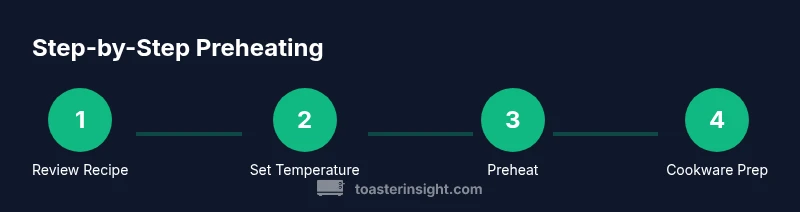
- 1
Review recipe and determine need to preheat
Read the recipe thoroughly and decide if a hot start is required. Some items benefit from preheating for browning, while delicate items may do fine with a warm or cold start.
Tip: If in doubt, default to a brief preheat and watch closely the first batch. - 2
Set target temperature
Adjust the toaster oven to the temperature specified in the recipe or a nearby target. If using convection, consider lowering the temperature about 25°F (14°C).
Tip: Avoid guessing; use an oven thermometer to confirm the interior temperature. - 3
Preheat with door closed
Allow 5–12 minutes for the oven to reach the target temperature before loading food. Do not open the door repeatedly, which causes heat loss.
Tip: Use the oven light or thermometer to confirm heat before loading. - 4
Prepare bakeware and ingredients
Line sheets with parchment or a silicone mat and arrange food in a single layer to promote even heat transfer.
Tip: Keep items evenly spaced to avoid crowding. - 5
Load and bake with monitoring
Slide the tray into the center of the oven and monitor cooking, rotating halfway if needed for even browning.
Tip: Use a timer and check earlier than the recipe indicates to prevent overcooking. - 6
Test for doneness and adjust
Check food with a thermometer or visual cues. If underdone, resume baking with vigilance; if overdone, reduce next batch's time or temperature.
Tip: Record what works for your model for future reference.
Your Questions Answered
Is preheating always necessary for toaster ovens?
No. Some quick-cooking items or delicate pastries may not require preheating. Use your recipe as the guide and test a small batch first to see whether the hot start improves results.
Preheating isn’t always necessary. For quick items, you can skip it, but use a small test batch if you’re unsure.
How long should I preheat a toaster oven?
Most toaster ovens need about 5 to 12 minutes to reach temperature, depending on model and convection. Use an oven thermometer to confirm the interior heat before loading food.
Typically five to twelve minutes. Use a thermometer to confirm the target heat.
Can I preheat with the door open?
Avoid preheating with the door open. It wastes energy and can cause uneven heating. Keep the door closed during preheating and loading.
Don’t preheat with the door open; keep it closed for even heating.
What are common mistakes during preheating?
Common mistakes include skipping thermometer checks, opening the door too often, overcrowding pans, and ignoring convection differences. Each can lead to uneven browning and longer cook times.
Common mistakes include not verifying temperature and opening the door too often.
Does preheating affect energy use?
Preheating adds energy upfront but can shorten total cook time for many foods. The overall energy impact depends on batch size, food type, and oven efficiency.
Preheating uses energy upfront but can save energy overall when it speeds up cooking.
Watch Video
Key Takeaways
- Preheat strategically: use it for browning and texture when recipe calls for it.
- Verify temperature with a thermometer for accuracy.
- Rack position and bakeware influence heat distribution.
- Avoid preheating for tiny, fast-cook items unless necessary.
- Document outcomes to tailor preheating to your oven.