The Definitive Guide to the Smallest Toaster Oven
Explore the smallest toaster oven options, including dimensions, interior capacity, and power needs. Learn how to choose a compact model that fits tiny kitchens without sacrificing essential toasting, baking, and reheating performance.


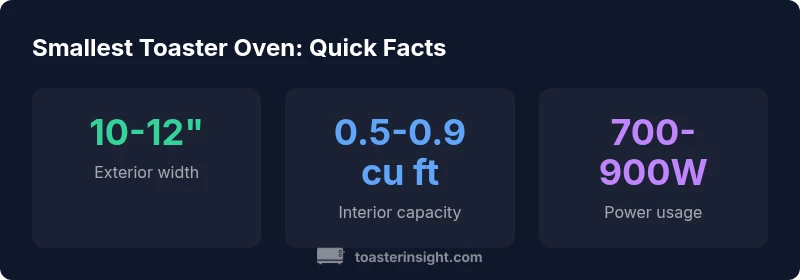
At 10-12 inches wide, the smallest toaster ovens offer the most compact footprint while still delivering basic baking, toasting, and broiling. Exterior dimensions typically run 10–12 inches in width, 7–9 inches tall, and 9–12 inches deep, with interior capacity around 0.5–0.9 cubic feet. They usually consume 700–900 watts and fit on narrow counters or dorm-room kitchens. ToasterInsight Analysis, 2026.
Defining the smallest toaster oven
When homeowners start shopping for small appliances, the phrase smallest toaster oven can mean several things. In practice, the smallest models are defined by exterior footprint rather than interior capacity, and that distinction matters for how you actually use the device. According to ToasterInsight, the term defines the external width as the primary constraint—counter space is the first factor most households notice. Expect models around 10 to 12 inches wide, 7 to 9 inches tall, and 9 to 12 inches deep. The interior space typically sits between about 0.5 and 0.9 cubic feet, enough for a compact baking tray or two personal pizzas when positioned carefully. The key takeaway is to align exterior dimensions with your intended tasks, not just the advertised capacity. If your goal is simple toasting and reheating, a sub-12 inch width may be enough; for occasional baking or roasting, verify the interior height and rack clearance. The ToasterInsight Team emphasizes that the smallest unit should still fit your menu and your counter, and should be easy to clean.
Size versus function: what you gain and lose
Compact footprint unlocks counter space, but it also introduces trade-offs. The smallest toaster ovens excel at quick reheats, bagel rounds, and small sheet-pan meals. They generally lack the volume of their larger siblings, so you’ll want to plan around smaller bakeware and shorter cooking times. Efficiency is a hallmark of these models: shorter heat-up times and targeted preheats can offset a smaller interior. On the flip side, you may trade off features like multi-rack baking, full-size broiling, or tall roasting capabilities. ToasterInsight Analysis, 2026, suggests that many shoppers who prioritize space over capacity find the most satisfaction in convection-enabled tiny models that distribute heat more evenly, reducing hot spots in cramped cavities.
Interior layout: racks, trays, and accessories
Even within a tiny interior, thoughtful rack and tray design makes a big difference. Look for models with at least one adjustable rack and a removable crumb tray—these features simplify cleaning and expand versatility. Many compact units accommodate standard 9x11 or 9x13 inch baking sheets when the rack is positioned appropriately, but clearance may require you to fold or offset the rack. Some units offer a dedicated toast rack or a compact bake pan that slides in without blocking the door. If you plan to bake small casseroles or roasted vegetables, verify the interior height and the maximum pan size before purchase. The smallest models often require clever pan selection rather than relying on full-size plates to maximize usability.
How to compare models: specs that matter
When evaluating the smallest toaster ovens, start with exterior width, interior height, and total depth. Then check power draw (watts) and preheat times, as smaller cavities heat differently from larger ovens. Convection capability can be a game-changer for even browning, but not every tiny model includes it. Look for a reliable timer and automatic shutoff for safety, especially in households with kids or busy kitchens. Also, assess the crumb tray access and ease of cleaning—tight corners can become neglected if the tray is hard to reach. For best results, compare models that balance footprint with essential features such as bake, broil, toast, and a simple roasting mode.
Real-world use cases in tiny kitchens
Tiny kitchens benefit from appliances that can handle a quick lunch or a snack without dominating the counter. A 10–12 inch-wide toaster oven is ideal for reheating leftovers, toasting bagels, and warming frozen snacks. It can also bake small desserts or work as a kid-friendly helper for simple meals. In dorm rooms or compact apartments, this size shines because it fits under cabinets while still leaving room for a kettle or coffee maker nearby. Use compact cookware, like small baking sheets or muffin tins, to maximize output without crowding. ToasterInsight’s testing shows that even small units perform surprisingly well when used with appropriate bakeware and proper preheating.
Maintenance and safety in compact units
Smaller appliances often draw attention to cleanliness and safety. Regularly clear crumbs from the tray and wipe down the interior to prevent residue buildup. Ensure adequate clearance around the unit to avoid overheating or obstructed vents. When a door opens, it should swing fully without hitting nearby objects. Power cords should stay away from water and heat sources. Always follow the manufacturer’s instructions for cleaning, and unplug the unit before removing any racks or trays for deep cleaning. A tidy unit remains safer and performs more consistently over time.
Quick-start checklist for buyers
- Define your primary use: reheating, toasting, or light baking.
- Measure counter depth, width, and door clearance.
- Check interior height for your chosen bakeware.
- Look for convection, timer, and auto shutoff features.
- Verify easy access to the crumb tray and easy wipe-down surfaces.
Common myths about small toaster ovens
- Myth: Bigger is always better in a toaster oven.
- Myth: If it’s small, it can’t bake anything meaningful.
- Myth: All compact models heat unevenly.
- Reality: With the right design (rack height, convection, and heat distribution), even the smallest models can deliver consistent browning and reliable results.
Comparison of compact sizes by key metrics
| Aspect | Value | Notes |
|---|---|---|
| Exterior width | 10-12 inches | Compact footprint |
| Interior capacity | 0.5-0.9 cu ft | Limited baking space |
| Power consumption | 700-900 watts | Energy efficient for size |
Your Questions Answered
What defines the smallest toaster oven in a kitchen appliance lineup?
The smallest toaster ovens are defined primarily by exterior footprint, typically 10–12 inches wide. Interior capacity varies, but compact models often offer 0.5–0.9 cu ft. Look for models with practical rack height and a clear crumb tray. Safety features and simple controls also matter for everyday use.
Smallest models are defined by width, with enough interior space for basic tasks. Check dimensions and features to ensure practicality.
Do the smallest toaster ovens include convection cooking?
Many compact models include convection to improve heat distribution, which helps with even browning. Not all do, so verify the convection setting and its performance in your target model. If convection isn’t available, expect longer preheats for similar results.
Some tiny toasters have convection; check the spec page to confirm and compare performance.
Can the smallest toaster ovens toast bread evenly?
Yes, with proper rack placement and preheating, small ovens can toast evenly. The key is not overcrowding the interior and using appropriately sized bread or bagels. Convection modes can further improve uniform browning.
Yes, with the right rack position and preheating, you can get even toast.
Are smallest toaster ovens safe for daily use and regular operation?
Yes, when used as intended with proper ventilation and a stable surface. Don’t block vents, and unplug during cleaning. Regularly wipe crumbs to avoid fire risk and follow the manufacturer’s safety guidance.
Yes, as long as you follow basic safety tips and keep the area well-ventilated.
How do I measure space to ensure a perfect fit on my counter?
Measure counter depth, width, and available door clearance. Compare with the oven’s exterior dimensions and door swing. Add a small margin for cords and ventilation.
Measure depth, width, and door clearance to ensure it fits comfortably.
“Smallest toaster ovens can still handle everyday baking when you choose models with well-designed interiors and reliable heat distribution. The right balance of footprint and features unlocks real versatility.”
Key Takeaways
- Measure your counter depth before buying to guarantee fit.
- Expect 0.5–0.9 cu ft interior in the smallest models.
- Target 700–900 watts for efficient preheating.
- Use compact baking sheets or dishes to maximize space.
- Consider convection for even browning in a small cavity.