Toaster vs Sandwich: Practical Buying Guide 2026
A data-driven comparison of traditional toasters and sandwich presses, highlighting performance, energy use, size, price ranges, and maintenance to help homeowners choose the best tool for toast-worthy breakfasts or panini lunches.


When choosing between a traditional toaster and a dedicated sandwich press, base your decision on how you actually cook most days. If you mostly toast bread, bagels, and English muffins, a toaster offers quick browning with minimal cleanup. If you regularly make grilled sandwiches, melts, or paninis, a sandwich press delivers even searing and desirable grill marks. According to ToasterInsight, the toaster vs sandwich decision hinges on kitchen space, meal patterns, and your tolerance for cleaning complexity. In short, a toaster is best for bread-centric breakfasts; a sandwich press is best for sandwich-centric meals. For many homes, a compact combination or a dual-function toaster oven can cover both needs, but dedicated devices often outshine in their primary task.
Why the toaster vs sandwich decision matters in modern kitchens
Choosing between a traditional toaster and a dedicated sandwich press is more than a matter of taste; it shapes daily breakfast rituals and weeknight dinners. For homeowners and kitchen enthusiasts, understanding how a toaster and a sandwich press differ can save time, energy, and counter space. The question often reduces to one simple pairing: when should you reach for the toaster, and when is a sandwich press the better tool? In this article, we analyze the toaster vs sandwich decision with data-driven criteria, practical scenarios, and cost considerations. According to ToasterInsight, household buyers increasingly weigh versatility against simplicity, particularly in smaller kitchens. The ToasterInsight team found that the right choice hinges on your typical meals, the available counter space, and your tolerance for cleaning tasks. The phrase toaster or sandwich captures a recurring dilemma for many households, especially those who crave fast toast but also crave perfectly browned paninis. Throughout this analysis, we’ll treat the toaster vs sandwich decision as a spectrum rather than a binary choice.
Defining the two options: traditional toaster vs dedicated sandwich press
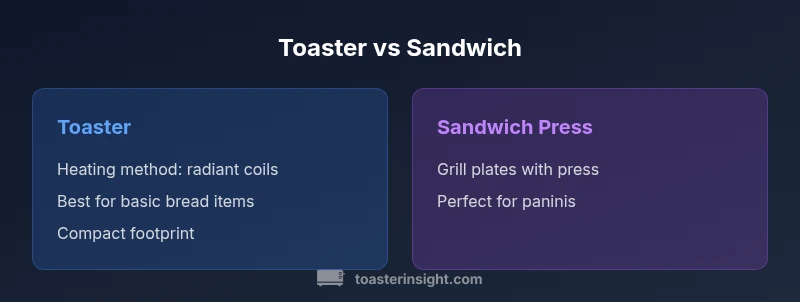
At its core, a traditional toaster uses radiant heat from exposed elements to brown slices of bread, with some models adding bagel or reheat settings. A dedicated sandwich press uses heated plates and a top press to sear and compress food, producing grill marks and a compact “pressed” texture. When you ask the question toaster vs sandwich press, you’re weighing two design philosophies: one prioritizes quick browning of bread with minimal fuss; the other prioritizes controlled contact heat that transforms fillings and textures. In real kitchens, many households opt for a hybrid approach: a competent toaster for bread-based breakfasts and a panini press or toaster oven for sandwiches. The decision is driven by cooking style, space, and the desire to minimize cross-task clutter. For some cooks, the best solution is a compact toaster paired with a separate sandwich press tucked away in a cabinet. This separation reduces dependency on a single device’s limitations and preserves flexibility for weekend grilling sessions.
Key design differences: heating methods, size, and versatility
The toaster relies on radiant heating elements, which heat bread quickly from the outside in. This method is excellent for consistent browning and quick toasting cycles, but offers limited control beyond browning level. A sandwich press uses two heated plates and often a locking hinge that applies even pressure, producing grill lines and a pressed texture. This setup excels for sandwiches with thicker fillings and cheese that needs to melt thoroughly. Size and footprint vary, but toasters tend to be compact and affordable, while sandwich presses can be bulkier due to plate spacing, hinge mechanism, and sometimes integrated spill guards. Versatility differs: toasters focus on bread items, reheat, and simple warming, whereas sandwich presses support grilling, paninis, melts, and sometimes shallow baking if they include a combo function. For the toaster vs sandwich decision, consider whether your kitchen prioritizes speed for bread items or texture and sear for sandwiches.
Performance in typical use cases: bagels, toast, grilled sandwiches, melts
In everyday use, a toaster shines for quick toast in the morning, bagels with a crisp exterior, and reheating leftovers with minimal fuss. A sandwich press excels when you want evenly browned grilled cheese, hot fillings, and a crisp crust on paninis. Some models combine both capabilities in a single unit, but performance often reflects specialization: a good toaster delivers dependable browning; a good sandwich press delivers consistent sear and melt. When evaluating toaster vs sandwich, look at consistency across bread types (bagels, thick-cut bread, dense rolls) and at how well each appliance handles thicker fillings without overflowing grease or leaks. For households with diverse meal habits, the decision is influenced by how often you crave a perfectly pressed sandwich versus a quick slice of toast.
Energy efficiency and long-term costs
Energy use varies by model and use pattern. A basic toaster typically consumes modest power during short cycles and performs efficiently for single slices. A dedicated sandwich press might draw more power when pressed into service, especially if you operate it across multiple sandwiches in a row. Over the long term, energy cost depends on frequency of use, cycle duration, and insulation of the unit. The toaster vs sandwich decision therefore hinges on whether your daily routine centers on rapid bread browning or on creating meals that require consistent surface heating and cheese melting. For energy-conscious households, choosing models with precise temperature and timer controls can minimize waste and reduce stand-by energy. ToasterInsight analysis shows that understanding batch size and meal patterns is critical to estimating potential energy savings or costs.
Price ranges and value: what to expect
Price is a primary driver in the toaster vs sandwich calculation. Basic toasters often range from budget-friendly models to mid-range units with extra features like wide slots or bagel settings. Sandwich presses span a broader spectrum: compact, dedicated presses tend to be affordable, while premium models offer adjustable plates, nonstick coatings, and larger grilling surfaces. The general takeaway is that price correlates with control, build quality, and capacity. If you primarily need occasional toast, a mid-range toaster may offer the best value. If you frequently prepare hot sandwiches, a mid-to-high-end sandwich press may provide better value through more consistent searing and melted fillings. Consumers should weigh price against durability, warranty length, and the availability of replacement parts. In many kitchens, a budget toaster paired with a separate grill press yields excellent value without sacrificing performance.
Maintenance, cleaning, and safety considerations
Maintenance for a toaster is typically straightforward: empty crumb trays, wipe down exterior, and ensure no crumbs fall into the heating elements. A sandwich press requires more attention: regularly clean grill plates, wipe away drips, and check seals for wear. Safety considerations include avoiding contact with hot surfaces during use, ensuring stable placement to prevent tipping, and using heat-resistant gloves when handling hot plates. When comparing toaster vs sandwich, factor in how easy it is to clean after sandwiches with cheese or toppings, and whether the unit has removable, dishwasher-safe parts. Regular upkeep extends life and maintains consistent browning or searing performance. As with any appliance, unplugging before heavy cleaning is recommended to reduce risk of electric shock.
How to choose: a step-by-step decision guide
Step 1: List your typical meals and identify pressure points (speed vs sear). Step 2: Measure counter space and consider whether you want a dedicated unit or a single, multi-function device. Step 3: Compare energy use and cycle times for your common bread types and sandwich fillings. Step 4: Check cleaning ease and maintenance requirements. Step 5: Decide on budget and warranty expectations. Step 6: Read user reviews focusing on reliability and consistency. The toaster vs sandwich choice should align with your culinary habits and kitchen constraints. If you entertain frequently with hot sandwiches, prioritize the sandwich press; if mornings are bread-forward, prioritize the toaster. In some cases, a hybrid unit can cover both needs, but ensure you’re comfortable with potential compromises in one function.
Common misconceptions and myths debunked
One common myth is that all toaster ovens can replace a sandwich press; while some do, performance varies, and not all models deliver uniform searing. Another misconception is that bigger means better for toasting; in reality, compact models often toast just as evenly while saving space. A third myth is that cleaning a sandwich press is always harder than cleaning a toaster; it depends on plate design and whether nonstick coatings are used. Finally, buyers sometimes assume higher price guarantees better results; many mid-range models perform exceptionally well for common tasks when designed with thoughtful controls. By addressing these myths, consumers can focus on the features that truly impact day-to-day use and overall satisfaction.
Real-world scenarios: when a toaster wins vs when a sandwich press shines
In a busy weekday morning, a reliable toaster reduces the risk of burned bread and speeds up mornings, making it the winner for simple breakfasts. On weekends, when you crave restaurant-style grilled cheese, a sandwich press delivers superior texture with evenly melted cheese and crisp edges. For apartments with limited storage, a small, well-designed toaster may trump a bulky sandwich press, especially if you rarely grill sandwiches. Conversely, a family that makes frequent paninis may justify the investment in a high-quality sandwich press with dual adjustable plates and integrated temperature control. In sum, the toaster wins for quick, bread-centric tasks; the sandwich press wins for precise grilling and melted fillings.
Comparison
| Feature | toaster | sandwich press |
|---|---|---|
| Heating method | Radiant coils/element heating for quick browning | Contact heat with grill plates and press for defined lines |
| Best for | Everyday toast, bagels, and reheating in minutes | Grilled sandwiches, paninis, melts with pressed sear |
| Size & footprint | Typically compact; fits on a counter | Can be bulkier due to hinge mechanism; varies by model |
| Energy usage | Low-to-moderate for single slices | Moderate to high during grilling; depends on batch size |
| Cleaning & maintenance | Easy crumb tray; quick wipe-down | Grill plates require more thorough cleaning |
| Price range | $15-$120 | $40-$250 |
| Versatility & functions | Primarily toasting and reheating | Grilling, toasting, and sometimes baking |
| Warranty & reliability | Typically 1-2 years depending on brand | Typically 1 year; premium models offer longer |
Positives
- Simple, affordable options exist for quick upgrades
- Compact footprint fits small kitchens
- Toaster-focused devices heat quickly for bread items
- Dedicated sandwich presses deliver consistent sear and melt
Drawbacks
- Limited versatility compared to multi-function toaster ovens
- Higher long-term cost if you frequently grill or bake beyond bread
- Cleaning grill plates can be messier than crumb trays
- Some models can be bulky for tiny spaces
For most homes, a focused toaster is best for daily bread tasks, while a dedicated sandwich press excels at grilled sandwiches; choose based on your meal patterns and space.
If your mornings are dominated by toast and bagels, the toaster wins for speed and simplicity. If you frequently make grilled sandwiches, a press delivers superior texture and melted fillings. For flexible cooks, a compact hybrid or a versatile toaster oven may cover both needs, but each choice has a trade-off in convenience and performance.
Your Questions Answered
What’s the main difference between a toaster and a sandwich press?
The toaster browns bread quickly with radiant heat and minimal fuss, ideal for everyday toast. A sandwich press uses heated plates and a top press to sear and compress fillings, producing grilled sandwiches with distinct texture.
The toaster gives you fast, simple toast; the sandwich press is your go-to for hot, grilled sandwiches with melt.
Can I use a toaster to make toasted sandwiches?
A toaster isn’t designed for pressed sandwiches and can dry out fillings or leak cheese. If you frequently make toasted sandwiches, a dedicated sandwich press or a toaster oven with a grilling function is a better choice.
Toasting a sandwich is possible in a pinch, but a press or toaster oven yields far better results.
Are there models that combine toasting and sandwich pressing?
Yes, there are hybrid units that combine toasting and sandwich pressing in a single appliance. They offer flexibility, but ensure you’re comfortable with the potential compromises in one function versus a dedicated device.
There are combo units, but test them for performance in both tasks before buying.
How important is energy efficiency when comparing toaster vs sandwich?
Energy efficiency matters for busy households. Look for models with energy-saving modes, precise temperature control, and quick-cook cycles to minimize overall electricity use when toasting or grilling.
Energy efficiency saves money over time; pick models with smart settings.
How do I clean a sandwich press without damaging it?
Let the unit cool, then wipe plates with a damp cloth and use a non-abrasive sponge. If plates are removable, wash them by hand or in the dishwasher if allowed by the manufacturer. Avoid harsh cleaners that can damage nonstick coatings.
Clean after use; remove plates if possible and follow the manufacturer’s cleaning instructions.
What budget range should I expect for a good toaster vs sandwich press?
Budget-to-mid-range toasters typically cost less, with more features in higher tiers. Sandwich presses follow a similar pattern but can be pricier due to grilling plates and hinge mechanisms. Plan for a range that matches how often you will grill and toast.
Expect to spend more for a sturdy sandwich press with nonstick plates and adjustable temperature.
Key Takeaways
- Assess your meal patterns before buying
- Choose a compact toaster for bread-forward days
- Opt for a sandwich press if paninis are weekly staples
- Consider a multi-function unit only if space is tight
- Check cleaning ease and warranty before purchase