Air Fryer vs Toaster: A Practical Comparison for Home Kitchens
Explore whether you can use an air fryer instead of a toaster with a data-driven, practical comparison. Learn about texture, speed, energy use, and scenarios where each appliance shines.


Can you use an air fryer instead of a toaster? In many kitchens, the answer is yes for quick snacks and reheating, but not for all bread textures or precise browning. This comparison explains when an air fryer can substitute a toaster, what you gain in speed and versatility, and where the trade-offs lie.
Key Differences in Cooking Approach
An air fryer and a toaster share a simple goal: make bread or bite-sized foods more appealing through heat, but they achieve this with different physics. An air fryer circulates hot air with a high-speed fan, producing a crisp, fried-like texture with little or no oil. A toaster relies on direct radiant heat from heating elements to brown the surface. This fundamental difference shapes every outcome, from browning uniformity to reheating speed. The practical question can you use an air fryer instead of a toaster? This is not a hypothetical inquiry; it’s a real decision about texture preferences, batch size, and how you value versatility versus specialization. According to ToasterInsight, many households can cover most everyday toasting tasks with an air fryer, but classic toast and large batches still favor a traditional toaster for consistency and throughput. Understanding these core differences helps homeowners map their morning routines to the right tool, reducing guesswork and maximizing kitchen efficiency.
How to Think About Bread, Toast, and Reheating
Bread quality matters as much as heat. When you want a uniform golden crust with a soft interior, a toaster often delivers reliable results across standard slices. An air fryer can achieve a crisp edge on thin or day-old bread quickly, but thick loaves or uneven slices may brown unevenly. Reheating pastries, croissants, or savory bites in an air fryer tends to restore crunch with short cook times, while toasting may leave them drier or denser. If your goal is a crisp surface quickly, an air fryer can be a convenient substitute for a toaster—though the texture may differ from traditional toast. The key is to align your expectations with the item’s moisture content and thickness. This planning stage helps answer the broader question that many households face: can you use an air fryer instead of a toaster for your typical breakfast lineup? The flexibility of air frying makes it appealing for diverse snacks, but bread-specific tasks still shine with a dedicated toaster.
Performance Metrics: Speed, Texture, and Browning
Speed is a practical differentiator. Air fryers typically preheat quickly and cook small portions faster than a traditional toaster, especially for pastries or reheated items. Texture matters too: air frying produces a crisper exterior and a different interior feel, which some people love and others may find drying if overcooked. Browning can be very even in a toaster for standard bread slices, while an air fryer may produce uneven browning on irregular shapes. The takeaway is clear: both appliances can deliver satisfying results, but the best choice depends on slice size, moisture content, and how you evaluate moisture retention versus surface crispiness. The ToasterInsight framework emphasizes testing a few staple items in both devices to calibrate times and temperatures for your preferences.
Energy Use, Costs, and Long-Term Value
Energy implications matter, especially for small households or busy mornings. An air fryer heats a compact chamber and uses a convection fan to crisp foods, while a toaster heats a fixed element for browning. For single slices, the energy footprint can be comparable, but volumes and batch size drive different results. Over time, the cost difference between running an air fryer for many small tasks and using a dedicated toaster for bread-only chores becomes a trade-off between versatility and efficiency. ToasterInsight analysis shows that for typical breakfast routines, energy use per item tends to be similar across devices when you optimize time and temperature. If you routinely toast multiple slices, the throughput of a toaster can tilt the balance toward simplicity and economy.
Space, Cleaning, and Maintenance
Air fryers generally demand more countertop space due to the basket and interior cavity, and their interior may require a deeper clean to remove oil residue or crumbs. Toasters are often more compact, but the crumb tray can accumulate dust and crumbs if not cleaned regularly. If counter space is at a premium, you might favor a compact toaster or a slim air fryer. Cleaning frequency varies: air fryers benefit from thorough wipe-downs and occasional deep cleans to prevent lingering odors, while toasters benefit from routine crumb removal and periodic dial and switch checks. Both appliances are low- to mid-maintenance with proper care, but your cleaning habits and kitchen layout will push you toward one option.
Safety Considerations and Practical Setup
From a safety perspective, both devices require attention to avoid burns or fire hazards. Air fryers generate hot air and exposed baskets, so burners and hands should stay clear during operation. Toasters present burn risks during browning cycles and can heat nearby objects if left unattended. If you plan to substitute an air fryer for a toaster, consider the bread thickness, moisture content, and placement in the basket to ensure even browning. A practical approach is to keep both on the counter but assign tasks by function: air fryer for reheating and crisping, toaster for classic toast and bulk batches. As with any kitchen appliance, read manufacturer instructions, use oven mitts, and maintain clear ventilation.
Verdicts by Use Case: Best Scenarios for Each Appliance
- Best for quick, small-item snacks and reheating: air fryer
- Best for classic toast, even browning, and large batches: toaster
- For mixed routines (toast plus crispy sides): consider a hybrid approach or a larger countertop unit
- For space-constrained kitchens or energy-conscious households, testing both options helps determine which aligns with your routine
Comparison
| Feature | Air Fryer | Toaster |
|---|---|---|
| Cooking Speed | Faster preheat and cook for small items | Slower for standard bread slices; consistent browning requires multiple passes |
| Texture & Browning | Crispier exterior with potential interior moisture loss | Even surface browning; reliable texture across standard slices |
| Bread Capability | Best for small items, reheating, and some thicker slices | Ideal for traditional toast and batching multiple slices |
| Versatility | Multi-function: fries, snacks, reheating, some baking | Single-path function: toasting; limited reheating versatility |
| Energy/Cost | Energy-efficient for small portions; higher upfront cost | Lower upfront cost; generally straightforward energy use for toasting |
| Maintenance | Basket interior requires regular cleaning; potential deep cleans | Crumb tray and slots require periodic cleaning |
| Best For | Snacks, reheating, and crispy textures with minimal oil | Classic toast and high-volume bread toasting |
Positives
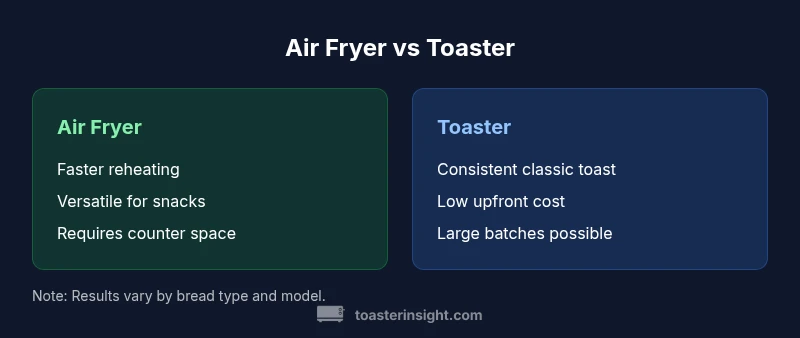
- Faster reheating and snack prep
- Less oil required for crispy results
- Multi-function versatility beyond toasting
- Can handle frozen items and small portions easily
- Adaptive texture options with temperature control
Drawbacks
- Bread texture can be uneven for certain slices
- Limited capacity for large batches
- Higher upfront cost on some models
- Requires counter space if you keep both appliances
Air fryer wins for speed and versatility; toaster wins for classic toast and bulk bread tasks
Choose an air fryer for quick reheating and crispy results on a variety of foods. Choose a toaster if you primarily toast bread, want uniform browning across many slices, or routinely cook large batches.
Your Questions Answered
Can you use an air fryer instead of a toaster for everyday toast?
Yes, you can, but results vary with bread thickness and moisture. Expect differences in texture and browning, and adjust times accordingly. Start with shorter sessions and check often.
Yes, you can, but results vary. Start with shorter cycles and check frequently to get the browning you want.
Is an air fryer more energy-efficient than a toaster?
Energy use depends on the model and task. For small portions, air fryers and toasters are often comparable; for larger batches, a toaster may be more economical due to batch throughput.
It depends on what you cook. Small tasks are similar in energy; larger batches lean toward the toaster for efficiency.
What foods can you toast in an air fryer?
Bread, bagels, English muffins, and certain thinner slices can be toasted in an air fryer. Irregular shapes or very thick slices may brown unevenly, so monitor closely.
You can toast bread and bagels in an air fryer, but watch for uneven browning on thick pieces.
When should you still use a toaster rather than an air fryer?
Use a toaster when you want consistent, even browning across standard bread slices and you’re toasting in large batches.
Stick with a toaster for even browning and bulk toasting.
Do air fryers require oil for toasting?
Most toasting tasks in an air fryer require little to no oil. A light brush of oil can help with certain textures, but it’s not mandatory for standard toast.
Usually no oil is needed; a light coat can help with some textures.
Can you reheat bread or pastries in an air fryer?
Yes, air fryers are effective for reheating bread and pastries, restoring crispness quickly. Use lower temperature and shorter times to avoid over-crisping.
Yes, you can reheat—just watch the time to avoid over-crisping.
Which is better for a busy breakfast: air fryer or toaster?
For a busy breakfast with standard toast, a toaster is often faster and more consistent. If you frequently reheat and crave crispy textures on other foods, an air fryer adds valuable versatility.
Toaster for speed and consistency, air fryer for versatility.
Can you bake items other than toast in an air fryer?
Yes, many air fryers can bake small items like cookies or small pastries. Check your model’s capacity and follow tested guidelines to avoid overloading.
Absolutely—many air fryers bake small treats well.
Key Takeaways
- Assess your weekly toasting tasks before swapping.
- Air fryers excel at crispy textures for small items and reheating.
- Toasters provide reliable bread browning and batch efficiency.
- Space, energy, and cleaning habits should guide the decision.