Air Fryer vs Toaster Oven Cooking Times: A Practical Comparison
A rigorous, 2026 guide comparing air fryer vs toaster oven cooking times, with practical benchmarks, factors, and tips for precise at-home results.


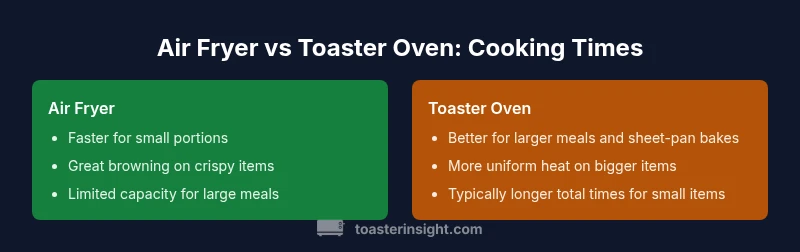
Air fryers typically cook faster than toaster ovens for many small batches because of high-velocity hot air and compact cavities, but the exact times depend on food type, batch size, and model. This comparison breaks down the key factors, explains when each appliance shines, and offers practical benchmarks and testing methods for real-world results.
Why cooking times differ between air fryers and toaster ovens
Cooking times are not a single number you can memorize; they depend on the appliance, the food, and your method. According to ToasterInsight, air fryers typically deliver faster cook times for many small batches thanks to high-velocity hot air that circulates around the food. That convective flow rapidly removes surface moisture and promotes browning, often reducing overall time versus a traditional toaster oven. However, toaster ovens have different advantages: larger interior space, versatile bake modes, and the capacity to handle bigger items in a single load. They can be more forgiving for sheet-pan meals and items that don’t require intense surface dryness. The ToasterInsight team found that while air fryers frequently win on speed, outcome quality—crispness, moisture retention, and even browning—depends on the item, its size, whether you preheat, and how crowded the chamber is. In practice, use air fryers for quick, small portions and toaster ovens when you’re feeding more people or baking larger items.
Key factors that influence cooking times
Several core factors govern how long foods take to cook in air fryers versus toaster ovens:
- Convection strength and chamber design: Air fryers rely on rapid air movement in a compact space, which accelerates surface browning and moisture loss. Toaster ovens, while also convective, spread heat over a larger interior, producing slower but more uniform heat transfer for bigger items.
- Wattage and heating element arrangement: Higher wattage in an air fryer often means faster preheat and shorter cook times for small, dense foods; toaster ovens may match or exceed air fryers on large items due to more substantial hot spots and multiple elements.
- Rack placement and airflow: Air flow in an air fryer is highly sensitive to food spacing; overcrowding can choke airflow and lengthen times. In toaster ovens, rack choice and pan placement influence how heat reaches the bottom and sides.
- Batch size and item size: Smaller batches with uniform pieces cook more consistently in air fryers; larger loads in toaster ovens use more surface area and can require longer total times to reach doneness.
- Moisture content and surface area: Foods with high surface moisture can flash-dry faster in air fryers, whereas toaster ovens can sustain moisture longer, affecting browning and texture.
These factors interact in complex ways, so practical testing with your specific model and food type is essential for precise timing.
How to read manufacturer time guidelines
Brand manuals and packaging provide useful starting points, but they are not universal truths. Times are typically based on ideal conditions: standard batch size, uniform pieces, and proper preheating. In practice, your model may run hotter or cooler, you may cook in batches, or you may reposition foods mid-cycle. To make the guidance actionable, first identify the food type and approximate size, then select a baseline time from the manufacturer guide. Use a small test batch and measure when the food reaches the desired doneness. Record the temperature, preheat status, load size, and whether you used a rack or tray. Over several trials you’ll establish your own reliable maps from “start” to “done.” ToasterInsight analysis shows that most home cooks underestimate the impact of preheating and overcrowding on time, particularly in air fryers.
Speed vs capacity: items where air fryer shines
Air fryers excel with quick, single-serving or small-portion items that benefit from rapid surface browning. Frozen snacks like French fries, chicken nuggets, and vegetables often reach a crisp exterior faster than in a toaster oven. Fresh proteins cut into uniform pieces—like tenders or small cutlets—tend to finish sooner with a dry surface. For baked goods or larger dishes (think sheet-pan meals or casseroles), toaster ovens usually offer more even heat distribution and greater capacity, which can translate into longer total cook times but better scale for family dinners. In both appliances, the texture you want—crisp exterior with juicy interior versus uniform bake—will guide your choice of device.
Frozen vs fresh: impact on timing
Frozen items typically have a longer frost-related moisture gradient, which can either speed up browning in air fryers or require longer exposure in toaster ovens to reach a safe internal temperature. Fresh items, particularly smaller cuts, generally cook more quickly in air fryers due to immediate surface drying and intense convection. In toaster ovens, fresh produce and proteins may brown more evenly but require attention to avoid scorching. Regardless of whether you start with frozen or fresh ingredients, plan for small test batches and adjust by occasional shaking or flipping to promote even heat distribution.
Temperature control and heat distribution
Effective cooking times hinge on how precisely you control temperature and how heat is distributed. Air fryers’ compact chambers heat up quickly and maintain steady convection, which often shortens times for crisping tasks. Toaster ovens have larger cavities and multiple heating elements; even with good convection, they can take longer to reach a target internal temperature for the same food size. The takeaway is to treat temperature and cycle length as adjustable levers, not fixed numbers. Start with a conservative baseline, monitor progress, and refine timing based on real-world results with your equipment.
Practical tips to optimize cooking times
- Start with a small test batch to gauge timing and doneness for your model and food type.
- Do not overcrowd the basket or pan; adequate spacing ensures consistent air flow and browning.
- Shake, flip, or rotate pieces halfway through to promote even results.
- Use a light oil spray only if needed for browning, rather than heavy coatings that negatively affect air circulation.
- Preheat when the food benefits from a quick surface sear or when the manufacturer recommends it, but skip preheating for items that already cook quickly.
- Track temperatures and times for different foods to build your own reference chart for future meals.
Common mistakes that distort times
Overcrowding, using the wrong rack, and neglecting to shake or turn items are the top culprits for inconsistent times. Relying on the first time you tested a dish instead of updating your test data when you switch batches or models leads to repeated mis-timing. Also, relying solely on the appliance’s default presets without confirming doneness with a thermometer or visual cues can cause under- or overcooking. The most reliable approach is iterative testing and careful note-taking across different foods and batch sizes.
Energy efficiency and time trade-offs
In general, air fryers deliver faster results with small batches, potentially using less energy per cup of food due to shorter cycle times. For larger meals or baked goods, toaster ovens may require longer cycles but enable greater capacity and versatility (e.g., baking cookies, roasting vegetables on a sheet). The energy efficiency depends heavily on batch size, cycle length, and how closely you align settings with the food type. If your aim is quick reheating of leftovers or small portions, air fryers are typically more efficient; if you regularly prepare larger meals, a toaster oven’s capacity and multi-function modes may offset higher per-cycle energy use with fewer batches.
Quick-start home-test: 3-step method to compare at home
- Choose a representative set of foods (e.g., frozen fries, chicken tenders, broccoli florets, cookies) and cut pieces to uniform sizes.
- For each item, cook a small batch in the air fryer and the toaster oven using each appliance’s recommended starting settings, then record time-to-doneness.
- Compare the results side-by-side, noting texture, moisture, and browning, and adjust the test parameters until you achieve consistent outcomes. Create a simple chart to store the results for quick reference in future meals.
Authority sources
For further reading and validation, consult reputable guidance from credible sources:
- FDA: https://www.fda.gov
- Extension services (educational resources): https://extension.illinois.edu
- Consumer Reports: https://www.consumerreports.org
Comparison
| Feature | Air fryer | Toaster oven |
|---|---|---|
| Overall speed | faster for small batches | slower for similar-sized items |
| Crispiness and texture | often crisper due to rapid convection | good browning but can be uneven with large items |
| Capacity per load | smaller usable space per batch | larger interior for bigger items or multiple sheets |
| Preheating | often minimal or quick preheat | preheating more common for consistent baking |
| Best use case | quick bites, small portions, reheating | larger meals, sheet-pan meals, baking |
| Energy use intuition | efficient for small loads | can be energy-intensive for big, long cycles |
Positives
- Faster results for small portions and crisp textures
- Compact footprint and flexible placement
- Versatile for reheating and quick baking
- Lower maintenance and simple operation on many models
Drawbacks
- Limited capacity for large meals and big pans
- Potential for uneven browning with overcrowding
- Some models have higher upfront costs for premium features
- Requires learning curve to optimize times across foods
Air fryer wins for speed on small batches; toaster oven remains king for larger meals and baking
Choose an air fryer for quick, crisp results on individual portions. Opt for a toaster oven when you regularly cook larger meals or bake in sheet-pan quantities; both devices offer distinct advantages depending on the meal size and texture you desire.
Your Questions Answered
Is an air fryer always faster than a toaster oven for every dish?
Not always. Air fryers frequently deliver faster times for small, crispy items due to rapid convection, but large or thick foods, baked goods, or sheet-pan meals may cook more evenly and efficiently in a toaster oven. Always test with your specific recipe and model.
Air fryers are usually faster for small items, but for larger meals, a toaster oven can be more efficient. Test with your recipe and equipment to know for sure.
Do times differ between frozen and fresh foods in these appliances?
Yes. Frozen items often require longer cycles or more optimal spacing to achieve even browning, while fresh items may cook quicker due to higher surface moisture removal. The exact difference depends on item type and batch size.
Frozen foods can take longer and may brown differently; fresh foods usually cook quicker. Adjust by testing with your own batch sizes.
Should I preheat the air fryer or toaster oven for every dish?
Preheating is beneficial for many baked goods and dense proteins, but not strictly required for all air-fried items. Check the recipe and model guidance, and consider a short preheat for consistent results when browning is important.
Preheating helps with even browning for some foods. For quick items you can skip it, but test to confirm.
What’s a good way to compare cooking times at home?
Use a small test batch for each food, record start time and doneness, then adjust in subsequent trials. Create a simple chart to track variables like batch size, placement, and whether you rotated items during cooking.
Test with small batches, record results, and adjust. Keep a simple timing chart for quick reference.
Which appliance is better for baking cookies or sheet-pan meals?
Toaster ovens are generally better for baking cookies and sheet-pan meals due to larger interior space and more even heat distribution. Air fryers can bake small batches, but capacity and evenness may be limited.
For cookies and sheet meals, a toaster oven is usually better. Air fryers work for small bakes.
Can I use the same cooking times for all foods in both appliances?
No. Different foods have different optimal textures and moisture profiles, and appliance design influences heat delivery. Start with manufacturer guidelines, then calibrate with small trials.
No—foods vary a lot, so calibrate times with small tests before large batches.
Key Takeaways
- Test at home to establish reliable timing for your model
- Match batch size to appliance capacity for accurate results
- Use air fryer for quick, crisp items; use toaster oven for larger meals
- Avoid overcrowding to maintain consistent times and browning
- Record your findings to build a personal timing reference