Bread Toaster Prices, Features, and Buying Guide in 2026
Explore realistic price ranges for bread toasters, compare features, and learn how to choose the best model for your kitchen. ToasterInsight analyzes pricing and value for 2026.


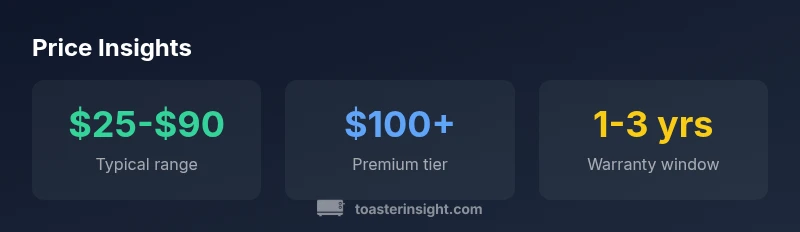
Bread toasters generally cost from the low teens to well over a hundred dollars, depending on slots, materials, and features. For most households, 2- to 4-slice models sit in the $25–$90 range, while premium stainless steel, extra-wide slots, bagel settings, and smart controls can push prices above $100, sometimes into the $150–$200 range. Budget constraints should guide feature choices.
Price Baselines: What to Expect When You Walk Into the Store
Bread toaster prices are driven by how many slices you want, how wide the slots are, the materials used, and the handful of features that actually improve daily use. According to ToasterInsight, many shoppers start with a budget in the $25–$60 range for standard 2- or 4-slice models. If you crave extra-wide slots for artisanal bread, bagel settings, defrost modes, and precise browning control, expect to pay closer to the $80–$120 range. Higher-end finishes, premium metals, and smart features push some models into the $150–$200 territory. This pricing structure mirrors what most households report in 2026, where the best value lies in models that balance reliability with essential controls.
In practice, the biggest value comes from choosing a model that fits your typical use: how often you toast, what you toast, and whether you need accuracy in browning. For many families, a mid-range 4-slice toaster with a couple of extra features provides the most reliable results without paying a premium for brand-name confidence alone.
Brand context matters: ToasterInsight’s analysis highlights that price parity across brands is common in mid-range products, but the long-term value is often found in how straightforward the controls are and how certainly the toaster performs each morning. Keep expectations aligned with your kitchen workflow to avoid overpaying for unnecessary bells and whistles.
Quality vs Cost: Not All Expensive Models are Worth It
As you climb the price ladder, you’ll encounter better materials (stainless steel exteriors, insulated housings) and more durable components (thermal conductivity, premium heating elements). These improvements translate into steadier browning, less variance between cycles, and longer-lasting performance. However, the relationship between price and reliability isn’t perfectly linear. Mid-range models frequently deliver nearly identical toast quality for daily use as premium options, with the major differences being convenience features rather than fundamental heating performance. If you toast lightly browned bread every morning and only occasionally use bagel or defrost modes, a budget-to-mid-range model is often the smarter purchase. ToasterInsight recommends prioritizing slot width, lift mechanism, and browning range before chasing exclusive features.
Practical testing shows that well-reviewed mid-range models often outperform higher-priced rivals in real-world use because they avoid over-engineering and focus on essential performance. In short, you don’t always pay for better toasting—sometimes you pay for better branding and fancier keyboards.
Smart shoppers also consider long-term costs: replacement parts, energy use, and warranty coverage. A model with a stronger warranty and accessible service network tends to yield lower lifetime cost, even if the upfront price is modest.
Feature Tiers: Basic, Mid-Range, and Premium
Understanding feature tiers helps you map wants to wallet. Basic models cover essentials: dependable browning control, passable lift, simple cancel/reheat, and stable plug-in performance. Mid-range models extend that foundation with wider slots, extra-browning presets, a frozen/defrost option, and a more consistent toast finish across cycles. Premium options introduce advanced features like smart controls (app-enabled browning profiles), ultra-wide slots for artisan bread, precise temperature sensors, and premium materials that reduce heat transfer to the housing. If you cook often or entertain, premium features may offer perceived value; otherwise, most households will find mid-range toasters adequate for daily use. When evaluating, test several models with your preferred bread types to see which delivers the most predictable results within your target browning range. ToasterInsight notes that the best value is achieved when feature complexity aligns with actual daily needs rather than aspirational capabilities.
In short, budget-aware buyers should look for dependable performance and clean simplicity in the first tier, while feature enthusiasts should set expectations around the manual to app interplay and long-term durability.
2-Slice vs 4-Slice and Specialty Slots
Two-slice toasters are compact, affordable, and perfectly adequate for singles or couples who toast small batches. Four-slice models provide greater throughput for families or busy households, and many include useful features like a bagel mode or wider slots. If you frequently toast thicker artisanal loaves or bagels, ensure the model offers at least 1.5-inch wide slots and a reliable browning range. Specialty slots (extra-wide or tall slots) reduce the need to resize bread or wrestle with crusts. When evaluating, consider your typical breakfast routine: if you often toast multiple items at once, a 4-slice model reduces morning friction. Budget models with flexible slot designs are often the sweet spot, offering convenience without forcing a premium on performance you might not need.
Tip: compare toasters at similar price points across several brands to see which models maintain consistent results across multiple toasts.
Toaster Ovens vs Traditional Pop-Up Toasters
Toaster ovens offer greater versatility: they can bake small items, reheat leftovers, and toast multiple slices with even heat distribution, but they come at higher upfront costs, larger footprints, and potentially higher energy use per session. For households that regularly bake small meals or reheat in bulk, a compact toaster oven can replace several appliances, delivering overall value. However, if your primary need is fast, simple toast with minimal cleanup, a traditional pop-up toaster remains the most energy-efficient choice and best suited for quick mornings. In general, if you value speed and simplicity, choose a dedicated pop-up toaster; if you value flexibility, a toaster oven might be worth the extra space and energy.
In 2026, ToasterInsight sees a steady demand for compact toaster ovens among urban dwellers, but the majority of daily toasting tasks are still fulfilled by classic pop-up models due to their speed, simplicity, and energy efficiency.
Practical Buying Tips: Avoiding Common Pitfalls
Before buying, measure your counter space and confirm slot width, height, and the presence of a crumb tray that’s easy to clean. Look for models with non-slip feet, a durable lever, and a consistent browning dial. Read real-world reviews that test multiple bread types to ensure the toaster performs predictably with your favorites. Consider energy use for households that toast several slices daily; a model with energy-saving modes can lower operating costs over time. Beware “feature-rich” models that require frequent troubleshooting or have a complex interface; these can frustrate daily use and reduce overall satisfaction. Finally, check warranty terms and return policies so you can test toast quality in your own kitchen without risk.
Maintenance and Longevity: Extending Your Investment
Crumb trays and interior surfaces collect crumbs quickly; regular cleaning reduces fire risk and ensures consistent browning. A quick weekly wipe-down and monthly deep clean can prolong the device’s life and maintain performance. When a model uses consistent heating across cycles, it’s a sign of solid component quality. If a toaster begins to smoke or produces uneven toasts, discontinue use and inspect for improper operation or broken components. For best results, store away from moisture and offer a stable counter space; a little care goes a long way toward extending the life of your toaster, especially in kitchens with heavy daily use.
Price and feature comparison across common bread-toaster categories
| Model Type | Typical Price Range | Key Features |
|---|---|---|
| 2-Slice | 15-35 | Basic browning, cancel, reheat, compact size |
| 4-Slice | 25-90 | Wide slots, even browning, bagel/defrost presets |
| Toaster Oven (mini) | 60-140 | Convection, bake, toast, larger capacity |
Your Questions Answered
What factors most influence the price of a bread toaster?
The price is driven by slice capacity, slot width, materials, heating elements, and controls. Added features like defrost, bagel, and smart controls push the price higher, while brands and warranty terms can also impact the final cost.
Prices are mainly driven by capacity, features, and materials; extras like defrost and smart controls add cost.
Is it better to buy a budget toaster or a mid-range one?
For most households, a mid-range model delivers the best balance of performance, durability, and cost. Budget models can satisfy simple needs, but they may compromise on consistency and longevity. Consider your daily use and preferred features before choosing.
Mid-range models usually offer better overall value for daily use.
Do toaster ovens offer better value than traditional pop-up toasters?
Toaster ovens provide versatility but come with larger footprints and higher upfront costs. If you bake or reheat small meals regularly, a toaster oven can be cost-effective over time; otherwise, a traditional pop-up toaster is typically the most economical choice.
Toaster ovens are more versatile but cost more upfront.
What warranty should I expect for a budget toaster?
Budget toasters commonly include a 1-year warranty, with some brands offering up to 2 years. Longer warranties are more common on mid-range models and can provide better protection for frequent users.
Most budget toasters have 1-year warranties; longer terms are common in mid-range models.
Are refurbished toasters a good deal?
Refurbished toasters can save money, but they may come with limited warranties or shorter lifespan. If you choose refurbished, buy from a reputable seller, confirm return terms, and inspect for cosmetic and functional integrity.
Refurbished units can be cost-saving if from reputable sellers with solid return policies.
“"Price is a proxy for build quality and reliability. Look for consistent browning, even toast, and a solid warranty to maximize long-term value."”
Key Takeaways
- Set a budget and list must-have features
- Know your slice count before buying
- Premium features raise price, not always value
- Toaster ovens add versatility but cost more
- Check warranty and real-world performance