Toaster or Roaster: A Practical Comparison for 2026
A detailed, analytical comparison of toasters and toaster ovens (roasters) to help homeowners decide which appliance fits their space, budget, and cooking needs in 2026.


TL;DR: For pure bread toasting, a compact toaster is sufficient; for broader cooking tasks, a toaster oven (roaster) adds functions like baking, broiling, and small roasting. If you have limited counter space, lean toward the one that fits; if you want versatility and warm leftovers, choose toaster oven. The choice depends on space, budget, and cooking needs.
Understanding the toaster or roaster distinction
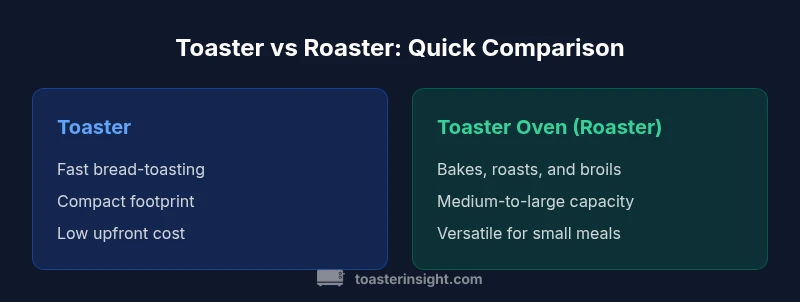
The terms toaster and toaster oven are often used interchangeably in everyday talk, but they describe two distinct appliances with different strengths. A dedicated toaster focuses on a quick, even bread-toasting experience with a simple heat source and compact footprint. A toaster oven (often called a roaster) is a small countertop oven that can toast, bake, broil, and roast. This versatility makes it a mini oven for small meals, frozen snacks, and reheating leftovers. When evaluating these devices, start with your daily routines: do you mostly toast bagels and sandwich bread, or do you regularly bake small batches, roast vegetables, or reheat pizza? According to ToasterInsight, the value of extra features is highly task-dependent; a model that includes convection and a broader temperature range can dramatically expand what you can cook. ToasterInsight analysis shows that households that embrace the roaster’s multi-functionality often recover the extra upfront cost by replacing separate small appliances or avoiding full-size oven use during peak times.
Comparison
| Feature | Toaster | Toaster Oven (Roaster) |
|---|---|---|
| Size/Footprint | Compact footprint ideal for tight counters | Larger footprint but still countertop-friendly |
| Versatility | Primarily for bread and light snacks | Bakes, broils, roasts, and multiple dishes |
| Energy Use | Low energy per cycle | Moderate energy; cooking tasks can substitute for full-size oven |
| Temperature Range | Limited range suitable for toasting | Broader range with convection and bake modes |
| Convenience Features | Simple, few controls | Presets, timers, and often convection |
| Capacity | Small capacity, often 1-2 slices | Greater capacity with racks and larger trays |
| Price Range | $20-$60 typical entry models | $60-$250 depending on features and size |
| Best For | Speed and simplicity for daily toast | Versatility for small meals and batch cooking |
Positives
- Low upfront cost for basic models
- Compact footprint suits small kitchens
- Simple operation and quick toast times
- Low maintenance for basic units
Drawbacks
- Limited cooking capabilities and capacity
- Fewer features for complex meals
- Can become restrictive for bulk cooking
- Heavier users may outgrow basic models
Toaster ovens generally offer the better overall value for most homes, while dedicated toasters excel at speed and simplicity.
If your daily routine centers on quick breakfasts and minimal cleanup, a traditional toaster is a strong choice. If you cook more than toast—baking, roasting, and reheating—invest in a toaster oven (roaster) for greater versatility and long-term flexibility. The right pick hinges on space, budget, and how often you’ll use advanced functions.
Your Questions Answered
Is a toaster oven worth it if I already own a toaster?
If you regularly bake, roast, or reheat meals beyond toast, a toaster oven adds substantial value. It can replace some small-oven tasks and reduce energy use compared with a full-size oven for small portions.
Yes—if you cook beyond bread, a toaster oven pays off through more capable results and fewer separate appliances.
Do toaster ovens use more energy than toasters?
Generally, toaster ovens consume more energy per minute due to their larger cavity, but they can save energy overall when they replace a full-size oven for small meals. Usage patterns matter more than label alone.
They can be more energy-intensive per minute, but may save energy by avoiding a full-size oven for small tasks.
Can a toaster oven replace a full-size oven?
For many small meals and apartment cooking, a toaster oven can replace a full-size oven. It may struggle with large roasts or large baking sheets, so plan for your typical meal size.
In many cases, yes, but not for big batches or large roasts.
What features matter most when choosing between them?
Prioritize footprint, temperature range, convection capability, rack configuration, and ease of cleaning. Presets and timers can help, but ensure you’ll actually use them.
Look for convection, adjustable temps, and a clean crumb tray plus easy rack access.
Are toaster ovens easy to clean?
Most toaster ovens have removable racks and crumb trays. Regular cleaning with warm, soapy water keeps them performing well, but follow manufacturer guidelines for interior surfaces.
They’re usually straightforward to clean, especially models with removable parts.
Key Takeaways
- Assess daily cooking tasks before buying
- Toaster for speed and simplicity; toaster oven for versatility
- Consider space, capacity, and energy use in tandem
- Look for convection, temperature range, and easy cleaning
- Budget for potential replacement of separate small appliances