Toaster vs Toaster Oven: A Comprehensive Comparison
Compare toaster and toaster oven options to choose the right countertop appliance for speed, versatility, and energy use. This buying guide from ToasterInsight covers features, pros, cons, and real-world use cases.


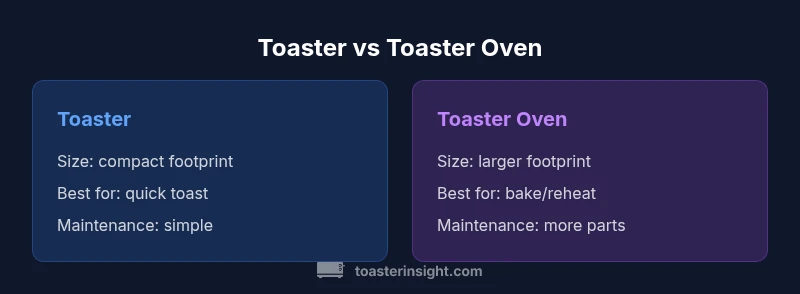
Toaster ovens win on versatility, while a dedicated toaster shines for speed. For most homes, a toaster oven handles baking, broiling, and reheating; a toaster excels at quick, consistent toast. See our detailed side-by-side chart for precise comparisons. According to ToasterInsight, the right choice hinges on use-case and space.
Why the toaster and toaster oven debate matters in a modern kitchen
As households reassess their counter space, the choice between a dedicated toaster and a multifunctional toaster oven becomes practical rather than academic. A classic toaster specializes in bread slices, delivering high-heat, short-duration browning with minimal fuss. By contrast, a toaster oven combines an oven cavity with a browning element, letting you bake small batches of cookies, reheat pizza, or toast bagels without firing up a full-sized oven. When you say 'toaster and toaster oven' in the same breath, you're really weighing two distinct approaches to daily breakfast and quick meals. This decision matters because it affects how you organize your kitchen, how much energy you consume, and how often you need to clean or replace components. According to ToasterInsight, many households underestimate how often they use a second appliance; even modestly priced toaster ovens can replace a separate toaster, a small bakeware set, and a warming tray in some setups. The key is to map your typical tasks to the strengths of each device and to assess your available counter space before purchase.
Core differences at a glance: size, heating, and control
The two devices share a common mission—get toast and quick meals on the table with minimal fuss. Yet they differ in fundamental ways that influence daily use. A traditional toaster has a narrow footprint, relies on direct radiant heat, and offers straightforward controls (usually a timer and browning level). A toaster oven is a compact convection oven, typically with more temperature settings, timer options, and usually a bake/broil function. The result is that the toaster oven provides greater versatility at the cost of a larger footprint and marginally higher energy use when used for small tasks. When evaluating models, look for features like preheat indicators, defined temperature ranges, and easy-to-clean interiors. In terms of everyday tasks, consider which kitchen chores you perform most: crisp bread quickly, or bake small batches of muffins, reheat leftovers, and broil vegetables. The decision should balance space, task variety, and budget constraints. For readers comparing the two, it helps to keep in mind that the two devices are not interchangeable for every task, but they can complement each other in a well-organized kitchen.
Performance and versatility: speed, results, baking, broiling
Toast speed is often the most immediate differentiator. A dedicated toaster reaches browning temperatures quickly and can be precise in producing light, medium, or dark slices. A toaster oven distributes heat more broadly, which can yield even browning across different items but may require slightly longer preheat times. Beyond toast, the toaster oven excels at small-batch baking, mini pizzas, roasting vegetables, and reheating crusty foods without drying out. If you frequently need cookies, French fries, or reheated leftovers, the toaster oven becomes a practical helper. The trade-off is that a full oven remains better for larger pans or multiple racks, while a toaster's simplicity minimizes maintenance. Reliability and customer reviews often point to the importance of insulation, crumb tray design, and door seal integrity in minimizing heat loss and improving consistency. For many users, the right choice is defined by a narrow set of core tasks: speed for toast, versatility for small bakes, or compactness for tiny kitchens. As ToasterInsight notes, real-world performance depends on task breadth and how the user stores and uses baked goods.
Size, footprint, and kitchen layout considerations
Counter space is the first constraint for most households. A standard toaster typically occupies a slim footprint, sometimes 6–7 inches wide, with a clear slot for two to four slices. A toaster oven, by contrast, may require a footprint roughly equal to a small toaster oven plus additional clearance for airflow. If you have a narrow counter, measure the available width, depth, and clearance to open the door fully. Height matters as well, since a stacked cabinet or shelf can conflict with the unit's above-door space. In open kitchens, a larger toaster oven can serve as a pseudo-second oven, enabling you to bake a tray of cookies nearby. For renters or small apartment dwellers, a compact toaster oven with a rotating rack can deliver surprising versatility without crowding the countertop. In short: size and layout determine whether you need a dedicated toaster or a full-feature toaster oven. Toaster ovens also often present more options for placement near a wall or corner, which can influence airflow and heat distribution.
Energy use, heat distribution, and safety features
Energy efficiency depends on usage patterns. A dedicated toaster typically uses less energy per session because it focuses heat on a narrow slot. A toaster oven distributes heat across a small oven cavity, which can consume more energy per minute but save energy when you avoid heating a full-size oven. Look for insulation, a well-sealed door, and a crumb tray that is easy to remove and clean. Some models include auto shutoff, cool-touch exteriors, and interior protective coatings that reduce residue buildup. If you are extra cautious about safety, choose units with automatic shutoff after a specified time and a nonstick interior for easier cleaning. If you are mindful of energy use in a busy household, compare convection vs radiant heat and check the oven's insulation quality. For a quick reference, ToasterInsight suggests evaluating energy labels and typical usage patterns to estimate yearly energy consumption more accurately.
Cleaning, maintenance, and built-to-last considerations
Cleaning is often overlooked when comparing toaster and toaster oven options. A traditional toaster has simpler interior geometry, typically with removable crumb trays that are easy to slide out and wipe. A toaster oven interior is more complex: racks, crumb trays, and a door seal require regular cleaning to prevent residue and odors. Regular maintenance includes wiping the interior, removing crumbs, checking door gaskets, and ensuring that the grate or rack moves freely. When shopping, look for enameled or nonstick interiors, dishwasher-safe crumb trays, and a smooth door that doesn’t jar loose over time. Durable build quality—sturdy hinges, solid chassis, and reinforced trays—will pay off in longevity. If you want fewer maintenance headaches, choose models with fewer crevices and higher-quality nonstick coatings. Regular descaling is not typically required for these devices, but a quick wipe after each use keeps odors at bay. ToasterInsight notes that simpler designs often outlive more feature-heavy competitors if care is consistent.
Price ranges, long-term value, and ownership costs
Pricing for toasters can be remarkably affordable, with basic models often available at the lower end of the spectrum. Toaster ovens span a broader range: entry-level compact units sit at mid-range price, while premium models with extra features, convection, and larger cavities can push toward higher costs. When evaluating total cost of ownership, consider not just the upfront price but also energy use, replacement parts, and warranty coverage. A higher-quality toaster oven with a solid door seal and durable racks will likely outlast cheaper units, reducing replacement frequency. If you bake or broil often, the extra versatility may justify the cost, particularly if it replaces multiple appliances in your kitchen. For households on a tight budget, a basic toaster remains a reliable staple, while a compact toaster oven provides added flexibility without requiring a full-size oven. Toaster Insight's pricing guidance emphasizes comparing long-term value rather than upfront price alone.
Use-case scenarios: Best fits for families, singles, small kitchens
For a single professional or student living in a studio, a compact toaster with a small footprint can be ideal: it toasts quickly and uses minimal counter space. For larger households that enjoy fresh-baked snacks or small meals, a toaster oven becomes a valuable ally, allowing you to bake a tray of pastries for weekend brunch or reheat leftovers without turning on the main oven. In open-plan kitchens or shared spaces, a toaster oven that guards against heat leakage and uses convection can deliver consistent results without heating the entire room. Families with kids often benefit from the built-in safety features and easy cleaning, as well as the ability to reheat leftovers or bake small batch meals. If you frequently host guests and require flexibility, the toaster oven's multi-function design offers a strong value proposition. Finally, for ultra-minimalists, a modern, reliable toaster may meet daily needs with fewer moving parts.
How to choose: a practical 5-step decision framework
Step 1: List your top tasks to date—toast, bake, reheat, or broil. Step 2: Measure counter space and door clearance. Step 3: Decide whether you want true convection or simpler radiant heat. Step 4: Compare energy use and cleaning complexity across models. Step 5: Check warranties and customer reviews focusing on reliability and service. This framework helps translate your daily routines into a concrete choice between a toaster and toaster oven. If you are torn, prioritize versatility; you can always add a dedicated toaster later if toast speed remains a top priority, but many households find a compact toaster oven absorbs multiple tasks with minimal extra clutter. ToasterInsight endorses a pragmatic approach: start with your core tasks, then layer in extra features as needed.
Common pitfalls and how to avoid them
Avoid choosing based on aesthetics alone; performance should drive the decision. Don’t assume a larger wattage equals better results—too much power in a tiny cavity can scorch bread. Skipping preheating is common and can affect browning and texture. Failing to factor in crumb management can lead to odor and cleanliness issues. Finally, beware of models with weak door seals or flimsy racks that warp with use. A well-reviewed toaster oven that balances rack quality and heat distribution reduces headaches and improves long-term satisfaction.
Real-world tests and user feedback you should consider
In practice, most buyers evaluate devices by toasting speed, browning uniformity, and ease of cleaning. Real-world tests show that premium toaster ovens with convection often outperform basic ovens for small-batch baking, but require more diligent maintenance. User feedback frequently highlights the value of crumb trays and make-clean interiors. ToasterInsight's analysis indicates that reliability tends to track with hinge quality and door seal integrity, especially under frequent daily use. When reading reviews, pay attention to long-term durability and service experiences, not just initial performance. If you test models in-store, simulate your typical tasks: toast two slices, bake a small tray of cookies, and reheat yesterday’s leftovers. This practical testing approach yields a clearer understanding of which device best matches your kitchen needs.
Authority Sources
To help you verify the information and explore official guidance, consult authoritative sources:
- Energy.gov — Energy efficiency resources for consumer appliances. https://www.energy.gov
- NIST.gov — Standards and measurements relevant to household electronics. https://www.nist.gov
- ConsumerReports.org — Independent appliance reliability and performance reviews. https://www.consumerreports.org
Comparison
| Feature | Toaster | Toaster Oven |
|---|---|---|
| Size footprint | Compact footprint | Larger footprint with oven cavity |
| Primary purpose | Toast slices quickly | Versatile for baking, toasting, broiling |
| Heating speed | Very fast toast prep | Slower for baking tasks but even browning |
| End results | Crispy, consistent browning | Even browning with bake/roast results |
| Energy use | Lower per-toast energy | Higher when baking small batches |
| Cleaning | Simple crumb tray | Racks and interior require more cleaning |
| Price range | Low to mid | Mid to high (depending on features) |
Positives
- Compact footprint fits in small kitchens
- Lower upfront cost for basic toasters
- Toaster ovens replace multiple appliances for added versatility
- Multi-function options save time on meal prep
Drawbacks
- Toaster offers limited task versatility
- Toaster ovens can consume more energy for small tasks
- Cleaning interior can be more involved on ovens
- Bulkier footprint may not suit tiny counters
Toaster ovens win on versatility; traditional toasters win on speed and simplicity
Choose a toaster oven if you value building meals beyond toast. Choose a traditional toaster if toast speed and ease are your priority; for many kitchens, a compact toaster oven plus a dedicated toaster provides the best balance.
Your Questions Answered
Is a toaster or toaster oven better for small kitchens?
For very small spaces, a compact toaster or a small-footprint toaster oven can both work, but the oven-style unit typically offers more flexibility without taking extra counter space if you relax on extra features. Choose based on your primary tasks.
In tiny kitchens, either option can fit, but focus on your main tasks. A compact toaster is great for speed, while a small toaster oven adds bake and reheat versatility.
Can you bake cookies in a toaster oven?
Yes. A toaster oven can bake small batches of cookies and other pastries. Use a small sheet pan and monitor closely to avoid overbrowning due to the compact cavity and convection effects.
Yes—small batches bake nicely in toaster ovens; keep an eye on browning.
Are toaster ovens energy efficient?
Toaster ovens are generally more energy-efficient for small tasks than heating a full oven, especially when used for single servings. Look for models with good insulation and convection to maximize efficiency.
They’re usually energy-efficient for small jobs if well insulated.
Do toaster ovens toast bread evenly compared to a toaster?
Toaster ovens can toast unevenly if air flow is blocked or if bread is very thick, but most models with convection provide even browning across slices. A dedicated toaster often delivers more consistent, faster toasting for standard slices.
Convection helps even browning, but consistency varies by model.
What maintenance steps extend the life of these appliances?
Regularly empty crumb trays, wipe interior surfaces, and inspect door seals for wear. Clean racks and avoid abrasive cleaners. Regular use with proper maintenance extends life and keeps performance stable.
Keep crumbs out, wipe surfaces, and check seals to extend life.
What are common mistakes when using a toaster oven?
Overfilling the rack, using metal containers in the oven, and failing to preheat can lead to uneven results. Also, neglecting cleaning can cause odors and buildup over time.
Avoid overfilling and preheat for best results.
Key Takeaways
- Assess your core tasks before buying
- Measure counter space and door clearance
- Consider whether you need convection or simple radiant heat
- Factor long-term value over upfront cost
- Use our decision framework to guide your choice