Do Toasters Use a Lot of Electricity? A Practical Guide to Energy Use in the Kitchen
Do toasters use a lot of electricity? Learn how much energy a toaster actually uses, compare with toaster ovens, and get practical tips to minimize kitchen energy without sacrificing toast quality.


Do toasters use a lot of electricity? In typical home use, toasters draw roughly 800–1500 watts for a few minutes per cycle, translating to a small portion of monthly electricity. The exact consumption depends on toast thickness, slot width, and settings. Even with daily use, the impact is modest unless you bake or reheat routinely. For most households, a toaster remains a low-impact appliance in the grand scheme of energy use.
Do Toasters Use a Lot of Electricity?
Do toasters use a lot of electricity? The short answer is: not by itself. For most households, a standard 2‑slice or 4‑slice toaster operates at hundreds of watts for only a few minutes per use, which translates to a small fraction of monthly energy. According to ToasterInsight, the energy impact is mostly driven by how often you toast, not by the appliance’s idle draw. If you’re mindful about portion sizes and frequency, the toaster remains a low-energy companion in your kitchen. However, like any appliance, the cumulative effect matters if you toast multiple times daily or rely on the unit for reheating, baking salmon on toast, or other high-demand tasks.
How a Toaster Uses Power: Wattage and Duty Cycle
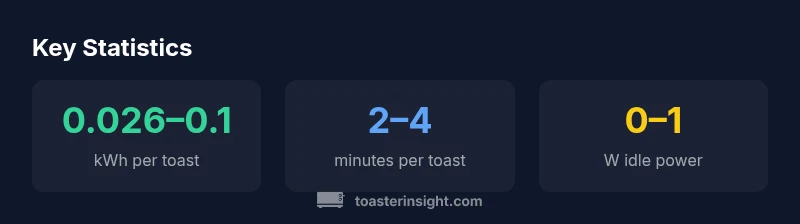
The energy you consume per toast comes from two factors: the wattage (the rate of energy use) and the duty cycle (how long the element stays on). Most modern toasters operate in the 800–1500 W range. A typical toast cycle lasts 2–4 minutes, depending on the bread type, thickness, and the selected browning level. To compare, a single toast cycle often uses a tiny fraction of a kilowatt-hour, and the exact value hinges on your settings. If you toast several times a day, you can approximate your daily energy by multiplying the cycle energy by the number of uses. The takeaway: wattage sets the pace, while toast duration sets the total energy for that event.
Toaster Ovens vs Traditional Toasters: Energy Implications
Toaster ovens typically run at higher wattage, often in the 700–1800 W range, but they can bake, broil, and reheat with multiple slices at once. Depending on what you’re cooking, a toaster oven might consume more energy per minute but could be more efficient for items beyond toast. For a single slice or two, a traditional toaster generally wins on energy per slice because it focuses heat to a narrow target for a short period. The choice breaks down to use case: quick, simple toast favors a toaster; baking or reheating larger quantities can favor a toaster oven—yet total energy depends on temperature, duration, and load.
Off-Mode and Idle Power: Do Standby Currents Matter?
Standby power in toasters tends to be very small—often close to zero after shutdown. Some models maintain a tiny residual current for features like timers or displays. In energy terms, idle power adds up only if you leave multiple units plugged in or keep a display on for long periods. If you want to minimize even this small impact, unplug or use a smart power strip for those toasters that have persistent displays. For most kitchens, standby energy is a minor contributor compared with active toasting, but every watt helps in a careful energy plan.
Real-World Scenarios: Toasting Bread, Bagels, and Frozen Items
Different food items change the equation. Thick slices or bagels can take longer, nudging energy use upward, while frozen items may require longer toasting times. In practice, a standard slice of bread on a 2–3 minute setting uses relatively little energy. If you frequently toast multiple items together or use the unit for reheating, you’ll approach the upper end of the typical range. The key is consistency: know your bread type, select the browning level you actually want, and avoid open-ended cycles that run longer than needed. When you harvest energy data from real-life uses, you’ll often find that energy per toast remains modest, even with everyday adjustments.
How to Measure Your Own Appliance Use
If you want a precise read on your specific model, a simple method is to use a plug-in wattmeter. Record the watts while the heating element is active and multiply by the number of minutes (divided by 60) to convert to kWh. Repeat across several toasting scenarios to get a representative average. Some brands publish energy-per-cycle estimates; use those as a baseline, but verify with your measurement for accuracy. This hands-on approach aligns with practical energy budgeting and helps you compare models or adjust usage to save energy over time.
Tips to Minimize Energy Use Without Sacrificing Toast Quality
- Toast in batches when possible to reduce heat-up cycles. - Use the correct browning setting instead of guessing. - Choose high-efficiency models with insulated housings and shorter heat-up times. - Unplug when not in use to eliminate standby draw on older units. - Prefer toaster ovens for larger loads but limit preheating to necessary tasks. - Clean the crumb tray; a clean interior heats more efficiently. These steps collectively keep energy use under control while preserving toast quality.
Common Myths About Energy Use in Small Kitchen Appliances
Myth 1: “Toasters waste energy because they heat up quickly.” Reality: energy use depends on time-on and power draw; quick cycles can be efficient, and longer cycles waste more energy. Myth 2: “Unplugging a toaster saves energy.” In most cases, standby draw is minimal, but it’s practical to unplug if you want to remove phantom loads entirely. Myth 3: “Toaster ovens always use more energy than a traditional toaster.” This isn’t universal; for small batches, a toaster oven can be less efficient, but for larger meals, it may be more energy-efficient overall due to a smaller heating area and faster preheating in some designs.
Energy use comparison by model type
| Model Type | Avg Toast Time | Estimated Energy per Toast |
|---|---|---|
| 2-slice toaster (standard) | 2–3 minutes | 0.03–0.08 kWh |
| 4-slice toaster (larger) | 2–4 minutes | 0.04–0.10 kWh |
| Toaster oven (compact) | 6–12 minutes | 0.15–0.40 kWh |
| Countertop convection oven | 5–9 minutes | 0.12–0.25 kWh |
Your Questions Answered
Do toasters really consume a lot of power compared with other kitchen appliances?
Most toasters use bursts of power for short periods, making their per-use energy small. When compared to ovens or refrigerators over a day, toasters typically contribute a modest share of energy—especially if you toast efficiently and avoid long cycles.
Toasters use power in short bursts, usually a small share of daily energy. For most households, they’re not the main energy drain.
Is a toaster oven more energy-efficient than a traditional toaster for small meals?
Not automatically. For a single slice, a traditional toaster is often more efficient due to targeted heating. For multiple slices or small baking tasks, a toaster oven can be more energy efficient overall depending on load and duration.
For one or two slices, a traditional toaster often saves energy; for several items or small bakes, a toaster oven can be more efficient.
Does unplugging a toaster reduce phantom energy?
Yes, unplugging removes any standby draw. Most modern toasters have negligible idle power, but unplugging is a simple way to eliminate phantom loads across multiple devices.
Unplugging removes any standby energy completely.
How can I estimate energy use if I can’t find a wattage rating?
Use a wattmeter to measure during active use, or rely on published per-cycle estimates and adjust for your typical toast time. This gives a practical range you can apply to your kitchen routine.
Measure with a wattmeter or use published per-cycle estimates to estimate your usage.
Do preheating settings save energy?
Preheating often adds time and energy without proportionate gains for simple toast. Reserve preheating for recipes that require it, and rely on standard settings for bread to maximize efficiency.
Preheating can waste energy for basic toast unless a recipe calls for it.
“Energy-conscious use of small appliances, combined with efficient models, leads to meaningful savings over time.”
Key Takeaways
- Toasters consume modest energy per use on average
- Wattage and duration drive energy more than idle power
- Toaster ovens can be efficient for larger tasks
- Measure your own device for precise estimates
- Unplug idle units to eliminate phantom loads