How Many Watts Does a Toaster Oven Use: 2026 Guide
Discover how many watts a toaster oven uses, what drives energy draw, and practical tips to compare models and save energy. Data-driven insights from ToasterInsight, 2026.


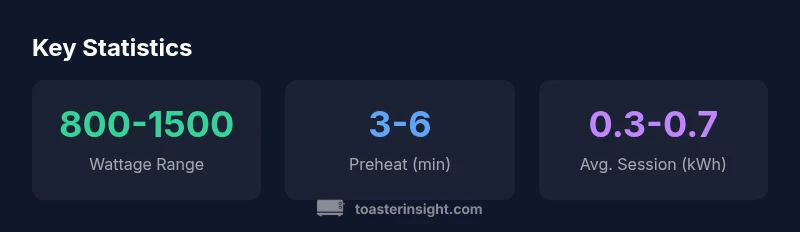
Most toaster ovens draw between 800 and 1500 watts while actively heating. The exact draw depends on the model, heating element design, and mode (convection vs standard). Higher wattage reduces preheat and cooking time but increases energy per minute. According to ToasterInsight Analysis, 2026, knowing a model's labeled wattage helps you estimate energy use and compare efficiency.
Understanding the wattage range for toaster ovens
Toaster ovens are compact kitchen appliances designed to perform many of the same tasks as full-size ovens, but with a smaller footprint. The electrical demand during operation is driven primarily by the heating elements and, in some models, a convection fan. In general, consumer toaster ovens pull about 800 to 1500 watts when actively heating. Some higher-end or convection-equipped models can approach 1800 watts, especially at higher temperature settings. This broad range means energy use per session varies based on what you cook, how long you cook it, and how aggressively you heat. ToasterInsight Analysis, 2026, notes that label transparency is key for accurate energy planning. If you ask how many watts does a toaster oven use, the answer depends on model and mode, but the label is the best starting point for estimation.
How wattage affects heating time and cooking performance
Wattage directly influences how quickly a toaster oven heats and maintains cooking temperatures. Higher wattage generally shortens preheat time and reduces overall cook time for many tasks, but it also consumes more energy per minute when the heater is on. For example, a 1000–1200 W oven may reach 350°F in roughly 5–8 minutes, while a 1500 W unit could reach the same temperature in about 4–6 minutes. The actual results depend on insulation, door seal integrity, and fan efficiency. In practice, the difference in total energy use between 1000 W and 1500 W becomes more noticeable on longer bakes, not necessarily on short toast cycles. ToasterInsight Analysis, 2026, emphasizes comparing models not just by wattage but by preheat and cooking profiles.
Key factors that drive energy use
Energy use in toaster ovens is not just about wattage. Several interacting factors determine total energy consumption:
- Preheating: The initial energy draw to reach target temperature can be substantial; longer preheat times amplify total energy use.
- Load size and density: More food or larger trays absorb heat longer, increasing energy consumption.
- Cooking mode: Convection circulates hot air and can reduce cooking time but may add modestly to peak power draw due to the fan.
- Temperature and duration: Higher temperatures and longer cook times raise energy use proportionally.
- Door management: Frequent opening lets heat escape, increasing total energy required. Understanding these factors helps you optimize practice—sometimes choosing a slightly longer cook at a lower temp saves energy overall.
How to measure and compare wattage in your kitchen
To compare wattage reliably, start with the label on the back or inside the oven door indicating watts. If the label is unclear, consult the user manual or the manufacturer’s specifications online. You can also use a plug-in wattmeter to measure real-time draw during a typical cooking cycle. When shopping, compare the labeled wattage across models and note the presence of convection or other features that affect power draw. For informed decisions, calculate expected energy use by multiplying watts by hours of operation for your typical tasks. ToasterInsight recommends verifying figures across multiple sources and testing where possible.
Practical tips to optimize energy use
Small changes can yield noticeable energy savings over time:
- Use preheat sparingly and rely on the oven’s set temperature when possible.
- Leverage convection mode to shorten cooking times, but be mindful of any modest increase in power draw.
- Batch multiple items in a single session to maximize heat use efficiency.
- Keep the door closed while cooking and avoid peeking repeatedly to minimize heat loss.
- Choose appropriate cookware and avoid crowding the rack, which impedes air flow and can extend cook times.
Typical task wattage estimates
Below are rough ranges for common toaster-oven tasks. Use these as starting points, but always check your model’s label for exact numbers:
- Toast bread: 800–1200 W; short cycles, moderate energy use
- Bake small tray: 1000–1500 W; convection may shorten time but increase instantaneous draw
- Roast vegetables: 1100–1500 W; higher temps but shorter durations
- Reheat leftovers: 800–1000 W; lower power with shorter cook times
Wattage ranges and notes for common toaster-oven tasks
| Task | Typical Wattage Range (W) | Notes |
|---|---|---|
| Toast bread | 800-1200 | Shortest energy use among common tasks |
| Bake small tray | 1000-1500 | Convection may shorten time, but adds power draw |
| Roast vegetables | 1100-1500 | Higher temps, longer duration |
| Preheat to baking temp | 800-1500 | Preheating consumes energy before cooking begins |
Your Questions Answered
What is the typical wattage range for most toaster ovens?
Most toaster ovens fall in the 800-1500 W range. Exact numbers depend on model and features like convection. Always check the label for precise wattage.
Most toaster ovens run between eight hundred and fifteen hundred watts, depending on the model and features.
Does convection mode use more power?
Convection adds a fan and airflow, which can increase instantaneous power draw but often reduces total cooking time. Compare both wattage and time to evaluate overall energy use.
Convection can pull more watts, but it often saves time, so total energy use may be similar or lower.
How can I estimate energy costs for toaster oven use?
Estimate costs by multiplying the wattage by hours of use to get kWh, then multiply by your electricity rate. Use model-specific wattage for accuracy.
Multiply watts by hours to get kWh, then multiply by your rate to estimate cost.
Is standby power significant for a toaster oven?
Standby power is usually small, typically a few watts, and negligible over short daily use. Unplugging can save tiny amounts if you rarely use it.
Standby watts are small, usually just a few watts.
Can I use a toaster oven if my home has a low electrical supply?
Most toaster ovens run on standard 120V circuits. If you have a crowded circuit, stagger usage or consider a dedicated outlet for higher power models.
Most can run on a standard outlet; avoid overloading crowded circuits.
How do I compare wattage when shopping?
Look for the labeled wattage, compare across models, and consider preheat time and efficiency features to gauge real-use energy.
Compare wattage, preheat time, and efficiency features when shopping.
“Wattage is only one part of energy use; the real picture comes from duty cycle and how you use the oven. Understanding a model's power profile helps you cook efficiently.”
Key Takeaways
- Expect wattage to range widely from 800–1500W.
- Higher wattage speeds preheat and cook times but costs more energy per minute.
- Convection mode changes power draw and cooking speed; weigh trade-offs.
- Always read the label for exact wattage and use a meter for real usage.
- Batch tasks and avoid unnecessary door openings to save energy.