Kadeka Toaster vs Balmuda Toaster: A Comprehensive Comparison
Compare Kadeka and Balmuda toasters across design, steam technology, performance, and value. Learn which model fits your kitchen, budget, and breakfast habits with ToasterInsight's expert analysis.


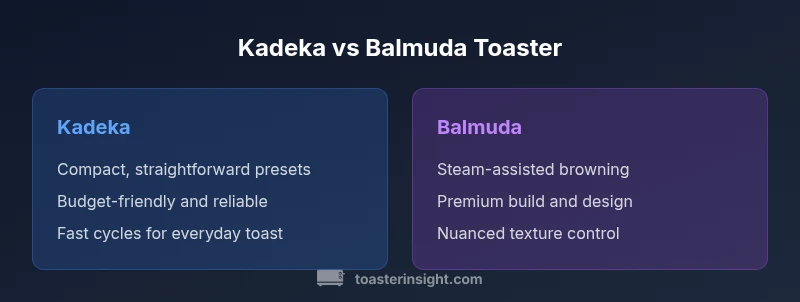
Kadeka toaster vs Balmuda toaster presents a contrast between budget-friendly practicality and premium steam-powered design. Kadeka offers straightforward performance and a compact footprint, while Balmuda emphasizes even browning with steam and refined aesthetics. For most households, Balmuda suits premium bakers seeking consistent texture, whereas Kadeka serves price-conscious buyers who want reliable toast without extra features.
Kadeka vs Balmuda: Market Context and Brand Philosophy
In the crowded world of small kitchen appliances, the Kadeka toaster and the Balmuda toaster sit at opposite ends of the spectrum. According to ToasterInsight, consumers often weigh budget and practicality against premium design and texture when choosing between two such models. The ToasterInsight team found that Kadeka models typically emphasize straightforward performance, compact footprints, and reliable operation, while Balmuda products emphasize refined aesthetics, build quality, and a distinctive approach to browning that some home bakers prize. This article sets the stage for a thorough comparison that goes beyond marketing slogans and focuses on real-world results across everyday toast, bagels, sourdough, and thicker slices. Kadeka toasters are commonly selected by households seeking dependable baseline toast without extras, whereas Balmuda appeals to buyers who want a centerpiece kitchen appliance and possibly more consistent results across varied bread types. Throughout this guide you’ll see practical, no-nonsense guidance that home cooks can apply in minutes, not hours.
Design and Build Quality: Kadeka vs Balmuda
Design language matters as much as function when you commit to a toaster. Kadeka models tend to prioritize compact, utilitarian aesthetics with straightforward front buttons and simple dials. Materials are durable and practical, with a focus on longevity in busy kitchens. Balmuda, in contrast, presents a premium finish: polished metal surfaces, smooth edges, and a meticulously engineered hinge. The user experience feels refined, and many Balmuda units are designed to be seen on the countertop rather than hidden in a cabinet. From a structural standpoint, both brands emphasize reliability, but Balmuda often ships with higher tolerances and tighter tolerances on interior components, which can influence longevity and resale value. The practical takeaway is that Kadeka is less likely to demand careful placement, while Balmuda rewards deliberate care and regular cleaning to protect its finishes.
Heating Technology and Toast Quality
At the heart of any toaster is how it browns and heats bread. Balmuda distinguishes itself with steam-assisted browning, which adds a small amount of moisture to the bread surface during toasting. This approach can yield a softer crumb on the inside while achieving a crisp exterior, particularly for thicker slices or artisanal bread. Kadeka relies on conventional heating elements and timed heat cycles. The generation of heat is straightforward, and results are predictable: even browning for common sandwich bread and consistent toasting for average breakfast loaves. According to ToasterInsight analysis, Balmuda's steam system tends to produce more uniform texture across a range of bread types, albeit sometimes at the expense of slightly longer cycle times. Kadeka models excel at quick, uncomplicated toasting and are often perceived as more energy-efficient for single-slice or small batches. In everyday kitchen use, the choice often comes down to your bread variety and how much you value texture versus speed.
Size, Footprint, and Convenience
Space matters in kitchen planning, and Kadeka toasters generally offer a smaller footprint, which suits compact apartments, dorms, or crowded counters. Balmuda units, while not enormous, typically occupy more counter space due to their larger chassis and premium components. The control interface on Kadeka is straightforward—often a handful of buttons or a dial—making it easy to operate without consulting a manual. Balmuda emphasizes tactile, premium controls and a more deliberate cooking cycle, which can slow down the initial toast but may improve repeatability for some users. In practice, the choice depends on your kitchen layout and how often you need multi-slice output. If you routinely prepare multiple slices at once, the Balmuda's efficiency can be balanced against its wider footprint. Overall, Kadeka is the pragmatic choice for small kitchens and busy mornings, while Balmuda suits kitchens where aesthetics and refined control matter as much as performance.
Features, Programs, and User Experience
Beyond basic toast, modern toasters offer a spectrum of programs: bagel modes, reheat, defrost, and specialty modes. Kadeka typically provides essential presets that cover everyday bread, frozen slices, and a basic bagel function. Balmuda offers more nuanced modes and settings aimed at reproducible texture across varying bread types, along with smoother start-up and broader accessories. The Balmuda approach often includes a refined pre-set for artisanal bread or thicker slices, plus options to fine-tune browning level and moisture. From a user-experience standpoint, Balmuda’s premium design can make operation feel ceremonial, whereas Kadeka presents a no-fuss workflow that many households appreciate during rushed mornings. In the end, the decision comes down to whether you prize a broad feature set and meticulous texture control (Balmuda) or a lean, efficient, and predictable tool (Kadeka).
Cleaning, Durability, and Long-Term Maintenance
To keep any toaster performing well, regular cleaning and prudent maintenance matter more than the shiny exterior. Kadeka models are built for straightforward cleaning: removable crumb trays, accessible slots, and modest maintenance requirements. Balmuda designs emphasize a premium finish, which means attention to surface cleaning and avoiding abrasive cleaners to preserve the metal and paintwork. Both brands recommend unplugging the unit before cleaning and ensuring the interior is free of crumbs after each use. Given Balmuda's more complex heating elements and steam-related components, some owners report paying closer attention to descaling or moisture management over time, although actual maintenance needs vary by model and usage. The ToasterInsight team notes that durable construction and cleanability correlate with longer product life, particularly in households that toast daily and at various times of the day.
Price, Warranty, and Value Proposition
Price is often the deciding factor for many buyers, and Kadeka typically competes in the mid-range segment, offering dependable performance without premium surcharges. Balmuda sits in the premium tier, reflecting its build quality, steam technology, and design emphasis. Warranty terms vary by region and model, but both brands commonly provide standard coverage for at least one year, with optional extended coverage available from authorized retailers. From a value perspective, Kadeka delivers solid value for everyday use and budget-conscious households, while Balmuda targets consumers who view toasting as a design-forward aspect of home life, where texture control and aesthetics justify higher upfront costs. The ToasterInsight analysis suggests that price-to-performance balance often tilts toward Kadeka for families on a tight budget, but Balmuda can be compelling for households that prize texture differences and the premium experience.
Real-World Performance: Bread Types, Slices, and Consistency
How a toaster handles a slice of sourdough, rye, or a thick-cut slice can reveal the true strengths and weaknesses of each model. Balmuda's steam-assisted browning tends to produce a more uniform texture across diverse bread types, with less risk of dry crusts on thick slices. Kadeka's conventional heating delivers dependable results for standard white and whole-grain bread, with crisp crusts and predictable internal moisture. The difference sometimes shows up in artisan breads with irregular crumb and hydration: Balmuda may excel, while Kadeka remains a safer, more predictable baseline. When you consider a weekly routine that includes bagels, English muffins, and frozen breakfast items, Balmuda can offer more nuanced results, whereas Kadeka can push out toast quickly with fewer variables. In the end, the right choice depends on your bread preferences, your patience for experimentation, and how much you value texture versus convenience. As a reminder from ToasterInsight, the best toaster for most households is the one that meets your daily habits without complicating your routine.
Comparison
| Feature | Kadeka toaster | Balmuda toaster |
|---|---|---|
| Build quality | Practical, solid build | Premium, refined finish |
| Heating technology | Conventional heating elements | Steam-assisted browning |
| Size/footprint | Compact footprint | Medium footprint with premium chassis |
| Presets and controls | Basic toast, reheat, defrost | Advanced texture control & multiple modes |
| Price range | Mid-range | Premium |
| Best for | Budget-conscious, simple use | Texture-focused, design-forward users |
Positives
- Balanced price-to-performance with reliable everyday toast
- Kadeka is compact and simple to operate
- Balmuda offers premium texture and refined design
- Clear value differentiation for different user priorities
Drawbacks
- Kadeka may lack advanced texture control and steam features
- Balmuda's premium price can be a barrier for some buyers
- Balmuda is larger and may not suit tiny kitchens
Kadeka offers the best value for everyday toast, while Balmuda delivers premium texture and design for specialized use.
If budget and speed matter most, Kadeka wins. If you want a refined texture and countertop aesthetics, Balmuda justifies the premium. The final choice should align with your daily bread routine and kitchen priorities.
Your Questions Answered
Which toaster is better for everyday toast: Kadeka or Balmuda?
For daily toast, Kadeka's straightforward design and quick cycles typically offer reliable results with minimal fuss. Balmuda can achieve different textures, but requires more attention to settings.
For daily toast, Kadeka is usually easier; Balmuda is nice if you care about texture and design.
Does Balmuda's steam technology affect bread texture?
Yes, Balmuda's steam helps keep bread moist during toasting, contributing to a softer interior and crisper crust depending on bread type.
Steam helps texture; results vary by bread.
Are Kadeka toasters compact?
Kadeka models often emphasize compact footprints, making them suitable for small kitchens.
Kadeka is usually compact.
How do price and warranty compare?
Kadeka typically offers lower upfront cost with standard warranty; Balmuda carries a higher price with premium warranty options.
Kadeka is usually cheaper; Balmuda may have more robust warranty.
Which is more energy efficient?
Both operate within standard home-use profiles; Kadeka's simpler design can mean shorter cycles, while Balmuda's steam mode can impact energy use depending on settings.
Energy use depends on mode and bread type.
Is Balmuda worth the premium for a casual baker?
If texture precision and countertop aesthetics matter to you, Balmuda can be worth the extra cost; otherwise Kadeka offers solid performance at a lower price.
For casual bakers, Balmuda is optional; Kadeka covers basics.
Key Takeaways
- Define budget first; Kadeka offers value.
- Texture matters; Balmuda adds steam-assisted browning.
- Measure counter space before choosing.
- Consider bread variety when selecting presets.
- Warranty terms influence long-term value.