Can You Use a Toaster Oven Instead of a Conventional Oven? A Practical Guide
Explore when a toaster oven can replace a conventional oven, how to adjust temperatures and times, and practical tips for reliable results. Learn from ToasterInsight on making small-batch cooking easy and energy-efficient.


Yes—it's often possible to use a toaster oven in place of a conventional oven for many cooking tasks. They heat quickly, fit small batches, and excel at baking cookies, toast, and small roasts. Key caveats include limited capacity, less even heat for large roasts, and temperature adjustments. For best results, select recipes meant for smaller ovens and monitor closely.
Why Home Cooks Consider Using a Toaster Oven
For many kitchens, a toaster oven is a nimble alternative to a full-size oven, especially when space is tight or batch sizes are small. You might be wondering can you use toaster oven instead of conventional oven for everyday meals? The short answer is often yes, with a few caveats. The ToasterInsight team notes that most tasks from toasting bread to baking a sheet of cookies can be done in a toaster oven, provided you adjust expectations and technique. In this guide, we’ll explore why this appliance is appealing, what constraints it imposes, and how to decide when to swap in a toaster oven. We’ll cover heat distribution, preheating nuances, and practical recipes that demonstrate the approach. By understanding the limits and advantages, you can confidently incorporate a toaster oven into your cooking routine, particularly for smaller households or busy weeknights. As you read, you’ll see how ToasterInsight analysis frames energy use and performance in real kitchen scenarios.
How Toaster Ovens Differ From Conventional Ovens
Toaster ovens are compact, countertop appliances with exposed heating elements on the top and bottom. They heat up faster, but their interior is smaller, which affects air circulation and browning. Conventional ovens rely on larger cavities and typically offer more even heat over larger surfaces. Some toaster ovens include a convection setting, which can mimic the airflow of a traditional wall oven, but not all models distribute heat identically. When asked whether you can use toaster oven instead of conventional oven for the same results, the answer depends on what you’re cooking. For many tasks like toast, rewarming, or small-sheet baking, results can be similar with careful adjustments. For larger roasts or multi-dish meals, you’ll likely want the full-size oven for even cooking and capacity. In practical terms, choose models with a reliable thermostat, a convection option if possible, and sturdy racks that support medium-sized pans. This guidance aligns with ToasterInsight’s practical approach to test-driving small appliances in real kitchens.
When a Toaster Oven Excels: Best Use Cases
Toaster ovens excel for small-batch cooking and quick meals. They’re ideal for cookies, single-sheet veggie roasts, reheating leftovers, mini casseroles, melting cheese on open-faced sandwiches, and toasting bread with precise browning. They’re also great for weeknight tasks that don’t require a full oven’s capacity. If you’re asking can you use toaster oven instead of conventional oven for these tasks, you’ll usually get excellent results as long as you adjust the temperature and keep an eye on doneness. For larger gatherings or bake-ahead tasks, a traditional oven remains the better option. Toaster ovens shine when you prioritize speed, energy efficiency for small batches, and a compact footprint in busy kitchens. As the ToasterInsight team notes, the right recipe in a toaster oven can rival the results of a conventional oven for many common baking tasks.
Temperature and Time: Making Accurate Adjustments
Because toaster ovens tend to run hotter in some spots and have smaller cavities, temperature and time adjustments are essential. Start by lowering the set temperature by a modest amount and monitor closely for signs of browning. In many cases, bake times are shorter, and you may need to remove items earlier than you would in a wall oven. If a recipe calls for a specific duration, check for doneness a few minutes early and rely on visual cues plus an internal thermometer when appropriate. Consistency improves with preheating, even rack positions, and avoiding crowded pans. This practical approach helps answer can you use toaster oven instead of conventional oven questions with consistent outcomes.
Pan Size, Racks, and Airflow: Getting Even Results
Interior space and rack configuration affect browning. Use a rimmed sheet pan or a shallow baking dish to maximize air contact and prevent spills. Place the pan on the middle rack for even heating, and rotate or swap racks if your toaster oven has hotter zones. Avoid tall or heavy pans that block heat to the food. For best results, keep food in a single layer and do not crowd the pan. Good air flow is critical for even browning and crust formation, which is essential when you’re translating a recipe from a full-size oven to a toaster oven. The goal is consistent browning and a clean, crisp finish. ToasterInsight’s practical testing suggests that simple layout choices have outsized impacts on outcomes.
Preheating and Warm-Up: How Long Does It Take?
Preheating behavior varies by model, but most toaster ovens warm quickly compared with conventional ovens. When a recipe instructs you to bake at a given temperature, you may not always need full preheating; some recipes tolerate starting from ambient temperature with slightly longer bake times. If you do preheat, keep the atmosphere closed to avoid heat loss. If your model offers a dedicated bake setting, use it to standardize heat delivery. As with any oven swap, a short period of observation during the first bake helps identify hot spots and timing differences. This is a practical, real-world consideration for can you use toaster oven instead of conventional oven questions.
Common Mistakes That Skew Results (And How To Avoid)
Common mistakes include overcrowding pans, using non-oven-safe cookware, and failing to adjust for smaller interior space. Another pitfall is relying on standard bake times without checking for doneness, which leads to undercooked centers or over-browned exteriors. Using foil near heating elements can cause uneven heating or scorching. Always measure with an oven thermometer if you suspect temperature drift. Rotate pans and stagger multiple items to improve air contact. Finally, read product manuals for wattage limitations and rack load capacity. By avoiding these missteps, you’ll get more reliable results when can you use toaster oven instead of conventional oven.
Energy Use and Safety Considerations
In most cases, toaster ovens use less energy for small-batch cooking than a full-size oven, particularly for short tasks. However, you’ll want to maintain clean crumb trays and avoid blocking vents, which can cause overheating or odors. Keep the door closed during cooking and use heat-resistant gloves when handling hot cookware. If you’re concerned about energy efficiency, compare wattage and estimated energy consumption per batch. The ToasterInsight team suggests that choosing the right size toaster oven for your typical batch loads can maximize efficiency and maintain safety.
How To Select The Right Toaster Oven For Oven-Replacements
Choosing a toaster oven that can stand in for a conventional oven requires attention to size, wattage, and heat distribution. Look for convection capability, accurate thermostat control, and a sturdy rack system that supports standard baking pans. Check for a crumb tray with easy release and a clear interior light so you can monitor progress. Prioritize models with a dedicated bake setting, even heat distribution, and durable construction. The ToasterInsight team recommends evaluating models by real-world tests rather than marketing specs alone. This approach helps you choose a toaster oven that will serve as a reliable oven-replacement for everyday cooking.
Note on Practical Everyday Usage
To recap, you can use a toaster oven instead of a conventional oven for many tasks, especially small-portion baking, toasting, and quick reheating. The key is understanding your model’s strengths and limitations, adjusting temperature and time, and choosing recipes that fit the appliance. With thoughtful planning, a toaster oven becomes a versatile tool in your kitchen, not just a backup.
Conclusion (Not part of this section; keyTakeaways cover the main insights.)
Tools & Materials
- Oven-safe baking sheet or shallow pan(Choose a size that fits the toaster oven cavity with 1 inch clearance around food)
- Oven mitts or heat-resistant gloves(For safe handling of hot trays)
- Instant-read thermometer (optional but helpful)(Helps verify internal doneness when timing is uncertain)
- Parchment paper or nonstick spray(Prevents sticking and supports even browning)
- Cooling rack(Allows air circulation after baking for crisp bottoms)
- Oven thermometer (external)(Use to verify accuracy if your toaster oven’s temperature is suspect)
- Silicone spatula or tongs(For safe food handling and turning)
- User manual for model-specific guidance(Important for wattage limits and rack positions)
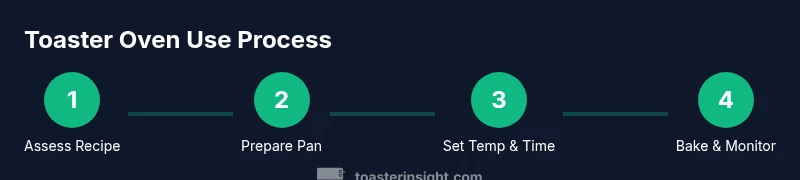
Steps
Estimated time: 15-40 minutes
- 1
Gather tools and ingredients
Collect your toaster oven, baking pan, parchment or spray, mitts, and the ingredients. Confirm the recipe is a good fit for a small oven and a single-layer bake. This upfront check prevents mid-cook substitutions that can derail results.
Tip: Having everything ready reduces the temptation to rush and crowd the pan later. - 2
Prep the pan and food
Line the pan with parchment or spray lightly to prevent sticking. Arrange food in a single layer with space between pieces for airflow. If using multiple items, stagger placement to avoid overcrowding.
Tip: A single layer improves browning and prevents steaming. - 3
Preheat if required
If your recipe calls for a preheated oven, allow the toaster oven to come to temperature before adding the food. If no preheat is required, place the food after the oven reaches the target temperature.
Tip: Some foods bake better when started in a preheated environment for crisp edges. - 4
Set temperature and time
Adjust the recipe’s temperature for the smaller cavity—typically lower than a full-size oven. Start with a shorter bake time and check for doneness a few minutes early. Use a timer to maintain consistency.
Tip: If unsure, start with 75-85% of the original bake time and evaluate. - 5
Bake and monitor
Place the pan on the middle rack. Keep an eye on progress and avoid opening the door too often, which can extend cooking time and cause heat loss. Rotate the rack or pan halfway through if your model has uneven heating.
Tip: Avoid frequent door openings to maintain stable heat. - 6
Check for doneness
Assess doneness visually and, if possible, with an internal thermometer. Remove items that reach the desired color and texture to prevent overcooking.
Tip: Trust visual cues in addition to time estimates for best results. - 7
Rest and evaluate
Let foods rest briefly after baking to finish carryover cooking. Evaluate the results and note adjustments for next time. If results aren’t meeting expectations, tweak temperature or time in small increments.
Tip: A small tweak can dramatically improve texture on subsequent bakes. - 8
Clean up and store
Once cooled, clean the crumb tray and wipe the interior. Proper maintenance improves performance and safety for future oven-replacements.
Tip: Regular maintenance reduces odors and smoke during use.
Your Questions Answered
Can I bake a full sheet pan of cookies in a toaster oven?
Yes, you can bake cookies in a toaster oven, but use a smaller sheet and prevent overcrowding. Rotate the sheet if your oven has hot spots and check early for doneness.
Yes, you can bake cookies in a toaster oven by using a smaller sheet and watching for doneness; rotate if you notice hot spots.
Is the temperature the same as in a traditional oven?
Not always. Lower the temperature slightly and shorten bake times. Use a thermometer when possible to gauge doneness.
Not always; lower the temperature a bit and check early for doneness.
Can I use metal bakeware in a toaster oven?
Most metal bakeware works, but avoid very thick pans that block heat. Ensure the cookware fits without touching the walls or heating elements.
Most metal bakeware is fine, but avoid thick pans and ensure it fits properly.
Are toaster ovens more energy-efficient?
For small batches, they can use less energy than a full-size oven, though efficiency depends on batch size and duration.
Yes, for small batches they often save energy, depending on the load.
What can’t I cook in a toaster oven?
Very large roasts or multiple trays at once may not heat evenly or fit. For bulk cooking, a conventional oven is usually better.
Large roasts or lots of trays at once can be tough; you might need a full-size oven.
How can I calibrate my toaster oven’s thermostat?
If you suspect inaccuracy, use an oven thermometer to verify temperature and adjust expectations or recipes accordingly.
Use an oven thermometer to check the actual temperature and adjust as needed.
Is convection essential for good results?
Convection helps with browning and even cooking, but it’s not mandatory. If your model lacks convection, you can still bake effectively with careful monitoring.
Convection helps, but you can still bake well without it by watching heat and placement.
What’s the best way to start swapping recipes?
Start with simple, quick-bake recipes designed for small ovens, then gradually adapt more complex dishes as you learn your model’s quirks.
Begin with simple recipes and learn how your toaster oven behaves before trying more complex dishes.
Watch Video
Key Takeaways
- Can you use toaster oven instead of conventional oven? Yes, for many small-batch tasks.
- Adjust temperature and time; monitor early to prevent under/overcooking.
- Choose recipes that fit a small interior and consider convection if available.
- Practice with simple dishes to learn your model's quirks and heating behavior.
- Use proper pans and maintain your toaster oven to maximize results.