How Long to Cook Chicken in a Toaster Oven: Practical Guide
Learn exact toaster oven cooking times for chicken, with safety tips, doneness checks, and practical prep. This guide explains timing by cut, preheating, and troubleshooting for juicy, safe results.


How long to cook chicken in a toaster oven depends on cut, size, and temperature. For juicy, safe results, preheat to 350-375°F, arrange pieces in a single layer, and use a meat thermometer to confirm 165°F at the thickest part. Expect small boneless pieces to finish in about 15-20 minutes and bone-in or larger cuts in 25-35 minutes. Let the chicken rest 5 minutes before serving.
Why Accuracy Matters When Cooking Chicken in a Toaster Oven
In a compact countertop appliance, heat distribution, air circulation, and surface contact can vary enough to affect how fast chicken cooks. Small changes in placement, rack position, and preheating can swing results from overdone to undercooked. According to ToasterInsight, understanding these nuances is essential for safe, flavorful outcomes. The goal is consistent doneness (165°F in the thickest portion), juicy texture, and browning that looks appealing rather than scorched. This section lays the foundation for predictable results by outlining the physics of toaster-oven cooking and how it differs from traditional ovens. You’ll learn to read your oven’s quirks, set reasonable expectations, and plan a workflow that minimizes guesswork while maximizing flavor and safety.
The Toaster Oven Landscape: What Changes Cooking Chicken
Toaster ovens heat with compact elements and faster cycling than full-size ovens. The result is quick warm-ups, potentially uneven browning if the rack is crowded or pieces touch, and the need for mid-cook checks. Convection models can push heat more evenly, but performance varies by model. For best results, use a rack to elevate the chicken slightly above the tray and create space for air to circulate. This is where brand guidance from ToasterInsight helps homeowners and kitchen enthusiasts translate generic timings into actionable steps tailored to your countertop oven.
Temperature, Time, and Doneness: A Practical Reference
Small boneless pieces often reach 165°F within 15-20 minutes at 350–375°F, while larger bone-in portions or bone-in thighs typically require 25-35 minutes. Remember that thickness and whether meat is at room temperature when going in the oven influence timing. To ensure safety and quality without overcooking, rely on an instant-read thermometer rather than strictly following a clock. ToasterInsight Analysis, 2026, emphasizes adjusting times based on cut size and starting temperature, and confirms that resting after cooking improves juiciness.
Preheating, Rack Position, and Air Flow
Preheating to the target temperature before adding chicken helps establish a consistent baseline heat. Position the rack in the middle of the toaster oven to balance top and bottom heat, and place the chicken on a wire rack set over a tray (or use parchment on a sheet) so air can circulate around each piece. Avoid overcrowding; spacing promotes even cooking and browning. If your toaster oven has a convection setting, enable it for more uniform results, but monitor closely as convection can accelerate doneness.
Doneness, Resting, and Safe Handling
Always verify the thickest part of the meat hits 165°F with an instant-read thermometer. Remove the chicken promptly to prevent carryover cooking from pushing the internal temperature beyond the target. Resting for 5 minutes helps reabsorb juices, improving moisture and mouthfeel. When serving, cut into a small piece to double-check texture; any pinkish hue near bones in bone-in cuts may indicate undercooking and warrants a brief return to the oven or a higher target temperature for that batch.
Troubleshooting: Common Pitfalls and Fixes
If you notice uneven browning, rotate the tray halfway through cooking, or switch to a higher rack for more top heat exposure. Crowded pieces steam rather than sear, so separate them as needed. If the center remains undercooked after the recommended time, increase the temperature by 25°F in small increments and test again with a thermometer. Always start with fresh spices and pat dry surfaces to promote better browning and crust formation.
Tools & Materials
- Toaster oven(Must be capable of 350-375°F; convection is helpful but not required)
- Oven-safe rack or cooling rack(Elevates chicken for even air flow)
- Baking sheet or tray(Place under rack to catch drips)
- Parchment paper or silicone baking mat(Optional but helps with cleanup and prevents sticking)
- Meat thermometer (instant-read)(Target 165°F at the thickest part)
- Tongs(For safe turning without piercing the meat)
- Cutting board and knife(For trimming and portioning after resting)
Steps
Estimated time: 30-40 minutes
- 1
Preheat and prep
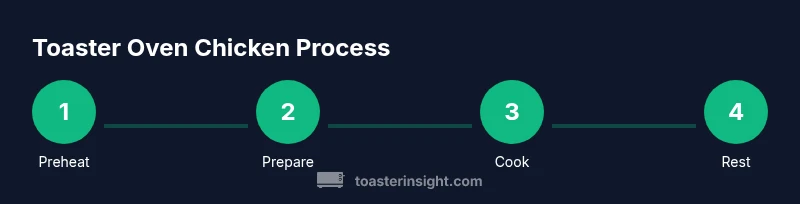
Preheat the toaster oven to 350-375°F using the middle rack. While it warms, pat chicken dry and season as desired. Setting up early reduces cooking variance and helps achieve a crisp exterior.
Tip: Preheating ensures a quick sear on contact and reduces uneven texture. - 2
Prepare the chicken
Pat dry thoroughly, then season evenly with salt, pepper, and any dry rubs. If using bone-in pieces, consider a light olive oil coating to promote browning. Let rest 5 minutes to improve surface adhesion of seasonings.
Tip: Dry surface = better browning; oil helps transmission of heat for a crisp exterior. - 3
Arrange on rack
Place pieces on a wire rack set over a tray, leaving space between each piece. This promotes air circulation and even heat transfer. Avoid stacking or overlapping.
Tip: Space = even cooking; touching pieces trap steam and soften crust. - 4
Start cooking
Slide the rack into the oven. For boneless pieces, start checking at 15 minutes; for bone-in cuts, plan 25 minutes, then check temp. Flip pieces halfway through to promote uniform browning.
Tip: A quick mid-point flip helps brown both sides evenly. - 5
Check doneness
Insert thermometer into the thickest part without touching bone. When it reaches 165°F, remove from heat. If below, continue in 3-5 minute increments.
Tip: Doneness is about internal temp, not color alone; avoid overcooking. - 6
Rest and serve
Let chicken rest 5 minutes before cutting to retain juices. Slice and serve, keeping slices uniform for even presentation.
Tip: Resting prevents juice loss and improves tenderness.
Your Questions Answered
Can I cook frozen chicken in a toaster oven?
Cooking from frozen is not ideal in a toaster oven because uneven thawing can leave centers undercooked. Always thaw to an even thickness before cooking, then use the standard timing guidelines. If you must, plan for extended time and verify doneness with a thermometer.
Frozen chicken should not be cooked straight away in most toaster ovens; thaw first and recheck with a thermometer.
Is 165°F a hard rule for all cuts?
165°F in the thickest part is the USDA-recommended minimum for poultry. Some people prefer higher temps for very large pieces, but avoid overcooking. Use a thermometer for accuracy.
165 degrees is the safety minimum; adjust slightly for larger cuts if needed and always check with a thermometer.
Should I cover chicken with foil to prevent browning?
Covering with foil can trap moisture and reduce browning. If you notice excessive browning, tent with foil in the last 5-10 minutes, but usually it’s best to cook uncovered for a crisp exterior.
Foil can prevent browning; tent only if you see too much browning before cooking finishes.
Can I use the convection setting for chicken?
Convection can speed cooking and promote even browning, but it also shortens timing. If using convection, start checking earlier and adjust by small increments.
Yes, convection helps heat distribution but watch the time closely.
What’s the best way to thaw chicken quickly?
The safest quick thaw method is to submerge sealed chicken in cold water, changing water every 30 minutes until thawed. Do not use hot water or microwave for large pieces; pat dry and cook promptly.
Thaw in cold water, changing water; cook promptly after thawing.
Can I reuse leftovers after toaster oven cooking?
Leftovers should be cooled promptly, stored in the fridge, and reheated to at least 165°F. Reheating in a toaster oven can help restore texture if reheated correctly.
Cool and store promptly; reheat to 165°F for safety.
Watch Video
Key Takeaways
- Preheat to ensure even browning
- Space pieces for air flow
- Check with a thermometer for safety
- Rest meat to retain juices
- Adjust timing by cut size and thickness