Is a Toaster Oven the Same as an Air Fryer? A Comprehensive Comparison
Learn whether a toaster oven is the same as an air fryer, how they differ in heating, performance, energy use, and use cases for home cooks.


Toaster ovens and air fryers are not the same tool, though they share some capabilities. A toaster oven uses traditional heating elements, while an air fryer circulates hot air at high speed for crisp textures. The difference matters for texture, capacity, and energy use. This comparison explains when to choose each and how to optimize results.
Is a toaster oven the same as an air fryer? Defining the two appliances
The short answer is no, but the differences matter for everyday cooking. If you search for is a toaster oven the same as an air fryer, you'll see that both appliances can toast, bake, and roast, but their core design and intended use differ. A toaster oven relies on traditional heating elements and a larger chamber, whereas an air fryer uses a compact space with a high-speed fan to move hot air rapidly around food. Understanding this distinction helps you pick the right tool for a given recipe or routine. The decision often comes down to texture goals, batch sizes, and how much counter space you want to devote to one gadget. According to ToasterInsight, readers frequently underestimate how much the heating method influences results, especially for foods that rely on surface browning and even interior warmth.
How heating methods differ in practice
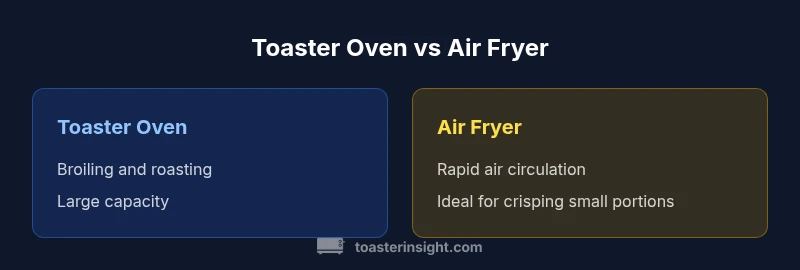
In a toaster oven, coils or radiant elements heat the interior, and convection may or may not be present depending on the model. An air fryer uses a dedicated fan to circulate hot air at high speed, yielding faster, crisper results with a bite that resembles frying—often with less oil. The practical takeaway is that air fryers shine for small, snack-type items and quick crisping, while toaster ovens excel at general baking, roasting, and larger meals. If you want a crisp exterior on frozen fries or chicken nuggets, the air fryer approach frequently wins; for baking a sheet of cookies or a roasted vegetable medley, the toaster oven is typically more flexible.
Texture, browning, and moisture: outcomes you can expect
Texture is the primary difference most cooks notice. Air frying promotes a uniform, dry surface with a pronounced crisp, while toaster ovens deliver browning that’s often more even across larger items, especially when multiple racks are used. Moisture retention varies by model and load; air fryers can dry foods if you overcook small portions, whereas toaster ovens may retain more moisture when used at moderate temperatures. For best results, monitor time and temperature and consider preheating control. As ToasterInsight notes, matching the cooking method to the dish matters as much as the device itself.
Capacity, footprint, and kitchen layout
Counter space and interior volume influence daily use. Air fryers are typically compact with a smaller interior, which makes them ideal for apartments or single-person households. Toaster ovens come in a wider range of sizes, from compact models to oversized units that can accommodate a full sheet pan. If you plan to roast a chicken or bake multiple trays of vegetables, a toaster oven offers more flexibility, even if it occupies more counter space. When measuring your kitchen, consider both external dimensions and interior capacity, as well as how the appliance will affect airflow and nearby outlets.
Cooking versatility: beyond toast and fries
While both appliances can toast bread, reheat leftovers, and warm pastries, the toaster oven often offers more cooking modes: bake, roast, broil, and sometimes convective bake. A dedicated air fryer primarily targets crisping and browning. Some models blur the lines by offering roasting trays or rotisserie features, but the broader value comes from how many cooking styles you can accomplish with one device. For curated meal prep, many households rely on a toaster oven for sheet-pan dinners and baked desserts, while an air fryer handles quick crisping of appetizers.
Energy use, efficiency, and control
Energy use depends on batch size, temperature, and preheating. Air fryers typically heat and cook quickly due to compact chambers and rapid air movement, potentially reducing overall energy for small meals. Toaster ovens handle larger batches but may require longer preheating or baking times for the same item, influencing energy use. The key factor is efficiency: choose the device whose performance aligns with your typical cooking volume. ToasterInsight notes that a common pitfall is running a large toaster oven for small tasks, which wastes energy and space.
Cleaning, maintenance, and longevity
Maintenance for both appliances is straightforward but differs in practice. Air fryers have fewer components to clean, but their baskets and racks can trap oil and crumbs if not cleaned promptly. Toaster ovens accumulate crumb buildup across racks and seals; regular cleaning keeps heating elements safe and consistent. A quick wipe, a periodic deep clean, and careful storage extend the life of either device. For longevity, choose models with removable, dishwasher-safe accessories and easy access to interior surfaces.
Costs, warranties, and long-term value
Prices vary by size and features, with toaster ovens offering a broad range from budget to premium, and air fryers generally occupying a similar spectrum. In many homes, a single, well-chosen toaster oven can replace multiple dedicated appliances, delivering better long-term value. When evaluating cost, consider not just the upfront price but also performance, energy use, and the utility of features like convection or rotisserie. Warranty terms matter for heavy daily use and should be compared across brands.
Use-case scenarios: when to choose which
If your cooking needs center on weekly baking, roasting, and larger sheet-pan meals, a toaster oven is often the smarter long-term choice. If you regularly prepare small portions and crave a fried-like crisp without added oil, an air fryer can be a time-saver. For households with limited space, a compact air fryer may suffice; for families and entertainers, a roomy toaster oven provides more flexibility. The best decision balances your typical meals, space constraints, and desire for simplicity.
Practical tips for choosing and using
To make an informed choice, start by listing your most frequent recipes and batch sizes. Check interior dimensions, rack configurations, and whether the model offers preheating, convection, and multiple cooking modes. Read user reviews for reliability and heat distribution, and compare energy efficiency statements where available. When using either appliance, experiment with time and temperature in small increments, document results, and adjust to your kitchen's unique conditions. With careful selection and routine cleaning, either device can become a workhorse in your kitchen.
Authority sources
For further reading and credible guidelines, consider consulting external references such as the U.S. Department of Energy and university extensions. These sources provide context on appliance efficiency and safe cooking practices, helping you interpret product claims and make informed decisions. While not device-specific, they reinforce best practices for energy-conscious cooking and home safety. Energy.gov and university extensions are reliable starting points for grounded, evidence-based guidance.
Comparison
| Feature | Toaster Oven | Air Fryer |
|---|---|---|
| Heat distribution | Conventional heating elements with possible modest convection | High-velocity hot air with a focused fan |
| Best for | Sheet-pan meals, baking, roasting, larger batches | Crisping small portions, quick snacks |
| Capacity | Larger interior and flexible racks | Smaller interior optimized for compact meals |
| Size footprint | Usually wider and taller on the countertop | Compact, fittable in tight spaces |
| Versatility | Broad cooking modes including bake/roast/broil | Specialized convection crisping |
| Crispiness | Good browning with proper air flow | Often best-in-class crispness for bites |
Positives
- Great overall versatility and larger capacity
- Can replace multiple appliances in some kitchens
- Flexible for baking, roasting, and reheating
- Useful for batch cooking and entertaining
Drawbacks
- Air fryers excel at quick crisping with small batches
- Can take longer to preheat and preheat may be uneven in larger models
- Air fryers require extra counter space when used with other devices
Toaster ovens win on versatility and capacity, while air fryers win on fast, crisp results for small batches
For most homes, a toaster oven offers superior overall value and flexibility. An air fryer is the right pick if your priority is rapid, oil-light crisping for small portions.
Your Questions Answered
What is the main difference between a toaster oven and an air fryer?
The main difference is in heating method: toaster ovens use traditional elements and possibly convection, while air fryers use a high-speed fan to circulate hot air for quick crisping. Both can bake, toast, and reheat, but texture and batch sizes vary.
The toaster oven uses elements with convection; an air fryer uses fast air circulation to crisp foods
Can you replace an air fryer with a toaster oven?
Yes, in many cases a toaster oven can handle the tasks you use an air fryer for, especially for larger meals or baking. It won’t replicate the crisping speed of a dedicated air fryer for very small portions.
A toaster oven can replace an air fryer for many tasks, but not for fast crisping of small items
Do toaster ovens use more energy than air fryers?
Energy use depends on batch size, temperature, and preheating. Air fryers can be efficient for small quantities due to rapid heating, while toaster ovens may be more energy-efficient for larger meals when used regularly.
Energy use depends on what you cook and how often; small tasks may favor air fryers, larger meals favor toaster ovens
Which is better for frozen foods?
Air fryers typically deliver crisper textures on frozen items, but toaster ovens can work well for thawed or larger frozen items when preheated and monitored.
Air fryers often crisp frozen items better, but a toaster oven can manage larger or thawed items effectively
Are toaster ovens safe for everyday use?
Yes, when used as directed, with proper placement and ventilation. Follow manufacturer guidelines for temperature limits and maintenance to minimize fire risk.
Yes, with proper use and maintenance, toaster ovens are safe for daily cooking
What features should I look for when buying?
Look for even heating, adjustable convection, multiple cooking modes, ample interior space, removable racks, easy cleaning, and a reliable warranty. Energy efficiency and consistent performance matter most.
Choose models with even heating, convection options, and easy-to-clean design
Key Takeaways
- Choose a toaster oven for baked goods and larger meals
- Pick an air fryer for weekly crisped snacks in small batches
- Evaluate counter space and power outlets before buying
- Consider a model with convection for best results in either category
- Regular cleaning extends appliance life