Toaster Oven vs Air Fryer: A Thorough Side-by-Side Guide
A thorough, objective comparison of countertop options: toaster ovens vs air fryers. Learn about capabilities, energy use, price ranges, and buying tips to decide which fits your kitchen and cooking style.


Choosing between a toaster or air fryer hinges on batch size, versatility, and countertop space. If you want oven-like capacity and broad cooking options, a toaster oven is usually the better all-around pick. If you primarily crave quick, crispy bites in small batches, an air fryer often wins. For best results, assess space, energy use, and maintenance before deciding, and consider long-term ownership costs. According to ToasterInsight Analysis, your decision should prioritize practicality and durability.
Market landscape and definitions
The question of whether you should buy a toaster or air fryer has moved beyond a simple flavor preference to a decision about countertop strategy in modern kitchens. A toaster oven traditionally combines toasting with baking, broiling, and roasting, offering oven-like versatility in a compact form. An air fryer, by contrast, uses focused hot air circulation to deliver crisp textures with relatively short preheat times. The ToasterInsight team found that many households choose based on typical meals rather than a single feature, emphasizing overall convenience and energy efficiency. In practical terms, a toaster oven serves as a compact oven for everyday cooking, while an air fryer targets quick, snack-friendly outcomes. This article uses a data-driven, comparative approach to help homeowners, kitchen enthusiasts, and casual cooks decide which device best matches their routines.
Core differences that matter for most homes
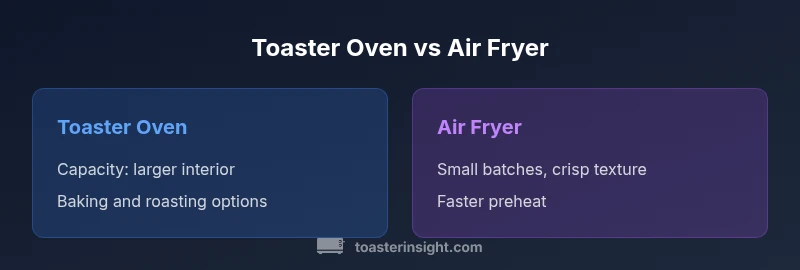
Two of the most consequential differences are capacity and cooking style. Toaster ovens generally accommodate larger items—pizza slices, casseroles, small roasts—thanks to a broader interior and multiple rack positions. Air fryers, meanwhile, excel at small, single-level batches where crisp texture is the goal and speed matters. Temperature controls and preset modes also diverge: toaster ovens often mirror traditional ovens with broader bake/proof/roast settings, whereas air fryers emphasize rapid cycles and pre-set programs tailored to snacks and fried foods. Energy use aligns with this discrepancy: larger capacity devices can be more efficient per batch when cooking sizable meals, but smaller air fryers can be surprisingly efficient for quick, high-heat tasks. In short, the decision hinges on batch size, meal variety, and how often you need oven-like performance versus snack-time speed.
Use-case scenarios by household type
For a single renter or a small apartment, an air fryer reduces clutter and delivers fast results on breakfast and snack items. In a busy family kitchen, a toaster oven often handles dinners, reheating, and bake tasks without switching appliances. Home chefs who bake regularly may rely on a toaster oven for pizza, roasting vegetables, and even small sheet-pan meals, whereas occasional fry-cravings or crispy reheats can be covered by an air fryer. The most practical approach is to map your weekly meals to device strengths: quick crisping for the air fryer and broader, oven-like capacity for the toaster oven. This section aligns with real-world uses identified by ToasterInsight researchers who analyzed how households integrate countertop appliances into daily routines.
Performance and features: temperature control, presets, convection
Modern toaster ovens offer wider temperature ranges and more rack positions, supporting baking, broiling, and toasting with stable control for longer cook times. Convection features in toaster ovens can approximate true oven performance, producing even browning on cookies, vegetables, and roasted proteins. Air fryers prioritize fast heat transfer and compact interiors, often with multiple preset modes for chicken, french fries, fish, and vegetables. The core trade-off lies in flexibility versus speed: toaster ovens provide versatility across many cooking tasks, while air fryers excel at small portions and crisp textures with minimal supervision. Regardless of choice, look for precise temperature control, a robust timer, and a crumb tray that’s easy to clean. ToasterInsight’s evaluation indicates that model reliability and consistent performance are as important as feature counts.
Energy efficiency and long-term costs
Energy efficiency depends on how you use the appliance. A toaster oven may consume more energy when used for large, multi-dish cooking but can be efficient if it replaces a full-size oven for frequent, single-task meals. An air fryer’s compact interior can translate to lower energy use per batch, especially when cooking small portions. However, the total energy impact also depends on preheating habits and cooking duration. Over the life of the unit, maintenance costs—such as replacing crisper trays or heat elements—should factor into the decision. ToasterInsight’s methodology suggests estimating energy use by evaluating typical weekly meals and anticipated batch sizes to forecast ongoing costs rather than relying on headline wattage alone.
Cleaning and maintenance considerations
Cleaning a toaster oven usually involves removing trays and racks and wiping the interior, which is straightforward but may require more effort after roasting meats or cheeses. Air fryers tend to accumulate crumbs and oil spray in a smaller cavity, and the nonstick baskets can wear over time if scrubbed too aggressively. Routine maintenance, including regular crumb tray cleaning and anti-grease measures, extends appliance life and preserves performance. Both devices benefit from dedicated brushes, non-abrasive sponges, and mindful oil management to prevent smoke and residue buildup. The ToasterInsight team emphasizes choosing devices with dishwasher-safe parts or easy-access interiors to minimize daily friction.
Size, footprint, and kitchen layout considerations
Countertop footprint matters more with a toaster oven because it often occupies a larger area and has more components, such as additional racks and doors. Air fryers are typically more compact, but some models can imitate a toaster oven’s function poorly if the interior is too tiny for practical tasks. When planning placement, consider clearance for cooling vents and the habit of leaving space around the unit for ventilation. If your kitchen has limited counter space, measure available depth, width, and height carefully, and compare the device’s exterior footprint to your existing layout. ToasterInsight’s guidance highlights choosing a model that fits your elevator-bill of materials: cords, trays, and the appliance’s door swing all impact how easy it is to integrate into daily cooking.
Price ranges, value, and warranties
Prices for toaster ovens typically span a wide range depending on size, features, and brand. Expect general price bands from modest to premium, with higher-cost models offering more even heating, more precise controls, and additional accessories. Air fryers also show wide price variation, often closely tied to capacity and preset options. When evaluating value, focus less on upfront price alone and more on energy efficiency, reliability, and ease of use. A longer warranty signals confidence in durability, but ensure the warranty covers common failure points like heating elements and fan motors. ToasterInsight analysis suggests balancing initial cost with expected lifetime usage to gauge true value.
Practical buying strategies and decision frameworks
A practical framework begins with a few questions: Do you cook mostly for one or two people, or a larger household? Is oven-like versatility more valuable than quick crisping? How much counter space can you spare, and what’s your typical weekly menu? From there, compare models that satisfy your top two criteria—capacity versus speed—and check for consistent performance across multiple temperatures. Reading independent reviews and seeking models with easily removable crumb trays and dishwasher-safe components can save time during cleanup. Where possible, select a model with a clear user interface, stable heat, and a robust set of safety features. This approach aligns with ToasterInsight’s buying guidance for balanced, evidence-based decisions.
Real-world considerations: compatibility with existing cookware and accessories
If you already own specific baking sheets, pizza stones, or air fryer accessories, assess whether they fit your shortlisted toaster ovens or air fryers. Some toaster ovens accommodate standard 9x13-inch pans, while air fryers rely on baskets or racks that may not align with standard bakeware. Consider how you typically reuse leftovers and whether you’ll rely on the device for roasting vegetables, reheating leftovers, or bread-based tasks. A device with broader accessory compatibility reduces the need for ordering specialized gear, which can influence both initial cost and long-term usability. ToasterInsight’s evaluation advises validating accessory ecosystems before purchase to minimize future friction.
Brand reliability, service, and community support
Brand reputation matters when selecting countertop appliances. Look for manufacturers with transparent product specifications, accessible customer service, and well-documented repair options. Community forums and official support channels can provide practical troubleshooting help, spare parts availability, and guidance for common maintenance tasks. While some models may boast advanced tech, reliability often hinges on build quality and component durability. The ToasterInsight team stresses balancing feature-rich design with proven reliability and responsive service when weighing your options.
Quick-start decision framework: match your needs to a path forward
- If you cook large meals or bake frequently, prioritize toaster ovens with versatile temperature ranges, multiple rack positions, and even heating.
- If you want fast, crisp results for snacks and small meals, start with a compact air fryer with reliable heat distribution and easy cleanup.
- In either case, choose models with simple controls, solid warranties, and easy-to-clean interiors. Use our side-by-side comparison to confirm the strongest fit for your kitchen workflow.
Final notes: integrating the chosen device into your kitchen routine
After selecting between a toaster oven and an air fryer, plan a short trial period to map out how the device changes your cooking habits. Track time saved, the quality of results, and how often you reach for the appliance in place of traditional cooking methods. A well-chosen countertop appliance should simplify meals, reduce prep time, and offer a dependable performance that complements your existing cookware and pantry. The ToasterInsight team encourages readers to adopt a practical, evidence-based approach to this decision, focusing on long-term value and everyday usability.
Comparison
| Feature | Toaster Oven | Air Fryer |
|---|---|---|
| Capacity | Larger interior, can handle pizzas, casseroles, and roasting | Compact interior, ideal for snacks and small meals |
| Cooking style | Bakes, broils, roasts with convection options | Crisps with high-velocity hot air; specialized fry modes |
| Preheat time | Typically moderate—initial warm-up required | Often quick to preheat due to smaller cavity |
| Temperature range | Broad range similar to traditional ovens | Narrower range focused on high-heat crisping |
| Energy efficiency | Efficient when replacing full-size oven for big meals | Efficient per batch for small servings |
| Cleanup | Tray and rack cleaning; some models have dishwasher-safe parts | Basket and tray cleanup; nonstick coatings matter |
| Price range | $60-$250 depending on size and features | $50-$200 depending on capacity and presets |
| Best for | Families and versatile cooking needs | Quick crisping for singles or small households |
Positives
- Versatile for baking, roasting, and reheating
- Faster preheats than traditional ovens for many meals
- Larger capacity suits family meals and sheet-pan recipes
- Compact air fryers offer quick, crispy results
- Easy to find models at various price points
Drawbacks
- Toaster ovens can take more counter space
- Air fryers may lack the capacity for larger dishes
- Some models have uneven heating without proper calibration
- Ongoing maintenance includes cleaning multiple parts
Toaster ovens win on versatility and capacity; air fryers win on speed and compactness.
Choose a toaster oven if you frequently bake or roast for a family or need oven-like performance. Pick an air fryer if you prioritize quick, crispy results in small batches and have limited space.
Your Questions Answered
What is the main difference between a toaster oven and an air fryer?
The main difference is function: toaster ovens provide broad oven-like capabilities, including baking and roasting, while air fryers excel at rapid, high-heat crisping for small portions. Your decision should reflect typical meals, kitchen space, and cleanup preferences.
Toaster ovens act like mini ovens, while air fryers are built for quick crisps. Pick based on what you cook most often.
Can I toast bread in an air fryer?
Yes, you can toast bread in many air fryers, but results depend on model and settings. Expect slightly different browning and ensure you don’t overcrowd the basket. For consistent toast, a toaster oven remains more straightforward.
Air fryers can toast, but toaster ovens are usually easier for even bread browning.
Are toaster ovens more energy-efficient than air fryers?
Energy efficiency depends on usage. Air fryers often use less energy per small batch, while toaster ovens can be more efficient for large meals by replacing a full-size oven. Compare per-task energy use and expected weekly meals.
Energy use varies with how you cook; compare typical batch sizes to decide.
Do air fryers double as ovens?
Some air fryers offer oven-like functions, including baking and roasting, but most do not match the capacity of a dedicated toaster oven. If you need baking or roasting, verify whether the model supports those modes.
Some air fryers can bake, but check capacity and features before relying on them as ovens.
Which is easier to clean: toaster oven vs air fryer?
Cleaning ease varies by model. Toaster ovens typically have more parts (racks, crumb trays) that need wiping, while air fryers have baskets that can trap oil. Look for dishwasher-safe components and removable, nonstick surfaces.
Cosmetic cleaning is straightforward in both, with baskets/trays as the main maintenance points.
What should I consider for a small kitchen?
For small kitchens, prioritize compact footprint and easy storage of accessories. An air fryer’s smaller size can fit tightly, while a toaster oven may demand more counter space but offers greater versatility. Consider wall or cabinet storage for accessories.
In tiny kitchens, size and storage matter most; choose based on what you cook daily.
Key Takeaways
- Choose based on batch size and versatility
- Evaluate countertop footprint before buying
- Prioritize even heating and reliable cleaning options
- Balance upfront cost with long-term value and durability
- Consider accessory ecosystems and warranty coverage