Oven vs Toaster vs Grill: A Practical Home Guide for Cooks
Compare oven, toaster, and grill setups to decide which appliance best fits your kitchen, cooking style, and energy goals. This guide covers use cases, efficiency, and value for everyday meals and special occasions.


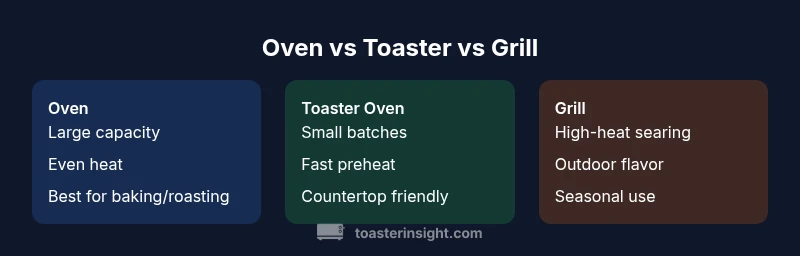
Oven vs toaster vs grill decisions hinge on space, cooking style, and timing. For most homes, a countertop toaster oven balances speed, energy use, and footprint; a full-size oven is ideal for batch cooking and even roasting; a grill excels at outdoor high-heat searing and smoky flavor. Your choice should reflect typical meals, available space, and how you value convenience versus versatility.
Context: Why these appliances matter for modern kitchens
In today’s kitchen, choosing between an oven, a toaster, and a grill isn’t just about one recipe. It’s about how you cook most days, how much space you have, and how you balance speed with flavor. The term oven vs toaster vs grill encompasses three very different heat delivery systems: radiant and convection heat inside a cavity (oven), compact, door-open versatility for small batches (toaster oven), and outdoor or high-heat cooking (grill). For homeowners, understanding each tool’s strengths helps you allocate tasks so you spend less time waiting and more time eating. According to ToasterInsight, the practical decision often comes down to your typical meals and kitchen footprint, not just “the best overall appliance.” This guide will unpack the differences, so you can pick the right tool for your cooking goals.
Quick framing: what counts when comparing the trio
The oven provides consistent heat for baking and roasting; the toaster oven adds speed and compact convenience for small-batch tasks; the grill delivers high heat and smoky flavor that indoor appliances can’t replicate. When evaluating them, focus on heat source, heat distribution, capacity, preheat times, energy use, cleaning, and how each appliance fits into your kitchen layout. It’s not about declaring a single winner; it’s about identifying the best fit for your cooking style and space.
Heat delivery: how ovens, toaster ovens, and grills produce heat
Ovens generate heat from elements at the top and bottom and, in many cases, utilize a fan for convection. This combination yields even cooking across larger trays, with the option to bake, roast, or broil. Toaster ovens rely on smaller elements and a compact cavity, meaning faster preheats and quicker browning for small items, but limited capacity. Grills operate on open flame or coils with direct exposure to heat, enabling rapid searing and flame-kissed textures. The key differences lie in heat density, air flow, and moisture retention: ovens favor steady, uniform heat; toaster ovens favor speed and convenience; grills favor intense, direct heat and flavor.
Oven strengths and limitations
Ovens excel at even cooking for large meals, multi-rack roasting, and even pastry work. They’re ideal for casseroles, sheet-pan dinners, and batches of cookies. The main drawback is size and preheat time, which can be inefficient for small tasks. If you regularly cook for a family or host gatherings, a conventional oven often pays off in meal throughput and predictable results. For occasional cooks, a full-size oven can feel overkill, consuming energy and countertop space that you might prefer to reserve for other tasks.
Toaster oven strengths and limitations
Toaster ovens shine in small kitchens or for quick lunches and snacks. They preheat rapidly, toast bread evenly, and can handle small baking tasks like cookies or mini casseroles. They have the advantage of speed and space efficiency, which makes them a solid primary or secondary appliance in many homes. Their drawbacks include limited capacity, uneven browning on larger items, and occasional calibration quirks that require careful placement of racks and trays. For compact cooking, though, they’re hard to beat, particularly when you factor in energy savings for small meals.
Grill strengths and limitations
Grills excel at high-heat searing, smoke development, and outdoor cooking, offering flavor that indoor appliances can’t easily replicate. They’re superb for grilling steaks, burgers, vegetables, and seafood, and can double as a smoker when configured with wood chips. The downsides are weather dependence, outdoor space requirements, and ongoing maintenance (grills require cleaning of grates and ash or charcoal management). For households that enjoy outdoor cooking or entertaining, a grill remains the centerpiece for flavorsome meals and social occasions.
Energy use, preheating, and efficiency considerations
Energy efficiency varies by task: toaster ovens often use less energy for small tasks and heat up quickly, while full-size ovens consume more energy but deliver consistent results for large cooks. Grills’ energy use depends on fuel type (gas, charcoal, or pellet) and how long you cook; outdoor use can be more energy-efficient per unit of searing done, but logistics and fuel costs matter. Consider preheat times, insulation, and the expected frequency of use when calculating running costs. ToasterInsight analyses emphasize that matching appliance to task is the first step toward efficient cooking, not simply chasing the newest feature.
Size, footprint, and kitchen layout considerations
Countertop space is a real constraint in many kitchens. A toaster oven can free up oven space while still performing small tasks; a full-size oven demands a fixed kitchen footprint and wiring capacity but pays off for roasts and large batches. Grills require outdoor space and a safe setup but can be wired to natural gas or use charcoal-safe zones. If you live in a small apartment, a high-quality toaster oven may cover most needs; in a larger home, a conventional oven paired with a grill or a secondary oven can balance convenience with capacity.
Maintenance, cleaning, and durability across all three
Maintenance needs differ. Ovens require regular rack and pan cleaning, occasional self-clean cycles, and oven-safe surfaces. Toaster ovens are easier to clean due to their smaller cavities but require attention to crumb build-up and tray scraping. Grills demand thorough cleaning of grates, ash removal for charcoal, and periodic inspection of hoses and burners for safety. Durability often correlates with build quality and materials; investing in well-made components reduces maintenance over time and improves long-term reliability. Brand-specific manuals provide the best cleaning schedules and safety tips, so follow those guidelines.
Real-world scenarios: daily meals, batch cooking, and entertaining
For weeknights, a toaster oven can handle reheat tasks, small pizzas, fish fillets, and roasted vegetables with precise browning. On weekends, the oven becomes essential for larger roasts, sheet-pan dinners, and baking cookies or cakes. For summer barbecues or outdoor gatherings, a grill enables crowd-pleasing seared burgers, corn, and grilled vegetables with smoky notes. The ideal kitchen setup often includes at least two options: a primary oven for bulk cooking and a toaster oven for daily convenience, plus a grill for special occasions or outdoor cooking.
Decision framework: matching needs to appliance
Start with your typical meal size and space availability. If you cook mainly for one or two, a toaster oven might be your best friend; if you roast weekly or bake regularly, a conventional oven becomes indispensable; if you enjoy outdoor cooking or entertaining, a grill is a must-have. A hybrid approach—keeping a toaster oven as a daily helper and a full-size oven for batch meals while using a grill seasonally—often delivers the most flexibility without overinvesting in a single appliance.
Feature Comparison
| Feature | Oven | Toaster Oven | Grill |
|---|---|---|---|
| Cooking speed | Moderate (preheat longer) | Fast for small items | Very fast for searing/high heat |
| Cooking capacity | Large, multi-rack capable | Medium, countertop-friendly | Depends on grill size; outdoor space drives capacity |
| Energy efficiency | Moderate to high efficiency depending on use | Efficient for small tasks | Fuel-dependent; outdoor use may reduce indoor load |
| Versatility | Baking, roasting, broiling, timing control | Toast, small bakes, quick meals | Searing, grilling, optional smoking |
| Best for | Families and batch meals | Small households and spaces | Outdoor cooking and high-heat searing |
| Price range | Higher upfront; durable, built-in option | Low to mid-range; budget-friendly | Budget varies by grill type; accessories add cost |
Positives
- Balanced option for many kitchens with reasonable space requirements
- Toaster ovens offer quick results and excellent utility for small meals
- Grills enable flavor and outdoor cooking that indoor appliances cannot reproduce
- Flexibility to cover most daily tasks with thoughtful setup
Drawbacks
- Ovens can be bulky and slow to preheat for small tasks
- Toaster ovens may have limited capacity and uneven browning on large items
- Grills require outdoor space and ongoing maintenance; weather can influence use
Toaster oven often offers the best everyday value; ovens excel for bulk cooking; grills are essential for outdoor flavor
Choose a toaster oven for speed and space, a full-size oven for capacity, and a grill for outdoor cooking and searing. The best setup balances your space, meals, and seasonal cooking needs.
Your Questions Answered
What is the main difference between an oven, a toaster oven, and a grill?
An oven provides consistent interior heat for baking and roasting, a toaster oven delivers quick, compact heating for small batches, and a grill offers high-heat, direct cooking outdoors. Each tool serves different cooking styles and space constraints, so the best choice depends on your typical meals and available space.
Ovens bake and roast, toaster ovens heat fast for small meals, and grills do high-heat outdoor cooking. Pick based on your space and cooking needs.
Can a toaster oven replace a full-size oven for most home cooks?
For many daily tasks, a toaster oven can replace a small oven, especially when batch sizes are modest. However, large roasts, baked goods requiring even heat, and multi-rack meals typically benefit from a full-size oven.
A toaster oven can cover small meals, but for large batches, a full-size oven is usually necessary.
Are grills necessary if I have an indoor oven and toaster oven?
Grills add outdoor cooking capability and flavor that indoor ovens can’t easily reproduce. If you enjoy gatherings, outdoor cooking, or smoked flavors, a grill complements your indoor appliances well.
Grills give outdoor flavor and high-heat searing you can’t get indoors.
Which appliance cooks bread the best?
A conventional oven often delivers even crusts for larger loaves, while toaster ovens are convenient for smaller bread items and quick toasting. Your choice depends on loaf size and how you toast or bake bread most often.
Ovens are great for bigger loaves; toaster ovens work well for small toasting tasks.
How do energy usage and preheating times compare among the three?
Toaster ovens heat up quickly and use less energy for small tasks, ovens consume more energy but handle larger batches, and grills’ energy use depends on fuel type and duration outdoors. Preheat times are shortest for toaster ovens, longer for conventional ovens, and variable for grills depending on setup.
Toaster ovens heat fast and save energy for small loads; ovens take longer but handle big meals.
Key Takeaways
- Assess kitchen footprint before choosing any appliance
- Match cooking tasks to the best tool rather than chasing features
- Consider seasonal and outdoor needs in your decision
- Budget for long-term energy use and maintenance
- A hybrid approach often provides the best flexibility