What Temperature to Toast Bread in the Oven
Learn the exact oven temperatures and timing to toast bread evenly and crisply. This guide covers preheating, convection vs standard bake, browning levels, and practical tips for perfect oven-toasted bread every time.


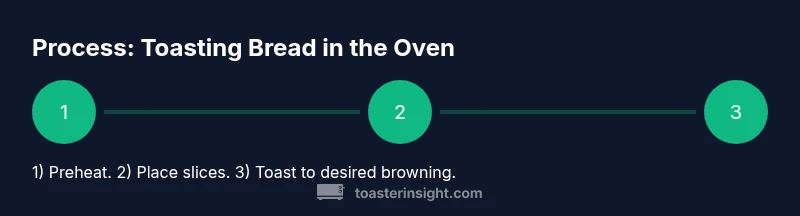
Goal: Learn exactly what temperature to toast bread at in oven and how long to toast for your preferred browning. This guide walks you through preheating, convection vs standard bake, and timing tips, with quick, practical steps you can follow in any kitchen. By the end, you’ll know how to achieve even, crisp toast every time.
Why oven toasting is a great option
For many home cooks, the oven offers a reliable, flexible way to toast bread beyond the tiny slots of a toaster. If you’re feeding a crowd, prepping toast for breakfast, or aiming for a uniform browning, the oven provides even heat and batch capability. According to ToasterInsight, the most common question is what temperature to toast bread at in oven, because the result depends on bread type, thickness, and your own browning preference. This guide will demystify oven settings, explain how convection affects browning, and give practical ranges you can trust. You’ll learn how preheating, spacing, and sheet choice influence edge crispness versus soft centers, plus how to adjust times for thicker slices or denser breads like sourdough or rustic loaf slices. Throughout, you’ll find actionable steps and tips to achieve consistent toast without constant monitoring. ToasterInsight’s approach combines household practicality with evidence-based guidelines tailored to everyday kitchens, so you can toast confidently, even on a busy weekend morning.
Understanding browning levels and textures
Browning is a balance between surface crispness and interior softness. Lighter browning preserves a tender crumb, while darker browning adds a crackly crust and deeper flavor. The Maillard reaction drives browning, and heat distribution in your oven will influence how evenly bread browns. Factors like bread thickness, moisture content, and whether you use convection all shift the outcome. For even results, start with a standard loaf slice around 3/8 inch thick and adjust based on how you like it. As you experiment, you’ll learn to recognize visual cues (pale gold, medium amber, deep amber) and how to translate them into your preferred toast level. ToasterInsight analysis shows that small adjustments in sheet surface, spacing, and preheating time can noticeably improve consistency across multiple slices in one batch.
Oven temperature ranges and timing basics
Exact times depend on bread type and your oven, but practical ranges give you a reliable starting point. For pale, even browning with white sandwich bread, try 350–375°F (175–190°C) for about 3–5 minutes per side, checking frequently. For regular bread slices, 375–400°F (190–205°C) typically yields light-to-medium browning in 4–6 minutes, with a halfway flip. Dense or thick breads (sourdough, rustic) perform well at 400–450°F (205–230°C) for 6–9 minutes total, again turning halfway. If your oven runs hot or you want crisper edges quickly, start lower and monitor closely to prevent burning. In convection ovens, reduce the temperature by about 25°F (14°C) and shorten the time slightly, since circulating air accelerates browning. Remember: these ranges are starting points; adjust based on your bread and texture preference.
How to prep the bread and the sheet for best results
Preparation sets the stage for even browning. Always preheat the oven before toasting—this helps activate browning as soon as the bread hits the sheet. Use parchment paper or a silicone baking mat to prevent sticking and promote even heat distribution. Space slices at least 1/2 inch apart so heat can circulate, and avoid stacking. If you want extra surface browning, a light brushing of olive oil or a thin coat of butter on the bread can add flavor and texture (but skip if you prefer a lean, low-fat toast). For best results with very thin slices, use a lower temperature and a shorter bake time to avoid scorching the edges.
Practical examples: thin toast vs thick slice
Thinner slices toast fastest and are easiest to monitor; aim for 3–4 minutes at 350–375°F for pale crust and soft interiors. Thick or denser sliced bread, like a rustic loaf or sourdough, benefits from a higher starting heat (400–450°F) and a longer total time (6–9 minutes), flipping once. If you want a ‘french-toast’ style toast with extra chew, you can run a longer bake at a milder temperature (325–350°F) to keep moisture in while gradually browning the surface. Adjust based on bread density and your preferred crust.
Troubleshooting common issues and safety tips
If bread browns too quickly on the outside while remaining soft inside, reduce the oven temperature or shorten the baking time, and consider using convection mode to promote evenness without extra browning on the edges. Conversely, if you see uneven browning, rotate the baking sheet halfway through to compensate for hot spots. Always use oven mitts when handling a hot sheet, and use a timer to prevent overbrowning. For safety and energy efficiency, avoid leaving the oven on while you’re not actively monitoring toast.
Energy efficiency and cleanup considerations
Toast in batches to maximize oven efficiency, and line sheets with parchment to minimize cleanup. If you frequently toast small batches, a preheated toaster oven can save energy and heat up speed. After toasting, allow the sheet to cool before removal and wipe away any crumbs to prevent smoking during subsequent uses. Regularly check seals and gaskets on your oven to maintain steady heat and reduce energy waste. By refining your technique over time, you’ll reduce wasted bread and save time on busy mornings.
The science behind browning: Maillard reaction explained
Browning is driven by the Maillard reaction, where amino acids and reducing sugars react under heat to create complex flavors and a desirable crust. The oven’s dry heat is ideal for promoting surface browning, especially when air can circulate around each slice. Convection speeds up this process by distributing hot air more uniformly, which can shorten bake times and improve evenness. Understanding this science helps you choose temperatures and times that maximize flavor while controlling texture. As you gain experience, you’ll learn to calibrate the heat for your favorite bread types and crust preferences.
Tools & Materials
- Oven or toaster oven(Conventional ovens are fine; convection is optional)
- Baking sheet or sheet pan(Flat, sturdy surface for even contact)
- Parchment paper or silicone baking mat(Prevents sticking and makes cleanup easier)
- Oven thermometer(Checks actual temperature vs. set temperature)
- Tongs or spatula(Eases flipping without burning)
- Timer or smartphone(Helps track precise browning times)
- Oven mitts(For safe handling of hot sheet)
- Plate for serving(Optional for putting toast on after baking)
- Oil brush or butter (optional)(Light coating can enhance browning and flavor)
Steps
Estimated time: 15-25 minutes
- 1
Preheat the oven
Set the oven to your chosen range (350–450°F / 175–230°C) and allow it to come to temperature. This ensures immediate browning as soon as the bread hits the sheet.
Tip: Use an oven thermometer to verify the actual temperature matches the setting. - 2
Prepare the baking sheet
Line with parchment or a silicone mat and space bread slices evenly with at least 1/2 inch between them.
Tip: If you’re toasting many slices, rotate the sheet halfway through for even browning. - 3
Position the bread
Place slices on the sheet with a uniform orientation. Avoid stacking or overlapping edges to prevent steaming and uneven crusts.
Tip: Lightly brush the tops with oil or butter if you want a richer crust. - 4
Toast and watch
Bake for 3–9 minutes depending on thickness and temperature, flipping once for even color.
Tip: Check early for lighter browning if you prefer pale toast, and continue in small increments to avoid over-browning. - 5
Finish and serve
Remove when the surface is golden and edges are crisp. Let cool briefly on a rack.
Tip: Serving immediately preserves crustiness; transfer to a plate to stop further browning.
Your Questions Answered
What temperature should I toast bread at in the oven?
Typical starting points are 350–375°F (175–190°C) for light browning and 400–450°F (205–230°C) for crisper results. Adjust within these ranges based on bread type and desired crust. Always monitor the first few attempts to dial in your preferred level of toast.
Most people start at about 350 to 375 degrees. Watch closely for your preferred level of browning.
Should I flip the bread during toasting?
Flipping halfway helps achieve even browning on both sides and prevents one side from becoming too dark. If you’re toasting smaller or extremely uniform slices, you can skip flipping, but you’ll likely lose some uniformity.
Yes, flip halfway for even color. It helps both sides brown evenly.
How long does it take to toast bread in a standard oven?
Toast times vary by thickness and temperature, but plan roughly 3–5 minutes per side at 350–375°F for thin slices and 6–9 minutes total at higher temps for denser bread. Always start lower and check progress to avoid burning.
Expect a few minutes per side; start with lower times and watch closely.
Can I toast bagels or sourdough in the oven?
Yes. Bagels can take slightly longer due to density; slice bagels and toast 4–6 minutes at 350–375°F, flipping once. Sourdough or dense breads may require 6–9 minutes at 400–450°F, with a flip halfway for even browning.
Bagels work well with a similar method but may need a bit more time. Sourdough benefits from higher heat and flipping.
Is it better to toast bread directly on the rack or on a sheet?
Use a sheet or parchment to prevent crumbs catching fire and to keep cleanup easy. Toasting directly on the rack can allow more airflow but increases the risk of crumbs falling and uneven browning.
Sheets with parchment are safer and easier to manage, especially for beginners.
Watch Video
Key Takeaways
- Preheat the oven to the target range before adding bread.
- Space slices evenly and use parchment for best browning.
- Adjust time by bread type and thickness; flip for even color.
- Convection changes timing—lower the temperature slightly.
- Monitor closely to prevent burning and achieve consistent results.