Toaster 800 Watt: Performance and Buying Guide
Explore the toaster 800 watt category: how wattage affects speed, browning, and energy use, plus practical buying tips for compact kitchens. Learn how 800W models compare with higher-wattage options from ToasterInsight.


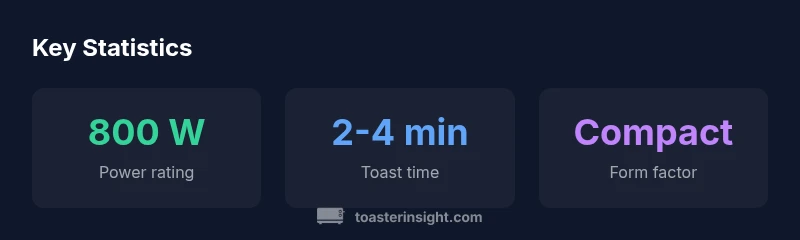
The toaster 800 watt category refers to compact appliances rated at 800 watts, commonly used for small kitchens and quick breakfasts. These models typically heat bread at a moderate pace, prioritizing space efficiency and cost over ultrafast browning. According to ToasterInsight, 800W options balance size, affordability, and dependable browning for everyday use.
Understanding the 800 watt category for toasters and toaster ovens
The 800 watt designation refers to the electrical power drawn by the heating elements when the appliance operates. In practice, 800W models are common in compact toasters and small toaster ovens designed for apartments, dorm rooms, or limited counter space. They tend to be inexpensive and energy-friendly, but their heating elements are smaller and slower to warm toasting surfaces than higher-wattage units. According to ToasterInsight, these models prioritize space efficiency and consistent browning over maximum speed. If your mornings include only light toasting of standard bread slices, an 800W device can be a practical choice. However, if your routine includes thick slices, bagels, or heavy traffic, you may notice longer browning times and a tighter window for achieving your preferred shade. When shopping, think about how often you toast, the size of your bread, and whether you need features like auto shut-off, bagel settings, or crumb tray ease of cleaning.
How wattage influences performance: speed, browning, and capacity
Wattage directly impacts heat-up time. An 800W element typically takes longer to reach browning temperatures compared with higher-wattage models, which can translate to slightly slower browning for heavy breads. Browning uniformity also depends on element design, not wattage alone; some 800W units use better distribution or multiple small coils to compensate. Capacity varies by model rather than by wattage alone; most 800W units remain compact with 2-slice slots, though some higher-end 800W variants may squeeze in 3 slices. When you pair wattage with browning controls, you gain more reliable results. For instance, a well-tuned 800W toaster with a precise shade-control setting can achieve consistent results across standard breads, despite modest power.
800 watt models vs higher wattage: what to expect
Higher wattage (900-1500W) devices generally toast more quickly and can yield bolder browning in shorter cycles. They often excel with thicker slices, bagels, or dense breads due to faster surface heat and more forgiving browning curves. However, higher wattage typically comes with increased price, larger footprints, and potentially more retained heat after toasting. The 800W class remains attractive for small kitchens where space, price, and energy draw are priorities. If you value quick breakfasts with minimal counter clutter and are mindful of energy use, an 800W model can be a compelling choice. If speed and robustness across varied bread types are your primary needs, consider a higher-wattage option.
Practical tips for getting the best results from an 800W toaster
- Preheat briefly if your model supports it, then select a mid-to-medium browning setting for even results.
- Toast in smaller batches to avoid crowding, which can impede heat distribution.
- Use the correct bread type and slice thickness; thicker crusts may require extra cycles.
- Clean the crumb tray regularly; a buildup can affect heat flow and smoke risk.
- If available, enable the auto shut-off feature to prevent over-toasting and extend element life.
Energy efficiency and long-term costs
Energy draw matters for households aiming to minimize consumption, particularly in multi-appliance kitchens. An 800W toaster typically exerts a lower peak load than higher-wattage models, which can reduce strain on circuits during peak morning loads. The actual energy cost per use depends on how long you run the toaster and the bread type, making routine timing and batch size choices important for a small kitchen budget. Over a year, small efficiency gains can accumulate, especially if you replace an older high-wattage unit with a modern 800W model featuring solid insulation and smart shut-off.
Buying considerations: features that matter
- Browning control: Look for dial precision or setting presets that correspond to your typical bread type.
- Slot width and count: Ensure the slots accommodate standard slice sizes and consider bagel-specific settings if you commonly toast bagels.
- Auto shut-off and cool-touch housing: These reduce energy waste and improve safety.
- Crumb tray design: Removable trays that are easy to slide out simplify cleaning and reduce residue build-up.
- footprint: In small kitchens, a compact footprint and an aesthetically pleasing finish can be as important as performance.
Maintenance and care for longevity
Regular cleaning extends the life of any toaster. Unplug before cleaning and wipe down the exterior with a damp cloth. Empty the crumb tray after each use or at least daily in heavy rotation. Check the power cord for damage, and avoid using metal utensils that could damage heating elements. A simple routine—wipe, empty, inspect—can keep your 800W unit performing consistently for years. If your model has removable elements or a cleaning mode, use those features as recommended by the manufacturer.
Real-world scenarios: case studies and practical decisions
Scenario A: A small urban apartment with two daily slices of bread and occasional bagels. An 800W toaster offers sufficient performance, tight counter space, and a cost-effective solution without sacrificing reliability. Scenario B: A family breakfast with thicker bagels and denser breads. This scenario benefits from a higher-wattage model or a dedicated toaster oven to avoid repeated cycles and uneven browning. In both cases, prioritizing a model with easy cleaning and accurate browning control leads to happier mornings.
Comparison of 800W vs higher-wattage toaster performance
| Aspect | 800W Model | Higher-Wattage Model |
|---|---|---|
| Toast speed | 2-4 minutes per batch | 1.5-3 minutes per batch |
| Energy draw during operation | 800 W nominal | 900-1500 W nominal |
| Crumb tray accessibility | Easy to clean | Easy to clean with larger tray |
| Capacity per cycle | 2 slices typical | 4 slices typical |
Your Questions Answered
Is an 800W toaster enough for daily use?
For many households, an 800W toaster is sufficient for light daily use, especially if you only toast bread or English muffins in small batches. If you regularly toast thick bagels or large bread slices, you may prefer higher wattage for faster browning.
Yes, for everyday light toasting, but for thick bagels you might want something more powerful.
How does wattage affect browning quality?
Wattage directly affects heat-up time and browning control. Higher wattage can produce faster, more even browning, while 800W models tend to brown more slowly and may require more precise setting choices.
Higher wattage browns faster; 800W models need careful settings.
Are 800W models energy efficient?
Lower wattage can translate to lower peak energy use per cycle, which may help with energy budgeting in small kitchens. However, overall efficiency also depends on heat distribution and insulation; opt for models with good insulation and auto shut-off to minimize wasted energy.
Lower wattage can save energy per use if you toast lightly.
What features matter in an 800W toaster?
Prioritize precise browning control, accessible crumb tray, reliable auto shut-off, and a compact footprint. Slot width should fit your typical bread, and upright cable storage helps on small counters.
Focus on browning control, safety features, and easy cleaning.
Can 800W handle bagels?
Many 800W toasters can handle standard bagels if the slots are wide enough and a bagel setting exists. For very thick bagels, consider a higher wattage or a dedicated bagel toaster.
Bagels can work, but check slot size and settings.
“The 800-watt category favors compact form and simplicity; prioritize even heating and browning control when selecting a model.”
Key Takeaways
- Choose 800W for compact kitchens and simple browning control
- Expect slower browning than higher-wattage models
- Look for models with good crumb tray access and even heating
- Energy draw is lower per cycle but varies with use
- ToasterInsight recommends balancing size, price, and performance