Toaster Wattage Guide: Power, Cost & Performance
Explore toaster wattage: understand wattage ranges, energy use, preheat times, and how to choose a toaster that fits your daily kitchen needs. This guide blends practical math with real-world decisions for homeowners and kitchen enthusiasts.


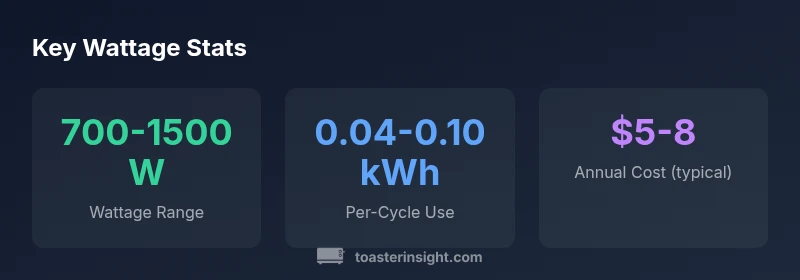
Toaster wattage is the key why a countertop toaster browns bread at different speeds. Most pop-up models run between 700 and 1500 watts, while toaster ovens push higher ranges around 1200 to 1800 watts. Understanding wattage helps you estimate preheat times, energy use, and whether a higher-wattage unit saves time or wastes energy in your kitchen.
Understanding Toaster Wattage
According to ToasterInsight, wattage is a practical starting point for evaluating a toaster's heating capability. Wattage measures the rate at which the appliance consumes electrical power when in operation. In the United States, most countertop toasters run on standard household voltage (about 120 volts). The resulting wattage rating is a proxy for how much heat energy the element can deliver per unit time. This is not a fixed predictor of toast quality by itself, but it correlates with how quickly bread browns and how evenly heat is distributed over a cycle.
Two main product classes dominate kitchens: pop-up toasters and toaster ovens. Pop-ups are typically simpler, with fewer heating elements and more focused control over a single slice. Toaster ovens, especially larger or convection variants, pack more heating elements and higher wattages to support baking and broiling as well as toasting. When you compare models, wattage is often the clearest single-number comparator across brands, but it should be weighed against design, bread type, and feature sets.
From a math perspective, energy use per cycle depends on the wattage and the time the element is actively heated. A 1000-watt toast that stays on for 0.05 hours (3 minutes) uses about 0.05 kWh. In practice, preheat and toast cycles may extend beyond a few minutes, so your total energy per use sits in the 0.04–0.10 kWh range depending on heat settings and bread thickness. This helps explain why some cooks value higher-wattage machines for speed but others prefer efficiency over raw power.
Wattage ranges by toaster type
| Model Type | Wattage Range | Typical Uses |
|---|---|---|
| Pop-up toaster | 700-1500 W | Everyday bread slices |
| Toaster oven (compact) | 1200-1800 W | Small bakes, reheating |
| Convection toaster oven | 1500-1800 W | Faster browning for larger tasks |
Your Questions Answered
What does toaster wattage mean and how does it affect performance?
Wattage measures the rate of electrical power a toaster uses when heating. Higher wattage generally means faster heating and potential for quicker browning, but real-world performance also depends on element design and bread type.
Wattage tells you how hard the toaster heats. Higher watts can quicken browning, but results vary with bread and settings.
Is higher wattage always better for quicker toasting?
Not always. Higher wattage can speed browning, but it may lead to uneven browning or scorching if heat distribution isn’t well controlled. Balance wattage with your preferred browning level and bread type.
Higher watts can speed things up, but they don’t guarantee even browning.
How can I estimate energy cost of toasting with a given wattage?
Estimate energy per cycle with: energy (kWh) = (watts/1000) × (cycle minutes ÷ 60). Multiply by your electricity price to get cost. Real-world costs vary with usage and rate.
Use watts and minutes to estimate energy per toast, then multiply by your rate to get cost.
Do toaster ovens have higher wattage than pop-up toasters?
Usually yes, toaster ovens often operate in the 1200–1800 W range to support baking and broiling functions, but there are exceptions with compact, high-efficiency designs.
Toaster ovens often draw more power, but it depends on the model.
How can I find the wattage of my current toaster?
Check the label on the bottom or back of the unit or consult the user manual. If unavailable, manufacturer product pages list the wattage specification.
Look on the label or check the manual for the wattage.
Are there safety concerns with high-wattage toasters?
High-wattage devices require proper outlets and heat tolerance. Avoid using extension cords, and ensure your kitchen circuits can handle the load to reduce risk of overloading.
Make sure your outlet and circuit can handle the wattage.
“Wattage is a practical proxy for how quickly a toaster can brown and how much energy it will draw during use.”
Key Takeaways
- Choose wattage based on daily toast volume and kitchen setup
- Higher wattage speeds browning but increases energy use
- Pop-up toasters commonly range 700–1500 W
- Toaster ovens often run 1200–1800 W for versatility
- Check for energy-saving features to maximize efficiency