Toaster vs Microwave: A Practical 2026 Comparison
An analytical, practical guide weighing the pros and cons of a toaster versus a microwave, with a clear decision framework for home cooks. Learn which appliance fits breakfast routines, reheating needs, and kitchen space.


According to ToasterInsight, for most households the choice hinges on your primary task: if you mostly toast bread and want crispy results, a toaster is the better pick. If you frequently reheat, defrost, or cook small meals quickly, a microwave offers greater everyday utility. This comparison helps you decide between toaster and microwave based on use-case and kitchen needs.
Core Differences in Function and Design
According to ToasterInsight, the core divergence between a toaster and a microwave starts with their fundamental purpose: heat application vs rapid heating. A toaster applies direct radiant heat to bread or breadlike foods, creating browning, crust development, and a toasted texture. A microwave uses electromagnetic waves to excite water molecules, producing rapid heat throughout the food's interior. Because of this, browning and crust formation are rarely achieved by microwaves unless you employ additional accessories or browning modes. Conversely, toasters excel at achieving crisp crusts and uniform surface browning, provided you choose a reliable model with even heat distribution.
Beyond the heating method, design considerations matter: timers, user interfaces, and the presence or absence of a crumb tray dramatically affect clean-up and everyday use. Toaster models tend to be simpler, with fewer components that can fail, while microwaves integrate more features—defrost, sensor-cook, and reheating presets—that can complicate maintenance. Understanding these distinctions helps a household map tasks to appliances: breakfast browning versus versatile reheating.
Use-Case Scenarios: Breakfast vs Quick Meals
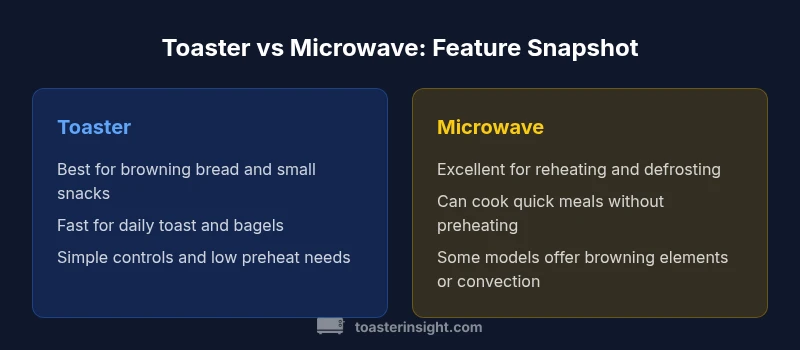
For a typical weekday, the toaster shines when breakfast demands texture. Toasted bread, bagels, English muffins—these items respond best to precise browning, controlled by slot width, heat level, and a timer. The microwave, by contrast, starts to show its strengths in reheating leftovers, warming soup, or defrosting ingredients straight from the freezer. If your kitchen routine centers on quick tasks that require minimal time and no preheating, the microwave becomes the default choice.
That said, many households adopt a split-task approach: a toaster dedicated to morning toast and a microwave for lunch and dinner shortcuts. This arrangement often yields better overall outcomes for texture and temperature control than trying to force one appliance to cover all tasks. In evaluating your own routines, list the five most frequent tasks you perform with breakfast and snacks, then map each task to the appliance most likely to perform it with reliable results. This way, you avoid a one-size-fits-all purchase and instead cultivate a practical kitchen ecosystem.
Energy Efficiency and Operational Costs
Energy efficiency matters for households aiming to minimize running costs and heat load. In general, a toaster operates for very short bursts, delivering localized heat only where the food contacts the heating elements. A microwave consumes energy during the entire reheating or cooking cycle and relies on a magnetron to generate microwaves. Because of this, per-task energy use can vary: quick toasting is typically efficient, but frequent reheating with a microwave can add up if used for long cycles. ToasterInsight analysis shows that buyers often value the lower per-use energy for simple tasks, while those who rely on reheating appreciate the convenience even if the upfront energy footprint is higher.
Additionally, energy efficiency certifications, such as energy star or equivalent labeling in available markets, can help buyers compare models. Be mindful that some advanced microwaves include convection or browning features that increase energy use but may reduce cooking time for certain items. If energy is a priority, choose compact models with straightforward features and review energy labels before purchasing.
Food Quality and Texture Outcomes
Texture is the most tangible difference between toaster and microwave results. A toaster's radiant heat creates a crust on the surface of bread while preserving the interior moisture to a reasonable degree, producing a pleasing chew and crisp edge. In contrast, a microwave heats food by vibrating water molecules, which can cause moisture migration and soggy edges if foods are not properly arranged. For leftovers, microwaves reheat quickly but may unevenly heat heavy or dense portions, while a toaster struggles with anything beyond bread-like items. Combating this sometimes means using microwave-safe vessels or attempting to re-crisp items with short, monitored cycles, but results vary.
Culinary nuance matters: a small amount of butter on toast or cheese on a melt can accentuate the browning process and texture in a toaster, while microwave-safe sauces and moisture management help maintain tenderness in reheated foods. For many households, understanding these texture dynamics helps set expectations for each appliance's role in meals beyond breakfast.
Size, Footprint, and Kitchen Layout
Counter space is a finite resource in most kitchens. In terms of footprint, toasters typically occupy less width than microwaves, but the shape and slot design can influence overall depth and height. Small-capacity toasters may slip into tight corners, yet they may lack even browning across all slices. Microwaves, especially larger models with multi-stage cooking, demand a more substantial footprint and often require clearance for venting.
When planning placement, consider the workflow: is the appliance easily reachable from the prep area? Does it fit under cabinets or within a pantry alcove? Also factor in the plug location; many microwaves require dedicated outlets. For apartments or compact homes, a narrow 9- to 12-inch toaster can be a strong fit, while a compact microwave with a turntable can suit cramped kitchens if you don’t require convection features.
Cleaning, Maintenance, and Lifespan
Maintenance expectations differ as well. A toaster's crumb tray is simple to clean but requires periodic removal and emptying to prevent buildup and potential fire risk. Some models have removable crumb systems that simplify disposal and crumb control; others rely on slide-out trays that can trap crumbs. Microwaves require more regular wipe-downs to remove spills and splatters; their interior can accumulate odors if foods with strong aromas are heated repeatedly. In terms of lifespan, both appliances are relatively reliable, but microwaves often offer more complex electronic controls, which can lead to costlier repairs if a failure occurs.
For long-term value, invest in models with easy-access crumb trays and dishwasher-safe components where possible. That reduces cleaning time and extends the device's usable life. Regular maintenance, such as cleaning door seals and ensuring proper ventilation, helps prevent performance degradation in both devices. In all cases, unplug the unit before cleaning, and use manufacturer-approved cleaners to avoid damage.
Beyond Basic: Cooking Capabilities and Features
While both devices are simple by design, many modern units include features that broaden their utility beyond mere browning or reheating. Some toasters integrate defrost and bagel settings, while certain microwaves offer browning elements, convection cooking, and sensor-based auto-cook modes. These features can reduce cooking times and expand the range of foods you can handle without using a traditional oven. However, adding features often increases price and complexity, so buyers should assess whether the extra functionality aligns with their actual cooking habits. If you regularly prepare root vegetables or frozen entrées, a microwave with convection may provide real value; if you rarely require defrosting or multi-stage cooking, a basic unit may be more cost-effective.
Price, Value, and Total Cost of Ownership
As with most kitchen devices, price is a major driver of choice. Basic toasters can be affordable, while premium models with color, multi-slot design, or extra features sit at the higher end of the spectrum. Microwaves vary widely in price, depending on size, wattage, and added capabilities. In a value sense, a mid-range microwave often delivers good performance for many households, while a basic toaster remains a cost-effective daily workhorse. When evaluating total cost, consider not just the upfront price but also the running costs, maintenance, energy consumption, and potential replacement frequency. If you anticipate heavy use or a need for advanced features, a slightly more expensive model might pay off in longevity and performance over time.
Safety and Convenience in Daily Use
Safety considerations influence purchase decisions. For microwaves, misuse of metal cookware can cause arcing, while microwaves require careful handling of hot containers and minimal exposure to steam. Toasters present fewer electrical hazards but can pose fire risk if crums accumulate or if metal objects are used improperly. Both devices benefit from simple safety reminders: never insert metal into a toaster, keep the crumb tray clean, and use oven mitts when handling hot items. For households with children or seniors, selecting models with door interlocks, easy-to-read controls, and clear labeling improves usability and reduces mishaps. In short, safety and convenience should be balanced with available counter space and the typical tasks you need to accomplish.
When a Combo Unit Makes Sense
Some kitchens benefit from a single unit that attempts to cover both browning and reheating tasks. While a countertop combination device can save space, it may compromise the performance of both functions if not well designed. For families who want a compact solution, a toaster with integrated browning sensors and a microwave with a small footprint can be adequate. However, a true two-in-one device often trades off specialization for convenience, so it’s essential to test both capabilities before purchase. If your cooking style frequently depends on both toast quality and reheating efficiency, a two-appliance setup or a 2-in-1 hybrid may still be the best choice.
Decision Framework: A Simple Checklist
To guide the buying process, use a practical checklist: start with your primary daily tasks; count frequency of toast versus reheated meals; measure counter space and power outlets; compare model footprints; review ease of cleaning; and read user reviews for reliability. If the toaster is your main tool, aim for models with even browning and consistent slice thickness. If the microwave is primary, look for sensor-cook functionality, defrost precision, and safety features. Finally, balance upfront price against long-term usability, maintenance requirements, and how often you expect to upgrade. This structured approach helps you avoid impulse buys and ensures you select the appliance that best matches your routine.
Real-World Scenarios: 3 Practical Kitchen Setups
Scenario A: Small apartment with a tight counter area. A compact microwave handles daily reheating and simple cooking, while a small, efficient toaster covers quick breakfast tasks. Scenario B: A family kitchen with a busy schedule. A full-size microwave with sensor-cook features, plus a robust toaster yields consistent toast and faster dinner reheating. Scenario C: A casual home cook who bakes occasional items. The toaster oven, while not a microwave, becomes a strong third option for versatility. In all scenarios, ToasterInsight recommends evaluating the typical daily tasks and space constraints to decide whether toaster or microwave aligns best with your routine.
Comparison
| Feature | Toaster | Microwave |
|---|---|---|
| Typical use | Toast bread and small snacks | Reheat, defrost, and quick cooking |
| Cooking capabilities | Limited to browning and simple heating | Versatile reheating with basic cooking options |
| Footprint and placement | Compact, narrow width | Typically taller with larger footprint |
| Energy pattern | Localized radiant heat | Electromagnetic heating of food mass |
| Maintenance | Easy crumb tray, simple cleaning | Interior wipe-downs and occasional deodorization |
| Best for | Daily toast and crusty textures | Speedy reheating and flexible meal prep |
Positives
- Toaster delivers superior browning for bread and bagels
- Microwave handles reheating and defrosting quickly and flexibly
- Compact footprints fit small kitchens
- Simple controls and easy maintenance
- Cost-effective daily workhorse for basic tasks
Drawbacks
- Toaster is limited to browning and simple heating; not a multifunction appliance
- Microwave can produce soggy textures and uneven heating for some foods
- Combo units can be bulky and pricey if you try to substitute for both tasks
Microwave generally offers broader everyday usefulness, while a toaster excels at bread browning.
If your priority is quick reheating and defrosting, the microwave wins; if you crave crisp toast and simple breakfasts, the toaster is best. For many homes, a two-device setup provides the most balanced coverage.
Your Questions Answered
Which appliance is better for everyday breakfast tasks, toaster or microwave?
For everyday breakfasts, the toaster excels at delivering crisp browning and texture, while the microwave offers speed for warming pastries. Your choice depends on whether texture or speed matters more in your routine.
For breakfast, the toaster gives you crisp toast, while the microwave is faster for warming items. Your choice should match your breakfast habits.
Can a microwave replace a toaster entirely?
No. A microwave cannot reliably recreate the crust and texture of toasted bread. If you value crust, keep a toaster; if you mostly need quick reheating, a microwave suffices.
A microwave can’t perfectly replicate toasted crusts. Use a toaster for texture or keep both if you want versatility.
Is it safe to use metal in a microwave?
Metal should never be used in a microwave unless the cookware is specifically designed for it and the manufacturer allows it. Always follow the user manual and use microwave-safe containers.
Never put metal in a standard microwave unless the manufacturer says it's safe. Use microwave-safe dishes only.
Do I need both appliances if space is limited?
If space allows, keeping both is ideal for coverage of texture and speed. If space is truly tight, prioritize the task you perform most often and consider a compact microwave with a toaster footprint.
Two devices cover more tasks, but a compact microwave plus a small toaster can fit tight spaces.
What features should I prioritize when buying?
Prioritize reliability, ease of cleaning, and task-relevant features such as browning controls for a toaster and sensor-cook or defrost for a microwave. Consider warranty and availability of replacement parts.
Look for reliable performance, easy cleaning, and features that match your tasks—browning for toast, sensor-cook for reheating.
Key Takeaways
- Assess your daily tasks before choosing
- Prioritize toast quality if breakfast is essential
- Consider counter space and power needs
- Don't overlook cleaning and maintenance
- A two-appliance setup often offers best coverage