Is toaster better than microwave? A Practical Comparison
Explore whether a toaster or microwave is better for everyday kitchen tasks. Weigh texture, speed, energy use, and space with guidance from ToasterInsight to decide what fits your home.


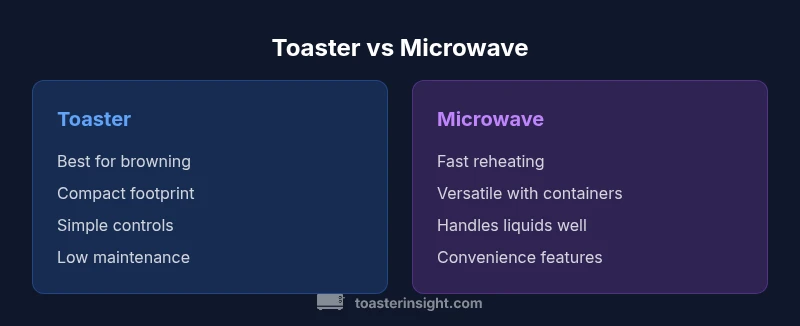
Is toaster better than microwave? According to ToasterInsight, in practice, it depends on your goal. For crisp, evenly browned toast, a dedicated toaster often beats a microwave on texture and flavor; for speed and versatile reheating, the microwave wins. If you want a compact solution that does both, a toaster oven is a strong compromise. This comparison helps homeowners decide based on bread tasks, leftovers, and kitchen space.
Core assumptions behind toasters and microwaves
When you frame the question is toaster better than microwave, you start from a few core assumptions: each appliance is designed for a specific set of tasks, user expectations, and trade-offs in energy use and space. The goal is not to crown a single winner but to identify which device consistently serves your most common routines. According to ToasterInsight, the simplest way to evaluate is to map inputs (bread items, plates, frozen foods) to outputs (crispness, warmth, moisture retention) and to consider how much counter space you’re willing to dedicate. The central premise is that texture and speed matter differently depending on the task. In this section, we outline the typical daily routines—toast, bagels, reheating leftovers, and even small baking tasks—and introduce the idea that a hybrid option, the toaster oven, can bridge specialization and versatility. Look for patterns in your week that reveal which appliance will save time while delivering predictable results.
Key takeaway: Prioritize your most frequent tasks and the texture or moisture outcomes you value most.
Comparison
| Feature | Toaster | Microwave |
|---|---|---|
| Best for | Crisp toast, browning, and small items | Speedy reheating and flexible warming of leftovers |
| Texture outcomes | Dry heat for browning, crisp exterior | Moist heat and steam can lead to softer edges |
| Reheating efficiency | Excellent for bread-focused tasks and dry foods | Excellent for liquids and mixed plates |
| Capacity and size | Compact slices only, minimal footprint | Larger cavity for bowls, plates, and containers |
| Energy use profile | Low for short toast cycles | Higher power draw for quick, wide tasks |
| Maintenance | Crumb tray and general wipe-down | Interior cleaning and splatter management |
| Upfront cost | Low to mid-range for basic models | Mid to high for compact microwaves with sensors |
| Best for | Bread-focused routines, small kitchens | Speed-focused multitask cooking |
Positives
- Clear performance for bread and browning with a dedicated heater
- Simple operation; reliable results with minimal setup
- Low maintenance for basic models and straightforward cleaning
- Compact options fit small counters
- Toaster ovens add versatility without full-size appliances
Drawbacks
- Limited versatility for reheating large or liquid-heavy meals
- Longer cook times for many meals compared with microwaves
- Toaster space can crowd a small kitchen; toaster ovens need more room
- Some models struggle with even browning on thicker slices
Toaster excels for bread-focused tasks; microwave wins for rapid, flexible reheating
Choose a dedicated toaster if crisp texture and browning are priorities. Choose a microwave for speed and versatility, especially for leftovers and liquids. For a balanced kitchen, consider a toaster oven as a compromise.
Your Questions Answered
Is a toaster better for toast than a microwave?
Yes. For toast, a dedicated toaster typically yields crisper edges and even browning with dry heat. Microwaves tend to make bread soggy or unevenly warm unless special accessories are used.
Yes—if your priority is crisp toast, a dedicated toaster is usually better.
Can you reheat leftovers efficiently in a toaster?
Toasters are not ideal for most leftovers; microwaves handle mixed textures better. For small items like chips or pizza crust, a toaster oven can do a respectable job without sogginess.
Microwaves work well for most leftovers; use a toaster oven for crisper edges when possible.
Are toaster ovens a good compromise between both appliances?
Toaster ovens offer a middle ground: they deliver browning like a toaster and can reheat a wider range of foods, though they still require more counter space and may take longer than a microwave for mass reheating.
A toaster oven often hits a sweet spot between texture and versatility.
How should I clean a toaster vs a microwave?
Keep the crumb tray clean in a toaster and wipe away spills after use. For microwaves, avoid metal objects, wipe the interior with a mild cleaner, and use a damp cloth to remove splatters.
Regular cleaning keeps both appliances performing well.
Can either appliance be energy efficient for daily use?
Yes, but it depends on task. Short, bread-focused cycles use less energy in a toaster, while microwaves excel at quick reheating with lower energy draw per minute for certain items.
Efficiency depends on what you’re cooking and for how long.
Should I replace both with a single appliance?
If you have the space, a toaster oven or a modern multi-cooker with a browning setting can cover most daily tasks. A stand-alone microwave still offers faster heating for many meals.
A single versatile unit can cover most bases, but plan for trade-offs.
Key Takeaways
- Assess your bread-focused needs before buying.
- Prioritize texture and browning over speed for toast tasks.
- Use the microwave for fast reheating and flexible cooking.
- Consider a toaster oven to combine capabilities when space allows.
- Factor in counter space and energy use when planning.