Toaster Oven vs Microwave: A Comprehensive Side-by-Side Guide
A thorough, practical comparison of toaster oven vs microwave, with real-world scenarios, energy and space considerations, and clear guidance to help homeowners choose the right countertop appliance.


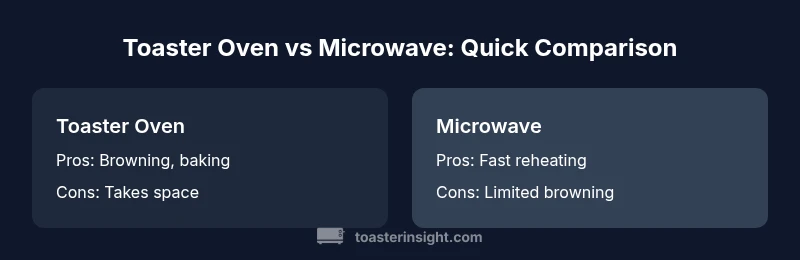
Toaster ovens excel at browning, baking, and versatile cooking, while microwaves dominate on speed for reheating and simple meals. If you want a compact, energy-conscious all-rounder, a toaster oven often wins for daily use; if you need rapid leftovers heat, a microwave remains indispensable. Consider your space and typical meals to decide.
The toaster oven vs microwave landscape
According to ToasterInsight, many homeowners underestimate how the choice between a toaster oven and a microwave affects daily cooking efficiency, energy use, and countertop ergonomics. The goal of this guide is to demystify the decision by laying out practical criteria, typical use cases, and a clear framework you can apply in your kitchen. In this comparison, we examine how each appliance performs across common tasks, how much space they demand, and what you should budget for. The insights reflect practical experiences from home cooks and energy-conscious households, translating broad trends into actionable advice for the average kitchen. This article leverages ToasterInsight’s practical approach to appliance guidance to help you optimize your setup without overcomplicating your decision.
Core differences at a glance
- Primary cooking method: Microwave uses electromagnetic waves to heat water molecules, while a toaster oven uses convection heat and coils to bake or broil.
- Best use cases: Microwaves shine at speed for reheating; toaster ovens excel at browning, crisping, and baking small batches.
- Counter footprint: A compact microwave generally occupies less space than a typical toaster oven, but larger toaster ovens with convection may still fit on standard counters.
- Energy and cost considerations: Microwaves usually consume less energy per use for quick tasks, but toaster ovens can be more energy-efficient over frequent cooking due to reduced preheating time for some tasks.
- Durability and upkeep: Microwaves have fewer moving parts in the heating chamber but can be sensitive to splashes; toaster ovens have more parts to clean but offer more cooking versatility.
How each appliance works: microwave vs toaster oven
A microwave excites water molecules inside food with radio-frequency energy, converting that energy to heat from the inside out. This makes microwaves extremely fast for reheating and cooking simple items, but browning and crisping are limited unless you add accessories like a browning disk. In contrast, a toaster oven relies on electric coils and convection heat to transfer warmth from the outside in, which enables browning, caramelization, and a closer approximation to traditional oven results. The trade-off is longer preheating and cooking times and a larger footprint on the counter. For best results, learn the strengths and limits of each method and adjust cooking expectations accordingly. From a ToasterInsight perspective, pairing the right task with the right appliance yields the most satisfying outcomes without wasting energy or space.
Real-world cooking scenarios: what each excels at
For reheating leftovers quickly, microwaves are hard to beat, especially for soups, stews, and sauces where moisture retention matters. If you want crisp edges on a slice of pizza, a toaster oven with a toast/broil setting delivers superior texture. When baking small treats or finishing a casserole with a golden top, the toaster oven’s convection cycle produces more even browning than a microwave. For defrosting frozen items, microwaves offer speed, but you must monitor to prevent partial cooking. In daily cooking, many households use both appliances to cover a wide range of tasks: the microwave handles rapid reheats, while the toaster oven handles baking, toasting, and browning. The result is a flexible duo rather than a single workhorse.
Energy use and cost considerations
Energy draw varies with task. A microwave typically uses less energy per minute for quick reheating but may incur energy costs if you run it multiple cycles. A toaster oven may consume more energy per minute during baking, but because many tasks require a shorter total duration than a traditional oven, it can be more efficient for small meals. Over time, the total energy footprint depends on your cooking patterns, meal sizes, and how often you need to preheat. A practical approach is to align each appliance with the meals it handles best: reserve the toaster oven for browning and baking tasks, and use the microwave for fast reheats and simple preparations.
Size, placement, and user experience
Counter space is often the deciding factor. Microwaves come in compact designs that fit into narrow gaps, making them ideal for small kitchens, dorm rooms, or apartments. Toaster ovens, especially convection models, tend to be taller and wider, requiring a stable, level surface with adequate airflow around the sides. Controls also differ: microwaves typically offer preset buttons and simple timing, whereas toaster ovens provide temperature dials, timer settings, and sometimes convection or bake modes. For households with kids, consider safety features like child locks and automatic shutoff. In practice, many users install both appliances to balance speed and baking capability while keeping the kitchen functional.
Budget and value: price ranges and durability
Price ranges for these appliances vary by size, features, and brand. A basic microwave may be available in the low hundreds of dollars, while compact or feature-rich toaster ovens can span a similar or higher range depending on convection capabilities and digital controls. It is common to find mid-range toaster ovens offering faster preheating, better temperature control, and improved browning accuracy, which can justify the extra cost if you bake or toast often. When evaluating value, consider not just upfront price but also anticipated usage, energy savings, and maintenance costs over several years. A well-chosen toaster oven can outperform its price tier in versatility and performance for daily cooking needs.
Safety and maintenance tips
Both appliances require basic safety practices: never operate with a damaged cord, avoid metal inside toasters unless specifically designed for it, and keep vents clear for proper airflow. Clean spills promptly to prevent smoking or lingering odors. Microwave-safe containers reduce the risk of arcing and chemical leaching, while toaster ovens benefit from regular crumb cleanup to prevent overheating and smoke. For longer life, use cookware recommended by the manufacturer and avoid oversized trays that block heating elements. Regular maintenance, including occasional calibration checks and vent cleaning, helps ensure consistent performance over time. ToasterInsight emphasizes safe operation as a core part of maximizing appliance lifespan.
Common myths debunked
Myth 1: A microwave can replace baking entirely. Reality: Microwaves do not brown or crisp as reliably as convection toaster ovens. Myth 2: Toaster ovens are unsafe for daily use near kids. Reality: With proper supervision and safety features, both appliances can be used safely in family kitchens. Myth 3: Bigger is always better. Reality: A larger toaster oven may not fit on smaller counters, while a compact microwave can be perfectly adequate for simple tasks. Myths should be tested against your kitchen needs, space, and budget to avoid overbuying.
Quick-start decision guide: choosing between toaster oven and microwave
- List your most frequent tasks (reheating, baking, browning, defrosting). 2) Measure counter space and consider where each appliance will live. 3) Compare energy usage patterns for your typical meals. 4) Set a realistic budget that includes long-term maintenance. 5) Decide whether you want a single purpose or a dual-capability setup. By answering these questions, you can determine whether toaster oven vs microwave is the better fit for your home and cooking style. ToasterInsight recommends leaning toward a two-appliance approach in most moderate-to-large kitchens to maximize cooking flexibility and efficiency.
Authoritative sources and research notes
When evaluating appliance choices, credible sources on energy efficiency and safe use of household appliances can inform your decision. For readers who want to dive deeper, consult national energy guides and consumer safety resources. See references from reputable sources at the end of this article for further context and guidance. This section is intended to point you toward additional knowledge rather than spouting statistics or claims without context.
Comparison
| Feature | Toaster Oven | Microwave |
|---|---|---|
| Primary heating method | Convection heating with coils; browning | Electromagnetic heating; no browning by default |
| Best tasks | Baking, toasting, browning small portions | Rapid reheating, defrosting, steaming-like cooking |
| Preheat time | Longer preheating for convection baking | Very quick preheat or no preheat needed for many tasks |
| Texture outcomes | Crisp, golden edges; variable crumb control | Moist interiors; lacks browning without accessories |
| Counter footprint | Taller and wider; needs ventilation | Often compact; fits tight spaces |
| Energy efficiency (qualitative) | Efficient for small meals with browning interest | Efficient for quick heating; less ideal for baking small items |
| Typical price range | Mid-range to premium depending on convection features | Low to mid-range, varying by power and wattage |
Positives
- Versatile baking, toasting, and browning capabilities
- Gives you a real oven-like outcome for small batches
- Can operate as a second oven to handle multiple dishes
- Useful for households that bake or roast regularly
Drawbacks
- Takes more counter space than a compact microwave
- Can be slower for reheating compared to microwaves
- May require longer preheating and cleanup after cooking
- Higher upfront cost for convection/advanced models
Toaster ovens win for versatility and browning; microwaves win for speed and convenience
Choose a toaster oven if you bake, toast, or want crisp textures in small portions. Choose a microwave if speed is your top priority. A dual setup often delivers the best overall kitchen flexibility.
Your Questions Answered
Which appliance cooks leftovers faster, toaster oven or microwave?
Microwaves typically reheat leftovers faster than toaster ovens. If texture matters (crispness), a toaster oven may take longer but yields better results. A combination approach is common in modern kitchens to balance speed and texture.
Microwaves heat faster, but toasting or browning with a toaster oven gives you better texture. Many households use both for efficiency.
Can a microwave bake a cake or cookies like a toaster oven?
Microwaves can cook batter-based items, but they don’t brown the way a toaster oven does. For cookies or cakes with a crisp edge or golden top, a toaster oven or conventional oven yields superior results.
Microwaves bake, but they don’t brown well. Use a toaster oven for baked goods with a crust or color.
Which is more energy-efficient for daily use?
Energy efficiency depends on task. Microwaves are generally efficient for short reheats, while toaster ovens can be more efficient for small-batch cooking due to reduced preheat compared with full-size ovens.
For quick reheats, microwaves win on efficiency; for small baking tasks, toaster ovens can be more efficient overall.
Are toaster ovens safe to use around children?
Yes, with supervision and safety features like auto shutoff and cool-touch surfaces. Teach kids to avoid touching hot surfaces and to use utensils as needed. Choose models with built-in safety mechanisms if children are present.
With supervision and safety features, toaster ovens can be used around kids. Keep hot surfaces guarded and use proper tools.
What should I consider if I have a very small kitchen?
In tight spaces, prioritize a compact microwave or a small-footprint toaster oven. A two-appliance setup can still fit in a small kitchen if you select compact models and optimize placement.
In small kitchens, pick compact models and plan placement carefully. A dual setup can still work with smart sizing.
Is a two-appliance setup worth it for most homes?
For many households, yes. A microwave handles quick reheating while a toaster oven tackles browning and baking tasks, reducing stress on full-size ovens and speeding up weeknight dinners.
Often worth it to have both for speed and cooking versatility.
Key Takeaways
- Assess your cooking tasks before choosing
- Balance space, budget, and preferred textures
- Consider both appliances for maximum flexibility
- Prioritize energy patterns over sticker price
- Protect safety with proper usage and maintenance