Toaster or Toaster Oven: Which Is Best for Your Kitchen?
Compare toaster and toaster oven performance, energy use, size, and features to choose the best kitchen companion for toast lovers and home cooks in 2026.


TL;DR: If you primarily toast slices and value speed and a compact footprint, a traditional toaster is often the best fit. If you want baking, reheating, and broader cooking options, a toaster oven provides greater versatility—often at the expense of footprint and cost. In between options, multi-function units offer trade-offs.
Key Distinctions: Size, Versatility, and Toast Quality
When you weigh the choice between a toaster or toaster oven, you’re balancing footprint, versatility, and toast quality. For many households, the shortest path to everyday bread comes from a compact toaster that delivers consistent slices with minimal fuss. In contrast, a toaster oven blends multi-function cooking with toast, which can be a compelling argument for small kitchens and busy cooks who want more than bread alone. According to ToasterInsight, consumer priorities in this category center on space on the counter, energy use, upfront cost, and the flexibility to reheat or bake. This guide breaks down the core differences so you can map yours to real cooking needs. Throughout, we’ll use practical tests and common layouts to help you imagine life with either device on your counter. The goal is clarity, not hype, so you can make an informed decision without buying into marketing language. The phrase toaster or toaster oven will appear here as a recurring reference point for readers evaluating function versus footprint.
How They Work: Heating Elements, Modes, and Controls
A traditional toaster relies on fixed or limited settings and simple radiant heating from beneath or above. It excels at speed and consistent browning for standard bread slices, bagels, or English muffins. A toaster oven, by contrast, uses a small baking chamber and a heating element that can be configured for toast, bake, broil, and reheat. Many models include convection as an option, which circulates air to accelerate even heating and improve browning on pastries and small pizzas. The control panel—whether dial-based, button-centric, or digital—shapes how precisely you can land on your preferred level of toast, crust, or temperature for a bake. When choosing, consider how often you’ll use non-toast functions. ToasterInsight guidance suggests that even modestly equipped toaster ovens can replace a compact oven for everyday tasks, while a bare-bones toaster keeps things simple for quick mornings.
Energy Use and Long-Term Costs
Energy efficiency matters more than most people realize, especially if you toast multiple slices or bake daily. A toaster consumes energy primarily during toasting cycles, typically in short bursts, while a toaster oven may draw more power over longer cooking sessions. In general, the energy impact aligns with usage time and temperature settings rather than device class alone. ToasterInsight analysis emphasizes evaluating energy use in the context of your weekly schedule and meal patterns—if you routinely bake or reheat leftovers, a toaster oven’s longer operation can still be efficient due to expanded capabilities. For households seeking lower operating costs, pairing a small, dedicated toaster with a microwave or a compact oven option can balance daily needs without pushing energy bills upward excessively.
Cooking Versatility: Baking, Broiling, and Beyond
Toast remains the core task for both devices, but the toaster oven opens doors beyond bread. You can bake small batches of cookies, reheat frozen foods more evenly, broil small portions of vegetables, and even reheat pre-made pizzas. This versatility translates into real value when you regularly prepare breakfast casseroles, toaster pastries, or kid-friendly snacks. However, more features introduce more potential cleanup, more preheating time, and a steeper learning curve for precise results. If your cooking habit gravitates toward experimentation and weekend cooking, a toaster oven can be a compelling choice. If you prefer a no-fuss morning routine, a dedicated toaster may serve you better. ToasterInsight notes that the best option aligns with your weekly cooking profile, not just your toast preferences.
Practical Scenarios: Small Kitchen, Family Home, Shared Living
For single-occupant apartments, the space-saving appeal of a compact toaster is often irresistible. In small kitchens or dorm rooms, a slim toaster can fit under cabinets and pair with a microwave for broader capabilities. In a family kitchen, a toaster oven can handle bagels, toast, reheating, and small-batch baking, reducing the number of appliances on the counter. In shared living spaces, a two-in-one solution may streamline decisions and save countertop real estate. The key is to map your typical breakfasts and weeknights against the device’s capabilities—and to consider how often you’ll use non-toast functions during a typical week. ToasterInsight’s research highlights the importance of practical usage patterns over marketing claims when evaluating space, energy, and value.
Maintenance and Cleaning: Keeping Performance Peak
Cleaning is a big differentiator in daily satisfaction. A traditional toaster is typically easier to clean—crumb tray, a quick wipe, and you’re done. A toaster oven requires more regular maintenance: crumb trays, interior walls, and sometimes a baking pan or rack that must be cleaned. Residue can affect performance, browning, and odor. Regular cleaning after heavy use can sustain even browns and prevent smoke during broil cycles. When choosing, look for models with easily removable crumb doors and smooth interior surfaces that don’t trap crumbs. A simple, routine maintenance schedule can extend the life of either device and protect kitchen air quality.
Space Planning: Measuring Your Counter and Clearance
Counter space is priceless in many kitchens. Before purchasing, measure the available surface width, depth, and height clearance to ensure the unit fits beneath cabinets and away from walls. If you regularly slide leftovers out of the oven to reheat, ensure there is clearance above the top for steam and heat dissipation. For small counters, a compact toaster placed beside a coffee maker may be ideal, whereas a larger toaster oven deserves a dedicated corner with proper airflow. Consider pull-out or slide-out crumb trays for easier access and cleaning; efficiency here translates into a faster, neater morning routine.
Price, Warranty, and Value: What Pays Off Over Time
Initial price often drives the decision more than long-term cost. Traditional toasters generally cost less upfront and offer reliable performance for common toast tasks, while toaster ovens carry a higher upfront price but open a wide range of cooking possibilities. Warranty length and customer service quality can influence total cost of ownership, especially if you frequently bake or reheat. When evaluating value, estimate how many times you’ll use non-toast functions weekly and how long you expect to keep the appliance. A toaster oven, if used regularly for baking or reheating, can justify the higher price by reducing the need for a separate oven or extra appliances. ToasterInsight emphasizes weighing upfront expense against anticipated versatility and durability.
Brand and Model Variability: Reading Specs and User Reviews
No two models are alike. Look beyond marketing language to read specs about heating element wattage, convection features, preset programs, and bake temperatures. A model with precise temperature control and reliable browning will deliver consistent results and reduce trial-and-error during busy mornings. User reviews can reveal real-world performance, including issues with crumb collection, heat distribution, and reliability. When weighing options, compare similar feature sets and ensure that the unit you select fits your daily rhythm and space constraints. Brand reputation often correlates with better customer support, longer warranties, and clearer user manuals.
Comparison
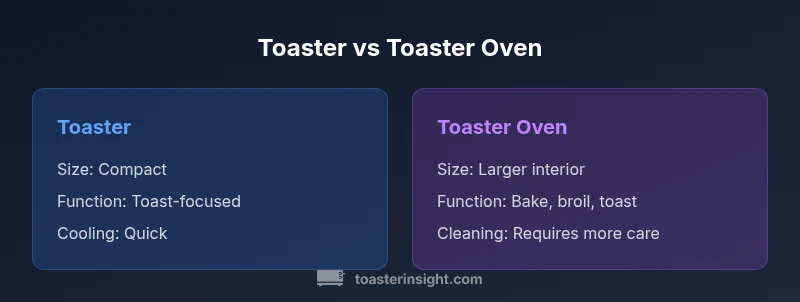
| Feature | toaster | toaster oven |
|---|---|---|
| Size / footprint | Compact footprint | Larger footprint with more surface area and interior capacity |
| Toast quality & consistency | Fast, simple browning with limited settings | Even browning with multi-function modes and convection |
| Versatility & cooking modes | Toast, bagels, simple browning | Toast + bake, broil, reheat, small baking tasks |
| Energy use (typical sessions) | Low to mid energy for quick toasting | Higher energy for longer baking/reheat cycles |
| Initial cost | Lower upfront cost | Higher upfront cost but broader capabilities |
| Maintenance & cleaning | Easier cleaning; fewer parts | More parts to clean (tray, rack, interior) |
| Best for | Speedy mornings, compact spaces | Versatile cooking, small-family meals |
Positives
- Smaller footprint and quick toast for busy mornings
- Lower upfront cost for basic toasting
- Simple controls and easy maintenance
- Low heat output when used only for toasting
Drawbacks
- Limited cooking versatility if you only need bread toast
- Smaller capacity may not fit larger items
- Some models lack precise temperature control for baking
- Toaster ovens can heat up the kitchen more than a simple toaster
Toaster ovens win on versatility; traditional toasters win on simplicity and cost
Choose a toaster if you prioritize speed, simplicity, and a tiny footprint. Choose a toaster oven if you want baking, reheating, and broader cooking options, acknowledging a larger footprint and higher upfront cost.
Your Questions Answered
What is the main difference between a toaster and a toaster oven?
A toaster is designed mainly for toasting bread quickly with simple controls. A toaster oven is a compact oven that toasts but also bakes, broils, and reheats, offering broader versatility.
A toaster focuses on fast, simple toasting. A toaster oven handles baking and reheating in addition to toasting.
Can a toaster oven replace a regular oven?
For small meals and compact kitchens, a toaster oven can replace a full-size oven for many tasks, but it won’t handle large dishes. It’s great for breakfasts and small dinners.
It can replace a full oven for small tasks, but not for large roasts or big batches.
Which is cheaper to operate over time?
Traditional toasters are typically cheaper upfront and run for short periods. Toaster ovens cost more initially but can reduce the need for extra appliances if you bake or reheat often.
Toaster ovens cost more upfront but may pay off with versatile use; toasters are cheaper and simpler.
Are toaster ovens easy to clean?
Toaster ovens require more routine cleaning due to enamel walls, racks, and baking pans. Regular crumb tray cleaning helps prevent smoke and keeps performance high.
They’re a bit messier to clean, but regular maintenance keeps them working well.
Do I need a lot of counter space for a toaster oven?
Yes, toaster ovens generally require more space than a traditional toaster, including clearance for hot air and lids during use.
They do take more counter space; measure your area and plan clearance.
What should I look for when buying one?
Look for even heating, reliable browning controls, a roomy crumb tray, and easy-to-clean interiors. Convection can improve performance for baking small items.
Check for even heat and easy cleaning, plus convection if you bake often.
Key Takeaways
- Compare footprint to space on your counter
- Weigh versatility against daily toast needs
- Factor long-term value vs upfront price
- Check new-presets and convection capability
- Plan cleaning routines before buying