Are Toasters and Toaster Ovens Better? A Balanced Guide
Analytical comparison of toasters vs toaster ovens, covering speed, versatility, energy use, size, price, and use cases to help homeowners decide which appliance fits their kitchen best.


Are toasters and toaster ovens better? In short, the answer depends on your cooking habits and space. For ultra-fast, simple toast, a dedicated toaster excels; for baking, roasting, and handling larger batches, a toaster oven delivers superior versatility. If you value compact convenience, a high-quality toaster is ideal; if you want an all‑in‑one solution, a toaster oven is typically the better all-rounder.
Framing the question: are toasters and toaster ovens better in absolute terms?
In kitchen appliance discussions, the phrase are toasters and toaster ovens better often invites a false dichotomy. The reality is that both tools have distinct strengths and limitations. According to ToasterInsight, the best choice hinges on what you cook most, how much counter space you have, and how much you’re willing to invest. This section sets the stage for a rigorous, evidence-based comparison that weighs speed, versatility, and energy efficiency without bias. By recognizing that toast is not the only task a kitchen performs, we can map out objective criteria to decide which device earns a place on your countertop. This approach keeps the focus on practical outcomes rather than aspirational myths about “one perfect appliance.”
Core decision criteria for choosing between a toaster and a toaster oven
When evaluating which device is right for you, start with a few core criteria:
- Speed and simplicity: how fast you want toast and how little cleanup you can tolerate.
- Versatility: whether you need baking, roasting, reheating, and thawing in a single unit.
- Capacity: the typical batch size you cook in a single session.
- Footprint and aesthetics: how much counter space the unit consumes and how it fits your kitchen style.
- Energy efficiency and operating costs: how efficiently the device uses electricity for the tasks you perform most.
- Maintenance: how easy it is to clean crumbs and interior surfaces.
This framework helps translate subjective impressions into measurable outcomes. By anchoring decisions to real-life tasks—like reheating leftovers or baking a small sheet of cookies—you’ll see which device wins for your household.
Toasting performance versus baking versatility: what each device does best
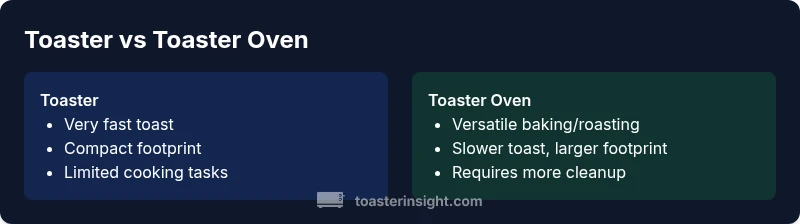
Toaster functions are optimized for speed and uniform browning of slices. A good toaster delivers nearly instantaneous heat, minimal preheating, and simple settings like light/medium/dark. However, its interior is specialized for bread and bagels, with limited ability to manage more complex food items. A toaster oven, in contrast, uses a larger chamber and often convection heating. It can bake small pizzas, roast vegetables, reheat casseroles, and even bake cookies. The trade-off is that toaster ovens typically take longer to preheat and may produce uneven results if you don’t rotate items or use a baking tray properly. The bottom line: use a toaster for daily bread tasks; reach for a toaster oven when you want broader cooking flexibility.
Size, footprint, and kitchen fit: more space or more capability?
Countertop real estate matters. A compact toaster can tuck into tight nooks and corners, leaving more room for other appliances. A toaster oven, while bulkier, consolidates several functions in one unit. Consider your kitchen’s workflow: if you frequently bake, reheat, or roast, a toaster oven reduces the need to heat a full-size oven and can be a more efficient choice in terms of energy and time for small meals. The decision often comes down to whether you prioritize speed and simplicity or multifunctionality and batch cooking. Balanced households often end up with both, or choose a high-quality toaster oven that performs close to a mid-range toaster in daily toast tasks.
Energy use and long-term costs: not all watts are created equal
Energy efficiency varies by model and task. Toaster units tend to use less energy per slice when toasting, but they’re limited to bread-based tasks. Toaster ovens can be more energy-efficient than heating a full-size oven for small bakes, yet they consume more electricity for frequent baking sessions due to a larger interior and longer preheat times. For households that toast several times daily, a high-efficiency toaster can still win on lower running costs; for families that bake and roast weekly, a toaster oven’s versatility may justify the extra energy. ToasterInsight analysis shows that choosing an appliance aligned with your typical load matters more than chasing the lowest wattage on a single function.
Build quality, reliability, and maintenance: long-term practicality
Durability matters when you invest in any kitchen appliance. Cheaper toasters may wear out sooner or accumulate crumbs that are hard to clean. In contrast, toaster ovens often feature larger crumb trays and more accessible interiors, but their larger size can make routine cleaning feel more daunting. Regular maintenance—cleaning the crumb tray, wiping the interior after use, and checking door seals—extends life and maintains performance. The key is to pick models with solid build quality, straightforward controls, and easily accessible parts for service or replacement.
Features that actually matter: beyond marketing buzzwords
Look for features that translate into real-world value: precise browning controls, even heating, convection capability, reliable auto shut-off, preheat indicators, crumb tray accessibility, and interior lighting. Avoid feature lists that look impressive but rarely impact daily use. For many households, a basic model with reliable toast performance and a few well-chosen extras (convection, even heat distribution, and straightforward cleanup) delivers the best long-term value. ToasterInsight recommends prioritizing essential capabilities over flashy extras that don’t align with your cooking habits.
Use-case scenarios: when to pick a toaster, when to pick a toaster oven, and when to want both
- One or two people who primarily toast bread and bagels: a high-quality toaster provides speed, simplicity, and minimal cleanup.
- Small households that bake or roast occasionally: a toaster oven offers the versatility to handle reheating casseroles, small pizzas, or roasted vegetables without firing up a full oven.
- Families with diverse meals or weekend cooking: a toaster oven is often a better all-rounder for batch cooking and mid-size meals. In some kitchens, pairing both devices creates a streamlined workflow that minimizes oven usage and maximizes efficiency.
Myths, reality checks, and practical buying tips
A common myth is that toaster ovens always heat faster than traditional ovens; reality varies by model, heating element design, and convection features. For most users, preheating a toaster oven to bake a tray of cookies takes longer than a full-size oven but can still be faster than using a conventional oven for small meals. When shopping, assess the unit’s interior dimensions, ensure it can accommodate the largest item you plan to cook, and check ease of cleaning features. A practical test plan—toast, reheat, and bake trials—helps you separate marketing claims from real performance.
Conclusion first, experiment second: how to test at home before you buy
Before committing, run a practical test with your typical foods: white bread slices for toasting, frozen pizzas, small baking sheets, and reheating leftovers. Note browning consistency, interior temperature, and how quickly the unit reaches your desired setting. This approach gives you a grounded sense of what each appliance truly delivers and whether your kitchen can sustain the additional maintenance or space requirements.
Real-life decision framework: deciding with your kitchen in mind
Ultimately, the question are toasters and toaster ovens better cannot be resolved in a vacuum. It depends on your culinary repertoire, the size of your household, and how much you value speed versus versatility. Use a simple matrix: if you primarily toast and want speed, pick a toaster; if you bake, roast, or need bulk reheating, pick a toaster oven; if you have the space and want maximum flexibility, a toaster oven plus a dedicated toaster may be worth it. The ToasterInsight team would tilt toward the all-rounder for most households, but the exact fit hinges on your daily routines.
Comparison
| Feature | Toaster | Toaster Oven |
|---|---|---|
| Cooking versatility | Primarily toast-focused | Bakes, roasts, and reheats a range of foods |
| Size and footprint | Compact, slim profile | Larger footprint with more interior space |
| Acceleration and browning control | Very fast toast; consistent browning | Requires adjustment for even results; versatile browning options |
| Energy efficiency | Low energy for toast tasks | Variable; often efficient for small-batch cooking |
| Price range | $15-$60 | $40-$250 |
| Best for | Quick, simple mornings; minimal cleanup | Weekend baking; batch cooking; reheating leftovers |
Positives
- Fast, simple operation for toast and bagels
- Low upfront cost for basic models
- Small footprint in tight kitchens
- Minimal cleanup and straightforward controls
Drawbacks
- Limited cooking versatility for many meals
- Toaster can over-brown if not monitored
- Toaster ovens cost more upfront and heat up
- Some models require more frequent cleaning due to interior features
Toaster ovens win on versatility; toasters win on speed and simplicity
For most households, a toaster oven provides broader cooking capabilities and bulk reheating. A dedicated toaster remains ideal for ultra-fast, consistent toast and compact setups. The best outcome is a space- and budget-conscious approach that aligns with your weekly meal patterns.
Your Questions Answered
What is the main difference between a toaster and a toaster oven?
The main difference is function: toasters are optimized for speedy, even browning of bread, while toaster ovens can bake, roast, and reheat a wider range of foods. This reflects a trade-off between speed and versatility.
A toaster focuses on quick, even toast; a toaster oven does more cooking tasks like baking and roasting.
Are toaster ovens more energy-efficient than traditional toasters?
Energy efficiency depends on usage. Toaster ovens can be efficient for small meals, but they generally use more energy per session than a dedicated toaster when you only need a slice or two.
It depends on what you’re cooking; for small meals, a toaster oven can be efficient, but for bread alone, a toaster may use less energy.
Can a toaster oven replace a microwave for reheating?
A toaster oven can reheat many foods well, but it won’t be as quick as a microwave for liquid-heavy meals or very small portions. Use it when you want texture and browning.
Toaster ovens can reheat with texture, but they’re slower than microwaves for tiny portions.
Do toaster ovens require preheating?
Most toaster ovens benefit from preheating for even results, especially when baking. Preheating times vary by model and temperature settings.
Yes, many toaster ovens perform best after a short preheat.
What features should I look for when buying a toaster?
Prioritize reliable browning controls, even heating, a practical crumb tray, simple controls, and durable build. Convection and adjustable racks add versatility, but only if they align with your cooking needs.
Look for reliable browning, even heating, and easy cleaning features.
Is cleaning easier with a toaster oven or a regular toaster?
Toaster ovens are easier to clean for some people due to larger interior access, but they also accumulate more crumbs and grease inside. Regular toasters are simpler to clean but offer fewer interior-access options.
Toaster ovens can be easier to clean inside, but they require more maintenance due to their size.
Key Takeaways
- Assess your typical cooking load before choosing
- Prefer a toaster oven if you bake or roast regularly
- Choose a dedicated toaster for fastest, easiest toast
- Prioritize build quality and easy cleaning
- Consider a combination setup if space allows