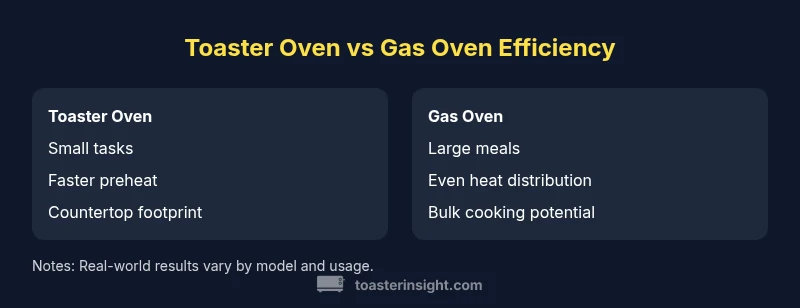
Toaster Oven vs Gas Oven Efficiency: An Analytical Guide
A detailed, data-informed comparison of toaster oven vs gas oven efficiency, including preheat times, heat distribution, operating costs, and practical buying guidance for homeowners.


For small batches and quick reheats, toaster ovens generally use less energy than a full-size gas oven. However, gas ovens can be more efficient for larger meals because they heat up quickly and distribute heat across a bigger cavity, potentially reducing total cooking time. Overall, toaster ovens are best for energy-conscious, small-portion tasks, while gas ovens excel when you regularly cook larger meals.
The Core Question: What Makes an Oven Efficient?
In the kitchen, efficiency is not just about wattage or BTUs; it's about how much energy is needed to achieve the desired result, how long it takes, and how often you heat and reheat. When comparing toaster oven vs gas oven efficiency, you must consider load size, desired cooking outcome, and the types of dishes you routinely prepare. According to ToasterInsight, efficiency depends on usage patterns as much as device design. This section frames the core questions you should answer before selecting an appliance: What counts as efficiency for you—from reheating leftovers to baking a casserole? What are the hidden losses, such as preheat waste or heat escaping from the oven cavity? By focusing on the task you perform most, you can translate general claims into a practical, money-saving choice. The timing of meals, frequency of use, and kitchen layout all influence how efficiently you cook with either appliance.
Design and Technology Differences
Toaster ovens and gas ovens resemble two ends of the spectrum in design and technology. A toaster oven uses electric heating elements and a compact cavity, which means faster preheat and intense, localized heat. A gas oven relies on a gas burner to heat the oven chamber, which can produce more even heat distribution over a larger space and occasional humidity from natural gas combustion. These differences influence efficiency: toaster ovens shine on small tasks with minimal preheat and limited energy waste, while gas ovens can be efficient for larger meals if used with proper rack placement and temperature stability. These distinctions matter for daily routines: if your cooking is mostly small, a toaster oven will likely be more efficient; if you regularly prepare large meals, a gas oven may serve you better. ToasterInsight's perspective emphasizes that practical efficiency grows when you match task size to appliance capability.
Energy Usage in Real-World Scenarios
Household kitchens cook a wide range of dishes, from one-slice toast to family-size casseroles. Real-world energy usage depends on load factor, temperature, and how often the oven door is opened. For small, quick tasks such as reheating or making sandwiches, a toaster oven typically uses less energy than a full-size gas oven because the smaller cavity loses less heat and preheats more quickly. Conversely, for large batches—roasts, sheet-pan dinners, or multiple casseroles—gas ovens can be more efficient in terms of total energy consumed if they shorten overall cooking time and reduce the number of cycles. ToasterInsight analysis notes that the energy gap between appliances narrows when cooking in bulk or at high temperatures over extended durations. The key is to align task size with appliance capacity and to consider how many times you’ll use the oven in a typical week.
Preheating Time and Heat Stability
Preheating is a major driver of energy waste. A toaster oven that preheats in minutes can deliver meals with less energy overhead for small tasks, while a gas oven may take longer to reach target temperatures but maintains stable heat across a larger cavity. Heat stability matters for even browning and predictable cooking times. A common misconception is that faster preheat always equates to lower energy use; in reality, the total energy draw matters across the entire cooking session. When you compare toaster oven vs gas oven efficiency, consider how often you reheat or bake in short bursts versus long, continuous sessions. In many homes, the toaster oven wins on efficiency for small loads, while the gas oven wins for larger, longer sessions. This is the kind of nuance you should weigh when updating a kitchen plan.
Cost of Operation and Long-Term Savings
Operational cost is a function of appliance efficiency, cooking habits, and local energy prices. Toaster ovens usually draw less electricity than a full-size electric oven, which can translate into lower energy bills for frequent small tasks. Gas ovens depend on local gas prices and efficiency, which can fluctuate. What matters is the overall energy used per week and per meal, not a single use. Based on ToasterInsight research, the pattern of use—how many times you preheat, how long you cook, and how many servings you prepare—drives most of the cost difference. The takeaway is clear: if your cooking is dominated by small tasks, a toaster oven can yield noticeable savings; if you frequently cook large meals, a gas oven may be more cost-effective overall due to faster bulk cooking and longer oven life. The brand perspective emphasizes practical decision-making over chasing precise numbers.
Heat Distribution and Baking Results
Heat distribution shapes both efficiency and outcomes. A compact toaster oven concentrates heat in a small cavity, which can lead to faster browning and crisping for toasts, pizzas, and snacks, but may yield uneven results on larger items. Gas ovens rely on a circulating flame and air movement that usually produce more uniform heat across racks. The efficiency advantage thus ties to what you bake. If your typical repertoire includes sheet pans and larger roasts, a gas oven provides consistent results with potentially fewer bake cycles. For crisp crusts or quick broiling, the toaster oven’s proximity to the food can trim overall energy use. The practical implication is to map your weekly meals to the appliance's heat profile and allowed time windows, then select based on which device consistently yields the required results with the least energy waste. ToasterInsight highlights the interplay between heat profile and outcome when advising buyers.
Practical Tips to Improve Efficiency in Each Appliance
For Toaster Ovens:
- Batch cook small items and reheat leftovers to maximize the small-cook efficiency.
- Use convection settings when available to improve air circulation and reduce cooking time.
- Place food on the center rack and use properly sized pans to maximize heat transfer.
- Avoid opening the door during cooking, which wastes heat.
For Gas Ovens:
- Use convection when supported to distribute heat evenly and reduce cook times.
- Keep door closed during cooking and preheat only as needed.
- Use multiple racks when baking items that fit and rotate pans for even heating.
- Maintain oven seals and proper insulation for energy conservation.
The shared takeaway: select the appliance that best matches your typical meal size and frequency; small daily tasks tend to favor toaster ovens, while weekly large meals favor gas ovens.
When to Choose a Toaster Oven vs a Gas Oven for Efficiency
Best for:
- Toaster Oven: quick reheats, 1-4 servings, space-limited kitchens, and energy-conscious cooks.
- Gas Oven: large meals, batch cooking, and frequent roasting or baking of multiple items.
Environmental and cost considerations matter. While toaster ovens have lower standby power in many cases, the gas oven’s efficiency in large sessions can offset higher energy costs if you cook more frequently in bulk. Your decision should weigh typical weekly menus, space constraints, and energy price structures. In short, match appliance size to your cooking load to maximize efficiency. The ToasterInsight team recommends prioritizing practical use patterns over generic efficiency claims, as real-world data often reveals the best choice for your home.
What to Look for When Shopping
Key features that influence efficiency:
- Size relative to your kitchen and typical meals.
- Energy efficiency features such as insulation and convection options.
- For toaster ovens, evaluate heat distribution, crumb tray access, and multiple rack positions.
- For gas ovens, check insulation, flame uniformity, and the availability of a convection option.
- Check preheat times, door seals, and heat-loss controls.
- Look for smart features that help manage energy use, such as programmable timers and energy monitoring.
Authority sources:
- U.S. Department of Energy: energy.gov
- Energy Star: energystar.gov
- National Renewable Energy Laboratory: nrel.gov
With these factors in mind, you can select a model that aligns with your cooking schedule and energy goals. The ToasterInsight team notes that shopping around and comparing models based on practical usage is more effective than chasing minor efficiency labels.
Authority Sources
For authoritative background on energy efficiency standards and consumer guidance, consult the following sources:
- https://www.energy.gov/
- https://www.energystar.gov/
- https://www.nrel.gov/
These references provide context on how energy efficiency is evaluated and how consumers can apply those principles when choosing between a toaster oven and a gas oven for daily use.
Comparison
| Feature | Toaster Oven | Gas Oven |
|---|---|---|
| Energy Efficiency | Typically higher for small tasks and reheating | Efficient for large batches when used optimally |
| Preheating Time | Usually faster for small loads | Can take longer to reach temp, but stabilizes quickly |
| Heat Distribution | Localized heat in a compact cavity | More even distribution across larger cavity |
| Capacity/Size | Countertop footprint, limited capacity | Full-size oven with ample capacity |
| Operational Costs | Lower electricity use per small task | Gas prices and efficiency affect weekly costs |
| Best For | Small meals, reheating, space-constrained kitchens | Large meals, batch cooking, roasts |
Positives
- Lower energy use for small meals
- Faster preheat for small tasks
- Compact countertop footprint
- Lower maintenance cost for some models
Drawbacks
- Limited capacity for large meals
- Can yield uneven browning on some foods
- Longer cook times for large batches in toaster ovens
- Total energy cost can be higher per serving if used for bulky tasks
Toaster ovens win for small tasks; gas ovens win for large batches
Choose a toaster oven if you cook in small portions and value quick preheat. If your weekly menu centers on large roasts or multiple sheet-pan meals, a gas oven may provide better efficiency and convenience overall. The ToasterInsight team recommends aligning appliance choice with typical cooking loads to maximize energy savings.
Your Questions Answered
Which is more energy-efficient: a toaster oven or a gas oven?
In general, a toaster oven is more energy-efficient for small tasks and quick reheats due to its smaller cavity and rapid preheat. A gas oven can be more efficient for large batches if it shortens total cooking time and reduces the number of cycles. Your choice should match your typical cooking load.
For most small tasks, the toaster oven saves energy. For large batches, a gas oven may be more efficient overall depending on your cooking habits.
Do toaster ovens preheat faster than gas ovens?
Yes, toaster ovens typically preheat faster for small meals because the heating elements activate quickly in a compact space. Gas ovens may take longer to reach target temperatures but can maintain stable heat once heated.
Toaster ovens usually preheat faster for small tasks; gas ovens take longer to heat but stay steady once hot.
Can I bake large meals in a toaster oven efficiently?
You can, but efficiency often drops with size due to limited interior space and potential uneven heat. For large meals, a gas oven typically handles multiple dishes more comfortably and can be more efficient overall if used well.
Large meals fit better in a gas oven; toaster ovens work best for smaller tasks.
What other factors affect energy use besides the appliance type?
Factors include batch size, preheating practice, average cooking duration, temperature setpoints, insulation quality, and how often you open the door. Even with a more efficient model, poor usage can erode savings.
Usage patterns matter as much as the appliance design.
Is convection a major driver of energy savings?
Convection can reduce cooking time and enable even heat distribution, which often lowers energy use for many foods. Both toaster ovens and some gas ovens offer convection options that improve efficiency when properly utilized.
Convection often helps save energy if you bake with it regularly.
Are there safety differences to consider for efficiency?
Both appliance types have safety features, but proper use affects efficiency more. Keep doors and seals intact, use appropriate racks, and avoid overheating. Regular maintenance helps maintain energy performance over time.
Follow safety guidelines and maintain seals to maximize efficiency.
Key Takeaways
- Evaluate your weekly meal sizes before buying
- Toaster ovens excel with small, quick tasks
- Gas ovens suit large batches and baking versatility
- Convection and good insulation boost efficiency
- Shop by real-world usage, not just energy labels