Microwave vs Toaster Oven Energy Use: A Practical Guide
A practical comparison of microwave vs toaster oven energy use for common kitchen tasks. Learn how task size, preheating, and efficiency affect overall energy consumption and how to minimize waste in everyday cooking.


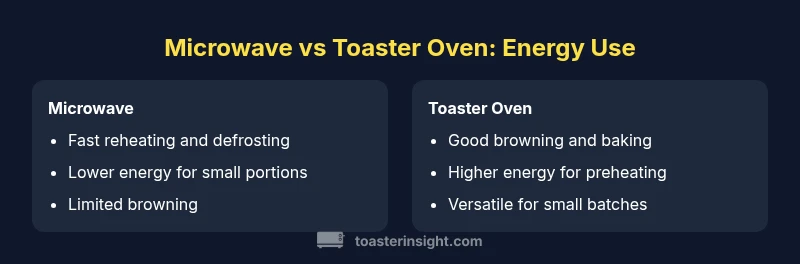
When choosing between a microwave and a toaster oven, consider the task at hand. For quick reheating or defrosting, the microwave typically uses less energy and finishes faster; for baking, browning, or cooking larger portions, a toaster oven can be more efficient overall. The microwave vs toaster oven energy consumption depends on time, load size, and model efficiency, so matching appliance to task saves energy and money.
Why Energy Consumption Matters in Everyday Cooking
The decision between using a microwave or a toaster oven hinges not just on convenience but on energy use. According to ToasterInsight, understanding the energy dynamics of these two common appliances helps homeowners make smarter choices that can cut costs and reduce heat output in the kitchen. The topic, often summarized as the microwave vs toaster oven energy consumption, has practical implications for daily cooking, especially for households that rely heavily on quick meals or small-batch baking. By analyzing task types, you can predict energy outcomes and select the appliance that delivers the best bang for your energy buck.
- Quick wins: Reheating small portions or defrosting tends to favor microwaves due to rapid energy delivery and shorter operation times.
- Longer cooks: Baking, browning, or roasting usually benefits from the toaster oven’s heating envelope, which can deliver more consistent results with potentially lower energy per unit of food cooked when done in moderate batches.
How Microwaves Use Energy: Mechanisms and Profiles
When evaluating the microwave vs toaster oven energy consumption, it’s essential to understand how microwaves use energy. A microwave heats food by emitting microwaves that excite water molecules, generating heat inside the food rather than heating the air around it. This targeted heating can be extremely efficient for small items or liquids, particularly when you only need to warm or defrost. However, microwaves typically do not brown or crisp food, which means you might need to finish some items in a conventional oven or skillet if texture matters.
From an energy perspective, microwaves often have lower power draw for short tasks, but the total energy depends on cooking time and the size of the portion. If you compare energy use across microwave vs toaster oven energy consumption for the same task, the microwave usually wins on speed and immediate energy efficiency for reheating. For larger batches, the toaster oven can offer a competitive energy profile by distributing heat evenly and reducing the need to run multiple cycles.
How Toaster Ovens Use Energy: Mechanisms and Profiles
Toaster ovens operate by circulating hot air around food, producing a browning effect that microwaves cannot replicate without additional steps. The energy use for toaster ovens depends on wattage, preheating time, and cook duration. If you preheat, energy consumption climbs, but for many baking tasks, a toaster oven’s efficient hot-air circulation can reduce overall time and energy compared to a full-size oven. When you weigh microwave vs toaster oven energy consumption, the toaster oven often proves more energy-efficient for small baking tasks or multi-item meals that would require reheating and browning in separate steps with a microwave.
Key variables include the size of the oven cavity, insulation quality, and cookie-batch size. Cheaper or older toaster ovens may waste energy through heat loss, while newer, well-insulated models can outperform a microwave for certain cooking scenarios. To maximize energy savings, consider loading efficiency—cook multiple items together when possible and avoid overfilling.
Comparing Common Tasks: Reheating, Defrosting, and Baking
- Reheating and defrosting: Microwaves excel here due to rapid, targeted heating. If you’re reheating leftovers or defrosting meat, the microwave usually uses less energy per minute of operation.
- Browning and crisping: Toaster ovens have an advantage since microwaves cannot brown without additional steps. If texture matters, the energy used in browning is often justified by the quality results.
- Baking small portions: A toaster oven can be more energy-efficient than a microwave for small batches, thanks to intense hot-air circulation and the ability to cook without preheating, depending on the model and task. If you’re baking cookies or small vegetables, compare total cycle times and batch yields to determine energy efficiency.
Real-World Scenarios: Where Energy Wins or Loses
Consider a typical week’s tasks: a handful of reheats, a defrosted chicken breast, a tray of cookies, and some roasted vegetables. In this scenario, the microwave typically handles the reheats with the least energy per item and quickest turnaround. For the cookies and vegetables, a toaster oven may reduce total energy by baking in a single session rather than running the microwave then another appliance. It is important to tailor the choice to the cooking goal and to consider batch sizes. In the end, energy savings come from using the appliance best suited to the task and avoiding redundant cooking cycles.
Factors That Drive Energy Use: Wattage, Load, and Efficiency
- Wattage and cooking time: Higher wattage can deliver heat quickly, but if you cook longer than needed, energy use increases. Consider the typical time you spend per task and choose an appliance whose heating profile aligns with your needs.
- Load size: Smaller portions are often more energy-efficient in a microwave, while larger batches may benefit from a toaster oven’s more even heat distribution.
- Insulation and air leakage: A well-insulated toaster oven reduces heat loss, improving energy efficiency. Older models may waste energy due to poor seals or aging components.
- Preheating: Preheating a toaster oven adds a notable energy penalty, but it may still be efficient for certain cooking tasks if it shortens total cook time.
Practical Tips to Minimize Energy Use in Your Kitchen
- Batch cook when possible: Use one appliance to handle multiple items in a single session, reducing total run time.
- Pre-plan tasks: If you need browning or crisping, choose the toaster oven over the microwave to eliminate extra steps.
- Use the right size: Match the appliance size to the portion; larger appliances don’t always mean more energy efficiency for small meals.
- Maintain efficiency: Regularly clean the interior and door seals of both appliances to reduce energy waste from heat leakage.
- Favor modern energy-efficient models: When purchasing, compare energy ratings and look for features like convection in toaster ovens and moisture-sensing or inverter technology in microwaves.
Debunking Myths: Common Misconceptions About Quick-Cook Appliances
A frequent myth is that microwaves always use less energy than toaster ovens. In reality, it depends on the task and the batch size. Browning, roasting, and baking often require longer heat cycles, where a toaster oven can be more energy-efficient per unit of food if managed correctly. Another misconception is that preheating is always wasteful; for certain baked goods, preheating reduces total cook time and energy despite the upfront cost. By clarifying expectations and matching tasks to appliance capabilities, you can optimize energy use in the kitchen.
comparisonTableTitleInBodyBlocksForContextOnlyIfNeededForHandoffToSectionOfThePage??":null
mainTopicQuery":"microwave energy consumption"},
comparisonTable
prosCons
verdictBox
keyTakeaways
faqSection
mainTopicQuery
Comparison
| Feature | Microwave | Toaster Oven |
|---|---|---|
| Typical power usage (wattage) | 600-1200W | 900-1800W |
| Preheat requirement | Often none or minimal | Often required for best browning |
| Best for reheating/defrosting | Excellent: fast, energy-efficient for small portions | Good: versatile for small batches but can be slower for very small items |
| Best for baking/browning | Limited browning; cooks quickly but texture may suffer | Excellent: browns and crisps; efficient for small to medium batches |
| Total task energy efficiency (subjective) | Often lower energy for tiny tasks | Can be lower for big or multiple items but efficient for small batches |
Positives
- Low energy for small, quick tasks like reheating or defrosting
- Fast response times reduce waiting energy waste
- Toaster ovens offer browning and crisping without a full oven
- Both appliances can be energy-efficient when matched to task
Drawbacks
- Microwaves can't brown or crisp, limiting tasks
- Toaster ovens can consume more energy for preheating or large batches
- Energy use varies widely by model and task; assumptions are risky
- Misusing each appliance (e.g., overfilling) reduces efficiency
Match the task to the appliance for best energy results
Use a microwave for quick reheating and defrosting to save energy. Use a toaster oven for baking or browning small batches to minimize total energy use. The best choice depends on the specific meal and batch size.
Your Questions Answered
Which uses less energy for reheating leftovers?
For most leftovers, a microwave will use less energy per minute and finish faster than a toaster oven. If you have a larger portion, the energy difference can shrink, but the microwave still tends to be more efficient for reheating small to medium portions.
For reheating, the microwave usually uses less energy and finishes quicker.
Does preheating a toaster oven waste energy?
Preheating does consume extra energy, but it can shorten overall cook time for certain dishes and produce better results, especially for baking. If you’re cooking small items or snack-size batches, weigh the trade-off between extra preheat energy and faster cooking.
Preheating adds energy use, but can save time and improve baking results.
Is defrosting more energy-efficient in a microwave?
Defrosting in a microwave is generally energy-efficient due to rapid and targeted heating, but uneven defrosting can occur. For dense items, finishing in a toaster oven may improve texture but will use more total energy.
Yes, microwaves are typically better for defrosting leftovers.
Can using both appliances save energy overall?
Using both can save energy if you batch tasks and avoid running multiple appliances. For example, preheat a toaster oven while microwaving small items separately, then combine the results in a final cook step if needed.
Yes—smart batching can reduce overall energy use.
How can I estimate energy use at home?
Look at the wattage rating and approximate cook time for each task, then calculate energy in kilowatt-hours (kWh) = (watts × hours)/1000. This gives you a practical sense of monthly energy costs for common tasks.
Estimate energy by multiplying watts by hours and dividing by 1000.
Key Takeaways
- Match task to appliance for energy efficiency
- Use microwave for quick reheats to save energy
- Use toaster oven for baking small batches to reduce energy per item
- Preheat only when it meaningfully reduces cooking time
- Batch cook to maximize energy savings