Toaster Oven vs Oven Cooking Times: What Changes in Timing?
Explore toaster oven vs oven cooking times and learn how preheating, convection, and dish size influence timing. Get practical tips for foods from toast to roasts and optimize kitchen efficiency.


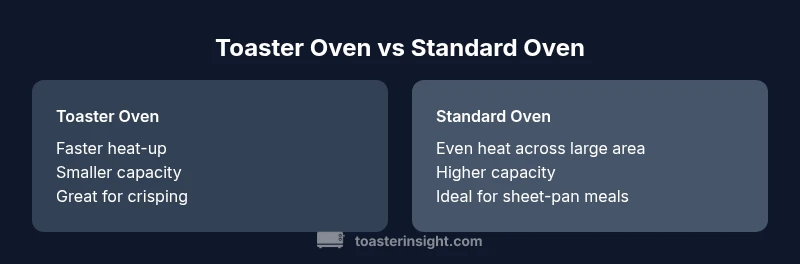
When you compare toaster oven vs oven cooking times, you’ll notice speed differences that hinge on size, preheating, and convection. For small tasks, a toaster oven typically heats quickly and delivers crisp results with minimal wasted energy. For large batches or pans, a standard oven usually provides more even heat and reliable timing. According to ToasterInsight, use the smaller appliance for quick searing or toasting, and reserve the full-size oven for sheet-pan meals and big roasts.
Why cooking times differ between appliances
The phrase toaster oven vs oven cooking times points to a fundamental truth: size, heat source, insulation, and airflow all shape how long food takes to reach the desired doneness. A toaster oven’s compact cavity heats more quickly and loses heat less evenly when crowded, while a traditional oven benefits from a larger chamber that can maintain stable temperature across multiple racks. The ToasterInsight analysis shows that small dishes reach serving readiness faster in a toaster oven, but larger meals often need the expansive heat and even distribution of a full-sized oven. For many home cooks, this means choosing tools by portion size, not just by function. In practical terms, think about what you’re cooking, how many people you’re feeding, and whether you’re aiming for a crisp exterior or a uniform bake. The core takeaway is simple: toaster ovens excel at speed and crispness for small tasks, while standard ovens excel at volume and evenness for larger dishes.
How preheating and convection influence timing
Preheating can dramatically affect how soon you can start cooking, especially when you are using a toaster oven. Because the cavity is smaller, heating elements reach target temperatures faster, so preheat times are often shorter. Convection, when available, adds a fan-driven air flow that speeds up heat transfer and can reduce cooking times by accelerating browning and evenness across a tray. When comparing devices, the presence and performance of convection in a toaster oven can be a deciding factor for tasks like roasting vegetables or baking cookies. In general, convection is a strong ally for time efficiency, but it can also cause uneven browning if racks are misaligned or overcrowded. For the best results, keep air moving, avoid overloading the pan, and use convection when you want a crisp, evenly browned finish. As ToasterInsight notes, understanding how convection and preheating interact with dish size helps you anticipate timing more accurately.
Understanding heat source and rack placement
The heat source location and how you place racks matter almost as much as the device itself. A standard oven distributes heat more evenly across the chamber, which means larger items cook through more uniformly—even when the temperature setting is the same. A toaster oven’s heating elements are closer to the food, which can yield quicker browning on the top or edges but may create hot spots if racks are stacked improperly. Rack placement determines how heat circulates: a single rack centered often yields even results, while a second rack can shorten total cooking time for multi-tray tasks, provided you rotate trays to balance heat exposure. If you want consistent results, consider using two levels only when necessary and rotate halfway through cooking to minimize disparities.
Food categories: proteins, vegetables, baked goods, and frozen items
Not all foods behave the same when cooked in a toaster oven versus a full-size oven. Thin proteins like chicken cutlets reach doneness faster in a toaster oven due to close heat proximity, while thick roasts benefit from the consistent, slower heat of a standard oven. Vegetables roasted on a sheet pan may brown more quickly in a toaster oven if the pan is small and hot, but batch size matters; overcrowding slows browning and can extend total cooking time. Baked goods, particularly cookies and small pastries, often perform well in toaster ovens with careful monitoring for early browning. For frozen items, both appliances can reach the target texture sooner if you avoid overloading the oven and use convection when available to speed heat distribution. Across foods, plan for faster start-up in toaster ovens and reserve slower, larger-batch cooking for standard ovens.
Practical timing strategies for common foods
A practical approach to toaster oven vs oven cooking times is to start with a baseline, then adjust. For a small batch of vegetables, begin with a lower temperature than your standard oven recipe and monitor browning closely, using convection if your model supports it. For reheating leftovers, a toaster oven can crisp the exterior in a fraction of the time compared with a microwave, but you should check for deterrents like moisture buildup. When baking cookies or small pastries, consider using the toaster oven’s convection setting to achieve even browning, but keep an eye on edges that might burn faster than the center. For larger items such as a turkey breast or a big casserole, preheat a standard oven and use a longer cooking window to ensure even heat penetration. The key takeaway is to adjust both temperature and time down compared with a standard recipe when using a toaster oven, and to use divided pans or multiple batches only if you must.
Size, capacity, and cookware impact on timing
The size and capacity of your appliance influence timing more than you might expect. In a toaster oven, the same recipe executed in a larger pan can cook faster due to the smaller mass needing heat to penetrate; however, the limited interior space may limit air circulation and cause hot spots if the tray is cramped. Cookware matters too: dark, nonstick pans absorb more heat and can shorten cooking times, while glass or ceramic can extend them. Positioning and spacing the cookware to encourage heat flow is essential. On a standard oven, air flow is designed for larger trays and multiple racks, which can reduce the need to rotate dishes, but this advantage is offset by higher preheat times and longer total cooking durations for small items. Understanding these dynamics helps you fine-tune recipes for consistent results across appliances.
When a traditional oven is preferable or not
There are scenarios where a full-size oven is clearly the better choice, even if toaster ovens are faster for many small tasks. If you’re feeding a crowd, need to roast multiple large items simultaneously, or require consistent results across several trays, a standard oven’s capacity, even heat, and ability to accommodate larger cookware makes it the better option. Conversely, for quick breakfasts, lunches, and tiny batches, a toaster oven often provides an efficient, space-saving alternative that minimizes preheat time and energy use. The decision comes down to batch size, desired texture, and kitchen footprint. ToasterInsight’s guidance emphasizes that knowing your typical meals will help you decide which appliance to rely on most days.
Quick-start guide: estimating times without a test bake
If you’re in a pinch and don’t have time to run a test bake, use a conservative approach: start with the toaster oven a little cooler than a standard recipe suggests, and check early for doneness, especially with foods that brown quickly. For larger meals in a standard oven, allocate extra time for preheating and assume even heat distribution, then adjust by monitoring the center of large roasts or casseroles. Keep a cooking log for new recipes to note how long items actually take in your particular model. Routine adjustments, paired with a simple timer, will help you approximate cooking times more accurately over time and reduce the guesswork that often accompanies toaster oven vs oven cooking times decisions.
Common mistakes that affect cooking times and how to avoid them
One common mistake is overcrowding the oven or toaster oven, which blocks air flow and increases total cooking time. Another error is relying solely on a recipe’s stated time without accounting for your specific appliance, pan size, or rack position; always verify with a visual check for browning and doneness. Failing to preheat or using an inappropriate temperature can lead to undercooked centers or over-browned exteriors. Finally, ignoring convection settings can extend cooking times unnecessarily. By calibrating your expectations, using proper rack placement, and allowing for a brief rest period after cooking, you can optimize outcomes and shrink the gap between toaster oven and oven cooking times.
Comparison
| Feature | Toaster Oven | Standard Oven |
|---|---|---|
| Heat-Up Time | Faster to ready (compact cavity) | Slower due to larger chamber and added mass |
| Convection | Often built-in (model-dependent) | Typically not convection unless fan-assisted |
| Capacity | Small to medium batches (1-4 servings) | Large batches and multiple trays (4-6+ servings) |
| Best For | Snacks, small meals, toasting, crisping | Roasts, sheet-pan meals, large casseroles |
| Energy Use | Lower energy per item; efficient for quick tasks | Higher total energy; better for big batches |
| Temperature Range | Typically up to 450-500F in many models | Broader range with full heat control including high temps |
Positives
- Faster preheating and smaller energy bursts for quick tasks
- Space-saving appliance for small kitchens
- Convection can enhance browning and even cooking when utilized
- Great for snacks, small bakes, and reheating with crisp results
- Typically lower upfront cost and easy replacement parts
Drawbacks
- Limited capacity for large meals or multiple dishes
- Potential for uneven browning on some models without careful placement
- Requires more frequent monitoring for precision with small items
- Preheating and cooking times can vary with door seals and insulation quality
Toaster oven wins for small tasks; standard oven wins for large meals
Choose a toaster oven for speed and crisping of small portions. Opt for a standard oven when cooking larger quantities or when even, uniform heat is essential for multiple trays or big roasts.
Your Questions Answered
Which cooks faster, a toaster oven or a standard oven?
In most cases, a toaster oven preheats and cooks faster for small portions due to its compact cavity and close heat sources. A standard oven takes longer to reach temperature but handles larger meals with more even heat distribution. The difference is most noticeable with single-serving or small batch cooking.
Typically, the toaster oven cooks faster for small portions, while a full-size oven shines for larger meals.
Do I need to preheat a toaster oven the same as a full-size oven?
Preheating a toaster oven is often shorter, sometimes only a few minutes, but it depends on the model and the target temperature. For many recipes, you can start cooking a bit sooner in a toaster oven, then monitor progress closely to prevent over-browning.
Yes, you should preheat, but it usually takes less time than a full-size oven. Watch the food closely the first few minutes.
Can I cook large meals in a toaster oven?
Toaster ovens are best for small to medium tasks. Large meals require more space and even heat, which a standard oven provides. You can cook larger items in batches if your toaster oven supports multiple racks and you’re mindful of airflow.
For large meals, a full-size oven is usually the better choice; use a toaster oven for smaller batches or quick tasks.
How accurate are times suggested for toaster ovens?
Times are guidelines and can vary due to model differences, rack position, pan material, and convection. Start with the lower end of the suggested time, then check for doneness and adjust in future attempts.
Times are guidelines—check early and adjust as needed.
What about frozen foods in a toaster oven?
Frozen items often cook faster in toaster ovens due to higher surface heat, but follow package directions and monitor closely to avoid sogginess or burning. Allow for a brief rest after cooking to improve texture.
Frozen items can cook quickly in a toaster oven; start with lower times and watch closely.
Key Takeaways
- Choose appliance by batch size and texture goal
- Leverage convection to reduce browning time when available
- Preheat appropriately and monitor early for best results
- Rotate trays and avoid overcrowding to improve even cooking
- Log your results to calibrate future times