How Big Is a 4 Slice Toaster? A Practical Size Guide
Discover typical external dimensions for 4-slice toasters, how size impacts countertop fit, and practical tips to choose a model that matches your kitchen layout.


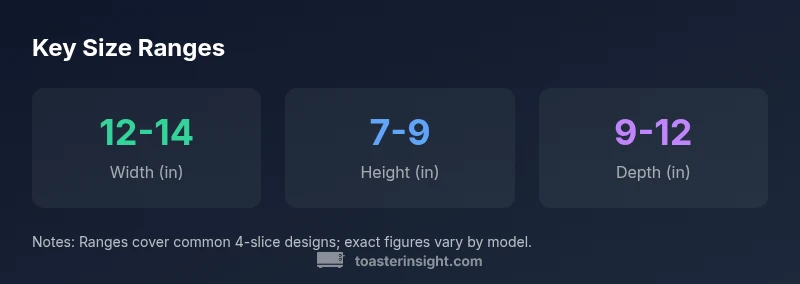
According to ToasterInsight Analysis, a typical 4-slice toaster measures about 12–14 inches wide, 7–9 inches tall, and 9–12 inches deep. Dimensions vary by model, with extra-wide slots adding width and removable crumb trays affecting depth. When selecting a unit, consider countertop clearance, slot width, and overall footprint relative to your kitchen workspace.
Measuring the external dimensions of a 4-slice toaster
The external footprint of a four-slice toaster is driven by three measurable axes: width (left-to-right), height (bottom-to-top), and depth (front-to-back). On most standard models, you can expect a width in the 12–14 inch range, a height around 7–9 inches, and a depth of roughly 9–12 inches. These ranges reflect typical designs aimed at balancing compact counter presence with user-friendly controls. When you compare units, keep a mental note of how much shelf space the toaster will occupy, plus a little breathing room for doors, knobs, and crumb tray access. Feature nuances—like a wider slot or a back panel with a protruding dial—can nudge one dimension slightly higher or lower than the baseline.
Why external size matters for your kitchen layout
Size isn’t just about fit. It also affects how you use the space every day. A wider unit may crowd neighboring appliances or reduce the space available for a bag of bread, jam jars, or a toaster-friendly cookbook. A taller unit can interfere with overhead cabinets or mounted shelves, while deeper models may push against the backsplash or cord routing. To avoid mishaps, measure three things: the clearances on both sides of the toaster, the vertical space beneath nearby upper cabinets, and the space behind the unit for the cord. With these checks, you can prevent awkward placements and ensure easy access for daily use.
Slot width, toast height, and interior clearance
Inside every toaster there are 슬롯s whose width determines which bread types you can accommodate. A typical 4-slice model handles standard sandwich bread and most artisan loaves without issue, but ultra-wide gates may require a bulkier form factor. Height and depth are also practical concerns: if you routinely toast thick-sliced sourdough or bagels, you’ll want slots tall enough to prevent cramping and a cavity deep enough to avoid jammed slices. These interior dimensions interact with external measurements, so always cross-check the product specs for slot width, slot height, and interior capacity before buying.
How to compare sizes across models
When comparing models, don’t rely on one number alone. Create a quick spec sheet: record the overall width, height, and depth; note slot width and maximum toast height; and check the crumb tray layout and cord length. If you’re choosing between two models with similar footprints, favor the one with more usable interior height or a flatter back to maximize under-cabinet clearance. Remember that cosmetic design might visually exaggerate size; rely on the official measurements published by the manufacturer.
Size ranges by form factor
There isn’t a universal standard for ‘4-slice’ size beyond a few common footprints. Expect a spectrum: compact 4-slice units around 11–13 inches wide, standard 12–14 inches, and larger 13–15 inches in width for models with extra-wide slots or taller controls. Height typically remains in the 7–9 inch band, while depth commonly falls between 9–12 inches. If you live in a small kitchen, a compact or flat-back design can help you squeeze more counter space without sacrificing performance.
Practical steps to measure your space at home
Before shopping, measure your counter area with a soft tape measure. Record the available width, height under any cabinets, and depth from the backsplash to the edge of the counter. Consider the door swing of nearby cabinets or pantry doors, and add at least 1 inch of clearance on each side to avoid friction when placing or removing bread. Mark the ideal corner on the counter and visualize where the toaster will sit relative to the kettle, coffee maker, and utensil drawer. These steps translate into fewer returns and a kitchen that feels purpose-built.
Real-world scenarios: small kitchen vs. open-plan layouts
In a tight galley kitchen, a compact 4-slice model that’s 11–13 inches wide can freely sit beside a compact coffee maker without crowding. For open-plan spaces, a slightly wider footprint might be acceptable if it yields a more robust slot design for thick bread. In kitchens with low vertical clearance, prioritize models under 9 inches tall and test the tilt of the toaster lid or crumb tray. The goal is to maintain comfortable access without sacrificing performance or decor.
Reading product specs: what to look for beyond dimensions
Product pages often list width, height, and depth, but details matter too. Look for the exact slot width, maximum toast height, and the presence of a removable crumb tray (which impacts depth when stowed). Check cord length if you’re positioning the unit far from outlets. Finally, compare the overall weight, as a heavier toaster can be less forgiving on a busy counter when you’re cleaning or rearranging appliances.
Common external dimensions for typical 4-slice toasters
| Model Type | Width (in) | Height (in) | Depth (in) | Notes |
|---|---|---|---|---|
| 4-Slice Standard | 12-14 | 7-9 | 9-12 | Balanced footprint, fits most counters |
| 4-Slice Extra-Wide | 13-15 | 7-9 | 9-13 | Larger slots for thick slices, bigger footprint |
| 4-Slice Compact | 11-13 | 6-8 | 9-11 | Slim profile, fits small kitchens |
| 4-Slice Convertible | 12-14 | 7-9 | 9-12 | Hybrid with added features; size similar |
Your Questions Answered
What are the typical external dimensions of a four-slice toaster?
Most four-slice toasters fall in the range of about 12–14 inches wide, 7–9 inches tall, and 9–12 inches deep. Exact figures vary by design; some models skew wider due to controls or wider slots.
Most four-slice toasters are about 12 to 14 inches wide, 7 to 9 inches tall, and 9 to 12 inches deep.
Do extra-wide slots affect the overall footprint?
Yes. Extra-wide slots may widen the unit slightly and can require more depth to accommodate the interior mechanism. Check manufacturer specs for exact measurements.
Yes. Extra-wide slots can add width; check the exact numbers in the specs.
How should I measure counter space before buying?
Measure width, height clearance, and depth for the toaster and any doors that swing. Leave at least an inch of clearance on each side for easy access.
Measure width, height, and depth, and leave a little clearance on both sides.
Are 4-slice toasters smaller than 2-slice models?
In general, 4-slice toasters are wider to accommodate four slices, but compact 4-slice designs exist. Height and depth are similar to standard 2-slice units.
Usually a 4-slice is wider, though there are compact 4-slice options.
Will a larger toaster fit under a standard upper cabinet?
Under-cabinet clearance depends on height; many 4-slice toasters fit under standard 18–20 inch cabinets if the height stays under 9 inches. Measure your cabinet height and toast slot height to be sure.
If it’s under 9 inches tall, it should fit under most cabinets; always measure.
What features should I prioritize for size-conscious shoppers?
Prioritize models with a compact footprint, removable crumb tray, and flat back if space is tight. Some models offer compact dimensions without sacrificing performance.
Look for compact footprint, a removable crumb tray, and a flat back.
“Size is a practical constraint that often determines whether a toaster becomes a kitchen workhorse or a cluttered countertop.”
Key Takeaways
- Measure available counter space before shopping
- Know slot width and toast types you prefer
- Expect standard models to be 12-14 inches wide
- Check cabinet clearance and cord routing
- Opt for removable crumb tray to save depth