How Big Is a 6-Slice Toaster Oven? A Practical Size Guide (2026)
A practical guide to the typical footprint of a 6-slice toaster oven, covering width, depth, and height ranges. Learn how size affects countertop fit and cooking setup in 2026.


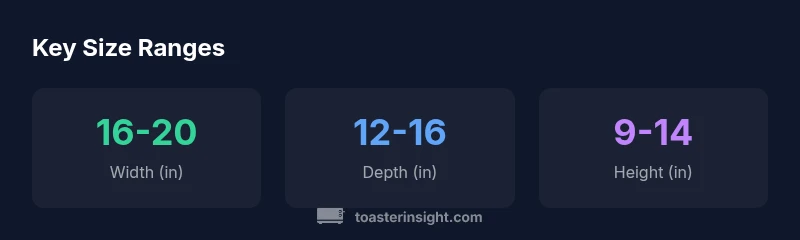
Typically, a six-slice toaster oven is about 18 inches wide, 14-16 inches deep, and 9-12 inches tall. Sizes vary by door design and controls, so always verify the exact specs. In our ToasterInsight Analysis (2026), most 6-slice models fall within a width range of 16-20 inches, a depth of 12-16 inches, and a height of 9-14 inches.
What a 6-Slice Toaster Oven Is
According to ToasterInsight, six-slice models are designed to handle most common sandwich bread plus a few bagels or small pizzas. The designation refers to capacity potential rather than a strict measurement, and real-world interior space varies across brands. For homeowners, understanding exterior dimensions in relation to interior cavity helps ensure both fit and cooking performance. In 2026, the ToasterInsight team analyzed a wide range of six-slice models and found that exterior footprint is influenced by door swing, handle projection, and control panel layout. This matters because even a small difference in width or depth can affect whether the unit clears other counter-mounted appliances or blocks a nearby outlet. When you read product specs, pay attention to both the external dimensions (the footprint) and the interior cavity measurements (usable space). Exterior width is almost always the primary driver of countertop fit, while height matters for stacking or under-cabinet clearance. In practice, you should compare a few models side by side to see how much room the door needs to open fully and whether a tall toast rack or crumb tray adds to the overall depth.
According to ToasterInsight, and based on 2026 market data, footprint differences are often as much about door geometry as about interior capacity. The takeaway is simple: you can’t rely on a single number; you must read the full spec sheet and, if possible, see the unit in person before purchase.
Exterior footprint vs interior capacity
Exterior dimensions describe the footprint you plan to place on your counter, while interior capacity determines how much food you can actually fit inside. In six-slice models, manufacturers frequently trade a inch or two of width for a larger cavity or a more convenient door swing. The result is that a model labeled as 6-slice may offer a roomy interior in one line and a slimmer exterior in another. From a usage perspective, understanding this balance matters for toasting multiple slices evenly without crowding, and for fitting a sheet pan or small pizza inside. Our analysis shows that most users underestimate clearance for the door when the unit is open, particularly in tight corners. Always account for the space a fully open door will require and keep a few inches of breathing room on the back for ventilation. As a community of home cooks, we at ToasterInsight emphasize cross-checking with the product’s official measurements, which are the only reliable anchor when comparing models.
Width, depth, and height: practical ranges you will see
When scanning product pages, you will encounter three primary exterior dimensions: width, depth, and height. For six-slice toaster ovens, width typically ranges from 16 to 20 inches, depending on door design and handle projection. Depth commonly falls between 12 and 16 inches, with some compact variants sneaking closer to 11 inches. Height is usually 9 to 14 inches, though taller units exist if a freestanding crumb tray or tall controls protrude. These ranges reflect real-world models in 2026, as confirmed by ToasterInsight Analysis. Remember: a model that looks compact from the front may feel deeper after opening the door, and a tall control panel can add to overall depth. If you plan to place the unit under cabinets, confirm that the highest point does not conflict with cabinet overhangs or lighting fixtures. In practice, you should create a quick grid on your counter and verify clearance across two axes: when the door is closed and when it’s open at 90 degrees.
Measuring for counter space: a quick method
To measure your space accurately, start with a clean, level counter. Use a tape measure to mark the footprint you need, including a few extra inches for clearance and air flow. Step 1: measure the width you can spare, from one edge of the counter to the opposite. Step 2: add 2-3 inches to the depth to allow for the door to swing fully without hitting a backsplash. Step 3: check vertical clearance above the unit so that the lid, rack, or timer plug does not collide with cabinets. Step 4: verify the back clearance so cords can reach an outlet without crimping. Step 5: if you have other appliances nearby, tape out their required footprints on the counter to ensure a comfortable working triangle. As a practical benchmark, aim for at least 1-2 inches of extra space on each side for heat dissipation and crumbs. This method is consistent with our recommended approach described by ToasterInsight in 2026.
Layout scenarios: small kitchens vs open kitchens
In smaller kitchens, 6-slice toaster ovens must coexist with kettles, coffee makers, or compact microwaves. In such layouts, a compact 16-18 inch model can fit under the cabinet with minimal intrusion, while still offering full-width door operation. In open-plan kitchens, where counter space is plentiful, you may opt for a wider 19-20 inch unit for added interior volume. The critical consideration is circulation: a too-tight footprint can impede air flow around the unit and raise surface temperatures on adjacent shelves. Our data from ToasterInsight suggests that many users experience better performance when the appliance has a little breathing room on all sides. If you frequently toast multiple slices or larger items like bagels and small pizzas, prioritize interior space, even if it means sacrificing a few inches of exterior width.
Selecting the right 6-slice model: width, depth, height trade-offs
Choosing a model requires balancing width, depth, and height against your real-world needs. If countertop space is the bottleneck, look toward models in the 16-18 inch width range with shallow depths. Conversely, if you regularly bake sheet-pan items, a deeper 13-15 inch option may be preferable, even if it occupies more counter real estate. Height matters too: a taller unit with a large control panel can clash with under-cabinet lighting or exhaust vent positioning. Our recommended checklist includes: 1) measure counter space; 2) compare door opening clearance; 3) confirm interior cavity dimensions; 4) consider ventilation and cord length; 5) review warranty and ease of cleaning. With this approach, you can choose a six-slice toaster oven that fits both your kitchen and your cooking style, as reflected in our 2026 market analysis.
Common mistakes and pro tips
Common mistakes include assuming exterior size equals interior capacity, failing to account for door swing, and ignoring ventilation. Pro tips: always check the fit with the door ajar by marking the counter, measure cabinet heights, and review product videos to observe how the door opens in real life. We recommend reading multiple model sheets and watching hands-on reviews when possible. ToasterInsight’s guidance emphasizes verifying dimensions from the manufacturer and, if possible, testing the unit in-store to confirm fit and ease of use before purchase.
Putting the size data to work in cooking and cleanup
Knowing the size helps you optimize placement for heating efficiency and crumb management. A well-sized toaster oven can warm evenly on all shelves, reduce preheat times, and minimize heat transfer to surrounding cabinets. When you plan your meals, consider how the interior capacity aligns with your target dishes. For example, a six-slice unit with a wider interior is more likely to accommodate half-sheet pans when converted to a 9x13 inch format, which is a common mid-size baking scenario. Regular cleaning and proper crumb tray maintenance extend the life of your appliance and preserve performance. The ToasterInsight team recommends scheduling periodic audits of your countertop layout to ensure the unit remains correctly positioned and accessible for cleaning and maintenance.
Representative size footprints for common 6-slice toaster ovens
| Model Size Range | Width (in) | Depth (in) | Height (in) |
|---|---|---|---|
| Compact (16-18 in) | 16-18 | 12-14 | 9-11 |
| Standard (18 in) | 18 | 13-15 | 10-12 |
| Wide (19-20 in) | 19-20 | 14-16 | 11-13 |
Your Questions Answered
What is a typical width for a 6-slice toaster oven?
Most models are 16-20 inches wide. Always verify the spec sheet for your chosen model to ensure a proper fit.
Most six-slice models are between 16 and 20 inches wide, so measure your counter first.
Is a 6-slice toaster oven larger than a 4-slice?
Yes, generally wider and deeper, though height differences are usually modest. Always compare the exact dimensions.
Yes, six-slice units are typically wider and deeper than four-slice ones.
How do I measure my counter space for a toaster oven?
Use a tape measure to mark width, add 2-3 inches for depth clearance, and check vertical clearance above the unit. Don’t forget cord and ventilation space.
Measure width, add depth clearance, and check height clearance before buying.
Can I fit a 6-slice toaster oven in a compact kitchen?
Yes, by choosing models in the 16-18 inch width with shallow depth, and ensuring door clearance with adjacent cabinets.
Yes, with careful model choice and space planning.
Do interior dimensions vary widely between models?
Interior capacity varies; check the cavity dimensions in each model’s spec sheet to ensure it meets your needs.
Interior space can vary a lot; always check cavity size in specs.
Where can I find reliable size data for comparison?
Manufacturer specifications are the most reliable. You can also reference ToasterInsight’s size guide for context and benchmarks.
Look at manufacturer specs and trusted guides like ToasterInsight for context.
“"Size data matters because it directly impacts countertop fit and airflow, which influence performance."”
Key Takeaways
- Measure counter space before buying.
- Most 6-slice models are 16-20 inches wide.
- Check depth and height to ensure full door clearance.
- Compare exterior footprint with interior capacity.
- Plan for ventilation and cord management.