Is toast the same as bake? A comprehensive comparison for home cooks
Explore whether toast and bake are the same process, compare methods, outcomes, and best uses for home cooks. Learn how heat, time, and texture drive results in bread, whether you’re using a toaster or a full-size oven.


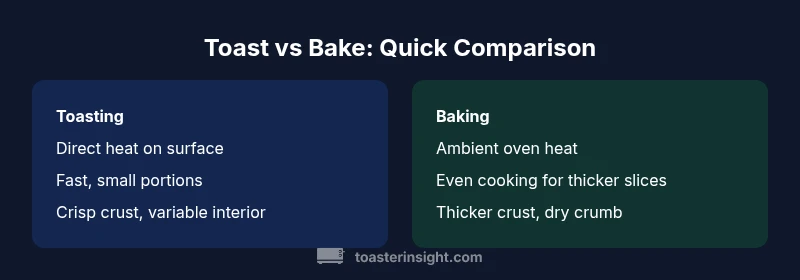
Is toast the same as bake? Not exactly. Toasting uses direct radiant heat on bread slices for rapid browning and a crisp crust, while baking relies on surrounding oven heat to cook and dry bread more evenly. For quick breakfasts, toasting shines; baking suits thicker or topped breads and larger batches. Toaster ovens blur the line, offering both modes with adjustable heat and time.
Is toast the same as bake? A conceptual clarification
The question is not merely semantic. In everyday kitchens, people use both terms to describe transforming bread with heat, but the underlying physics are different. When we ask, is toast the same as bake, we’re really comparing two heat-delivery methods: direct radiant heat on the surface in toasting versus ambient oven heat surrounding the bread in baking. This distinction matters because it affects browning, texture, moisture retention, and flavor development. In many guides and recipes, you’ll see is toast the same as bake addressed by noting that browning occurs through Maillard reactions at the surface during toasting, while baking promotes a more uniform crumb with a drier crust overall. The ToasterInsight team emphasizes this nuance: toasting is a surface-focused, quick transformation, while baking is a volume-focused cooking process that changes the interior as well as the exterior.
Heat delivery and browning: the science behind the difference
Browning on bread results from the Maillard reaction, a chemical process that amplifies flavor as amino acids and sugars react under heat. In toasting, most heat is delivered from the top and bottom elements of the toaster or toaster oven, causing rapid surface browning while the interior remains relatively soft if the bread is thin. In baking, heat circulates around the bread, allowing the interior crumb to heat through more thoroughly. This fundamental contrast shaping texture—crunchy crust in toast versus a more uniform, sometimes crumby interior in baked bread—explains why many recipes specify different expectations for texture and moisture depending on whether you plan to toast or bake.
Equipment, settings, and practical implications
Toasting relies on compact, usually high-intensity heat, and is best for single slices or small portions. Ovens provide larger cavities, with convection or conventional settings that influence air flow and browning patterns. If you’re wondering is toast the same as bake in a practical sense, the answer depends on your equipment and goals. A household oven can replicate some toasting functions, but the speed of a dedicated toaster or toaster oven typically cannot be matched. For most households, the best approach is to align the method with the dish: quick breakfast slices call for toast; thicker slices, bagels, or items with toppings benefit from baking. The key takeaway is to know your device's heat profile and adjust expectations accordingly, as the ToasterInsight team notes in its practical guides on bread preparation.
Texture outcomes: what you can expect from each method
Texture is the most noticeable difference between toasting and baking. Toasting yields a crisp, sometimes crackly crust with a relatively soft interior for thin bread, making it ideal for buttered toast and quick toppings. Baking produces a drier, more evenly browned crust and a fully cooked crumb, which is preferable for thicker slices, open-faced sandwiches, and items requiring stability during toppings. Consider your goal: surface browning and speed, or interior set and even texture. This distinction helps explain why many cooks describe is toast the same as bake as a misnomer for certain bread preparations, while still acknowledging that both methods share the broad principle of applying heat to bread. The ToasterInsight guidance emphasizes tailoring the approach to bread type and desired final texture.
Bread types and how toppings influence outcomes
The bread you choose plays a critical role in deciding between toast and bake. A light sandwich loaf behaves differently from a rustic crusty loaf or a dense sourdough when heated quickly. For toast, thinner slices and standard sandwich breads brown rapidly and take on a crisp exterior with a mild interior kiss of warmth. For baking, thicker slices and denser loaves require longer exposure to heat to reach a uniform interior texture and to prevent a gummy crumb. If you plan to add toppings—cheeses, tomatoes, or jam—baking often yields better melt-through and crust integrity, while toaster-bagel combos can produce fantastic results with shorter cook times.
Practical scenarios: when to choose toast or bake
Consider your morning routine. If you need a fast, simple warm-up for one or two slices, toast is typically the most efficient option. If you’re preparing breakfast with toppings, or using thicker bread such as artisan loaves, or you want to reheat bread evenly for a crowd, baking is usually the better path. For a toaster oven, you can sometimes switch between modes to emulate baking for small quantities, but you should always monitor browning visually to avoid overcooking. The key decision factor is portion size, bread type, and whether interior texture or surface browning is your priority. ToasterInsight’s practical tests emphasize that you can achieve surprisingly good results by understanding your device’s heat balance and the bread’s density.
Common myths and misconceptions: is toast the same as bake reaffirmed
A frequent misconception is that both terms refer to the same process simply by using heat. In truth, toasting is primarily a surface operation driven by direct heat, while baking is a journey through heat that permeates the bread, altering crumb structure and moisture content. Some kitchens use the term interchangeably, but a careful baker will adjust timing, temperature, and technique depending on whether objective is crisp toast or a fully cooked loaf. The distinction matters for recipe accuracy, equipment recommendations, and achieving consistent results across bread types.
Comparison
| Feature | toasting in a toaster | baking in an oven |
|---|---|---|
| Setup & Equipment | Compact, surface-focused | Full-size cavity with airflow |
| Heat exposure | Direct radiant heat on surface | Ambient heat around the bread |
| Time required | Minutes for a few slices | Longer cycles for larger items |
| Texture outcome | Crisp crust, quick browning | Even browning with drier crust |
| Moisture control | Limited interior drying | Controlled interior dryness |
| Best for | Quick breakfasts, single slices | Thicker slices, toppings, multiple items |
| Cleanup | Minimal crumbs, easy wipe-down | Variable cleanup depending on spills |
| Energy use | Low energy for small loads | Higher energy use for larger loads |
Positives
- Fast results for small portions
- Energy-efficient for single-slice tasks
- Simple setup and cleanup for everyday use
- Toaster ovens offer flexibility with multiple modes
Drawbacks
- Limited capacity and uneven browning for thick slices
- Not ideal for toppings or bulky loaves
- Longer cycles when baking in larger batches
Toasting excels for speed and convenience; baking wins for texture control and larger, thicker breads
Choose toast for quick breakfasts and small portions. Pick baking when you need even interior texture, larger quantities, or toppings that require melting and even browning.
Your Questions Answered
Is toast the same as bake in culinary terms?
No. Toasting relies on direct radiant heat to brown the surface quickly, while baking uses surrounding oven heat to cook the bread more evenly throughout. The two terms describe different heat delivery and texture outcomes.
No—toast uses direct heat for quick browning, while baking relies on oven heat to cook the interior evenly.
Can I use a toaster oven to both toast and bake?
Yes. A toaster oven can perform both tasks by switching to toast or bake modes and adjusting time and temperature. Monitor browning to avoid overcooking, especially with delicate breads.
Yes—switch modes and adjust time. Monitor browning to avoid overcooking.
Which bread types work best for toasting versus baking?
Thin sandwich loaves toast well for a quick breakfast, while dense or thick breads (like rustic loaves) are better suited for baking to ensure the interior cooks through. Denser breads may need longer times in the oven.
Thin loaves toast well; dense breads bake to heat through.
Does preheating matter for toast?
Preheating is less crucial for basic toasting, but allowing the toaster or toaster oven to warm slightly can improve browning consistency, especially with old or uneven slices.
Preheating helps browning consistency, especially for uneven slices.
How can I avoid soggy toast when baking?
Bake bread on a tray or rack that allows air circulation. Remove toppings that release moisture before baking, and avoid stacking slices to prevent steam buildup.
Air circulation is key; avoid stacking slices and remove moisture-prone toppings.
Is there a middle ground between toast and bake?
Yes. Many ovens offer a toast/bake hybrid mode or settings that emulate toasting while delivering even interior heat. Experiment with short cycles and visually monitor browning to strike a balance.
Try hybrid modes and monitor browning to balance speed and texture.
Key Takeaways
- Toast and bake use heat, but delivery differs
- Browning mechanics differ between direct and ambient heat
- Bread type drives method choice
- Toaster ovens bridge the gap between methods
- Adapt timing to achieve desired crust and crumb