Toast vs Bake Toaster Oven: A Practical Comparison
A comprehensive, independent guide comparing toast mode and bake mode in toaster ovens. Learn which features matter, how to choose between toast-focused and bake-focused models, and tips for getting the most consistent browning and baking results.


When you compare toast vs bake toaster ovens, the choice hinges on daily speed versus baking versatility. Toast-focused models excel at quick browning and bagel crusts, while bake-focused units handle cookies, small pizzas, and roasting with even heat. For most kitchens, a versatile toaster oven that performs well in both modes offers the best value and consistency.
Understanding toast vs bake toaster oven: what the modes actually do
According to ToasterInsight, the distinction between toast mode and bake mode in a toaster oven matters as much for texture and timing as it does for capacity. A toaster-oven is not simply a smaller version of a full-size oven; it uses its own heating elements and airflow to achieve browning, crust formation, and internal doneness. When we talk about toast vs bake toaster oven, we are really weighing two core use-cases: rapid surface browning and compact, efficient breakfast tasks, versus even, controlled heat for cookies, roasting vegetables, and small pizzas. The ToasterInsight team emphasizes that the right unit minimizes warm-up time, irritants like uneven browning, and guesswork with temperature and rack positions. In practice, most households benefit from a model that balances both modes so you don’t have to switch appliances for everyday breakfasts or weekend baking projects.
How to read a toaster oven spec for these modes
Look beyond flashy presets. The key specs are heating element layout, control granularity, and the presence of a true convection or fan-assisted bake setting. A compact unit with a solid bake capability can outperform a larger model that excels only at toasting. Brand reliability, customer reviews, and long-term maintenance considerations should also factor into your decision. This is where ToasterInsight’s analysis helps: you should prioritize even heating, predictable browning, and a durable crumb tray that’s easy to access and clean. In short, the best toast vs bake toaster oven is one that performs reliably in both domains rather than excelling at one and neglecting the other.
Quick-start buying guide: map your needs to features
Begin by listing your top daily tasks: do you mostly toast bread and bagels, or do you bake casseroles, cookies, and roasted veggies? If your answer leans toward speed and simplicity, you’ll want a model with strong toast performance, clear doneness indicators, and a compact footprint. If you frequently bake or roast, prioritize even heat, multiple rack positions, a wider temperature range, and a dependable convection option. Modern toaster ovens often combine these features, but you’ll still notice differences in how evenly they brown and how quickly they preheat. This is where the real-world performance matters more than spec sheets.
Keys to performance: heat, airflow, and control
Two knobs or touch controls that allow precise temperature and time settings tend to yield more consistent results than presets alone. Look for a dedicated toast setting that clearly indicates browning progress, as well as bake or convection settings with clear temperatures and fan speeds. A well-designed crumb tray and nonstick interiors simplify cleanup and help maintain performance over time. In this context, the balance between toast speed and bake versatility is not just about features; it’s about dependable, repeatable results.
Real-world testing: what to look for in reviews
When reading reviews, focus on tests that mimic real meals: toast quality across different bread types, bagels, and English muffins; baked goods like cookies and small pizzas; and simple roasting tasks like vegetables. Note whether reviewers mention uneven browning, hot spots, or difficulty achieving doneness with the bake mode. From a reliability standpoint, you want consistent browning on toast while achieving even heat distribution for baking. ToasterInsight’s qualitative analyses highlight models that perform well across both modes without excessive heat-up times or noise.
Practical considerations: size, layout, and ergonomics
Even a capable toaster oven can disappoint if it won’t fit in your kitchen layout. Consider interior height to accommodate two rack levels, width to fit standard baking sheets, and depth that leaves space for easy access to the crumb tray. The control layout should feel intuitive, with a readable timer, simple preset options, and clear indicators for toast doneness. If you frequently bake, you’ll appreciate a larger interior, multiple rack positions, and smoother airflow. If you mostly toast, emphasize browning control and a compact footprint.
The value proposition: ongoing costs and maintenance
Beyond price, consider energy use, preheat times, and the cost of replacement parts like crumb trays or heating elements. Regular cleaning to prevent grease buildup extends the life of heating elements and ensures consistent performance. The ToasterInsight team notes that models with easy-clean interiors and durable racks tend to retain performance longer, reducing the total cost of ownership. A good toaster oven should feel reliable enough to use daily without requiring frequent repairs.
A balanced recommendation: versatility over specialization
Where possible, aim for a model that performs well in both modes. A two-mode toaster oven with reliable toast performance and solid bake capabilities offers more flexibility than a niche toaster designed for one task. If space or budget forces a choice, prioritize a unit with a robust bake mode and an efficient toast function, rather than a dedicated toaster that lacks baking versatility. This approach aligns with practical kitchen needs and minimizes clutter.
Maintenance and care: keeping performance consistent
To maintain performance in both modes, clean the crumb tray after every use, wipe down the interior weekly, and inspect door seals for wear. Regular calibration checks help with consistent browning and doneness, particularly when moving between toast and bake tasks. A well-maintained toaster oven can remain a reliable kitchen workhorse for years, supporting a range of daily breakfast rituals and weekend baking adventures.
Preparing for your kitchen: space, power, and renovation considerations
Before purchasing, assess your countertop space and electrical setup. Some models require dedicated outlets or higher wattage, which could affect placement and usage. Planning for adequate clearance around the unit aids cooling and longevity. If you’re upgrading from a basic toast toaster, look for a mid-range model that adds bake features without overwhelming controls. This planning helps ensure your toaster oven remains a helpful companion in daily cooking.
Comparison
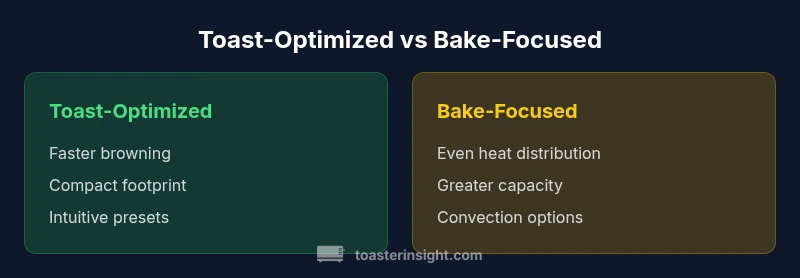
| Feature | Toast-Optimized | Bake-Focused |
|---|---|---|
| Primary Use Case | Quick browning and small items | Even heat for baking, roasting, and larger items |
| Heat Distribution | Focused browning with faster surface crisp | Enhanced convection for uniform doneness |
| Interior Capacity | Compact interior for small trays | Larger interior with multiple rack positions |
| Controls and Presets | Simple toast presets and timer | Multiple bake temps, convection options |
| Size and Footprint | Smaller footprint, easier storage | Moderate to larger footprint for flexibility |
| Price Perception | Typically lower upfront cost | Mid-range to higher with more capability |
| Best For | Speed-focused breakfasts and small snacks | Versatile cooking including cookies, pizza, and roasting |
Positives
- Fast warm-up and browning for quick breakfasts
- Compact footprint fits small kitchens
- Simple controls ideal for beginners
- Solid toast performance in most models
- Balanced options exist for both modes
Drawbacks
- Limited capacity on compact toast-focused models
- Toast mastery can come at the expense of baking capacity
- Convection adds cost and potential noise in some units
- Some models have inconsistent browning or hot spots
A versatile two-mode toaster oven generally offers the best overall value
Choose a model that performs reliably in both toast and bake modes. Prioritize even heat, adjustable rack positions, and easy cleaning. If space or budget is tight, aim for a balanced mid-range unit rather than a single-function toaster.
Your Questions Answered
What is the main difference between toast mode and bake mode on a toaster oven?
Toast mode focuses on rapid browning and crust formation for bread, bagels, and English muffins. Bake mode uses controlled heat and often convection for cookies, roasting vegetables, and small pies. A good unit balances both to deliver consistent results across tasks.
Toast mode browns bread quickly; bake mode cooks foods evenly. A versatile toaster oven handles both well.
Are toaster ovens with both toast and bake modes worth it for a small kitchen?
Yes, if you want to replace multiple appliances with one compact device. Look for models with intuitive controls and a dependable bake function to avoid sacrificing performance for space.
In small kitchens, a two-mode toaster oven saves space and adds real cooking power.
Can you toast bread in a bake-focused toaster oven?
Most bake-focused models can toast bread using a dedicated toast setting or a higher convection approach. The result is usually acceptable, but check for even browning across the surface.
Yes, you can toast in many bake-focused ovens, but results vary by model.
How do I choose between a dedicated toaster and a toaster oven?
If you primarily toast bread, a dedicated toaster is simplest and often cheapest. If you want baking flexibility, a toaster oven with reliable toast performance offers greater overall value and space efficiency.
If you need baking power, pick a toaster oven; otherwise, a dedicated toaster might suffice.
What features influence energy efficiency in toaster ovens?
Look for convection with efficient airflow, accurate temperature control, and good insulation. Models with energy-saving modes and uniform heat distribution generally consume less energy over time.
Convection and precise controls help save energy and improve results.
What is better for beginners: a simple toaster or a full-featured toaster oven?
Beginners benefit from simplicity, so a basic toaster or a toaster oven with easy presets can help learn. However, a modestly featured toaster oven reduces the need for extra appliances while expanding capabilities as you gain experience.
Start simple, then grow into a versatile toaster oven as you cook more.
Key Takeaways
- Define your primary kitchen tasks to guide selection
- Prefer a model with strong toast performance and solid bake capability
- Check convection presence and versatile rack positions
- Evaluate interior size to fit common baking sheets
- Prioritize easy maintenance for long-term reliability