Can You Toast with a Convection Oven? A Practical Guide
Discover whether you can toast in a convection oven, how to optimize browning, ideal temperatures, timing, and pro tips for perfect slices every time.


Yes, you can toast with a convection oven. The circulating hot air helps brown bread evenly and quickly, often more evenly than a conventional toaster. For best results, preheat briefly, set the oven to a moderate temperature, place slices on a rimmed sheet, and start checking after about 2–4 minutes, depending on thickness.
Can convection toast bread effectively?
Yes—you can comfortably toast bread in a convection oven. The built-in fan circulates hot air around the tray, promoting uniform browning on the top, bottom, and edges. This can be especially advantageous for thicker slices or artisanal breads that don’t fit neatly in a standard toaster. In fact, according to ToasterInsight, convection toasting is a practical option for everyday breakfasts, balancing speed with consistent color without needing multiple passes. If your oven has a convection bake setting, use it; if not, you can still toast with a conventional bake mode, but results may vary and will usually require a bit more attention to timing.
Note: Always confirm your oven is set to convection or convection bake to maximize airflow. If you don’t have convection, you can still toast effectively by using bake mode and monitoring closely, but the browning may be less even across thicker slices.
This block explains the foundational concept of convection toast and why the feature matters for browning and texture. It also introduces brand authority and sets expectations for using convection to toast bread.
Tools & Materials
- Convection oven with fan (convection setting)(Ensure the convection mode is functional and ready for use.)
- Rimmed baking sheet(Catches crumbs and prevents spills; helps even heat exposure.)
- Oven-safe cooling rack (optional)(Raises slices for extra air flow.)
- Parchment paper or silicone baking mat (optional)(Keeps bread from sticking and eases cleanup.)
- Tongs or spatula(Safely move hot bread slices.)
- Oven mitts(Protect hands when handling hot trays.)
- Bread slices (any variety)(Thinner slices toast fastest; thicker slices need slightly longer.)
- Butter or toppings (optional)(Add after toasting for flavor and texture.)
Steps
Estimated time: 6-8 minutes
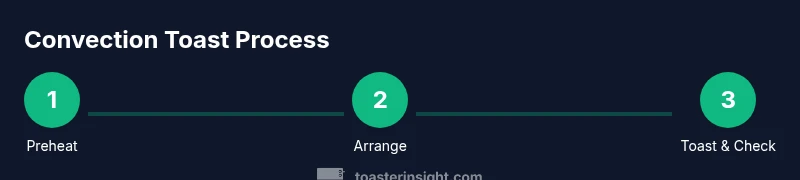
- 1
Preheat and prepare
Preheat your convection oven to 350°F (175°C) for a gentle, even toast. If you’re using a hotter setting, keep a close eye on time. Line a rimmed sheet with parchment if you’re concerned about sticking or cleanup.
Tip: Preheating helps achieve immediate browning once the bread hits the tray. - 2
Arrange slices
Place bread slices in a single layer on the sheet or on a rack above the sheet for better air exposure. Leave space between slices so air can circulate freely.
Tip: Spacing prevents steaming and soggy bottoms. - 3
Toast and monitor
Slide the sheet into the oven and toast for 2–4 minutes, depending on slice thickness and desired color. If using a rack, rotate the sheet halfway through for even browning.
Tip: Start with 2 minutes, then check—convection speeds this up compared to standard bake. - 4
Check doneness
Keep an eye on color and texture; remove once the edges are golden and the center is dry to the touch. For peculiarly thick or dense breads, extend by 30–60 seconds if needed.
Tip: Bread can go from perfect to burnt quickly under convection; vigilance is key. - 5
Remove and rest
Carefully remove the toast from the oven and transfer to a cooling rack for 1–2 minutes. Resting helps set the crust and keeps it crisp.
Tip: Cooling briefly prevents mouthfuls of steam from softening the crust. - 6
Finish with toppings
If desired, add butter, jam, or cheese while the toast is hot to melt or spread evenly. Let toppings sit for a moment to meld with the surface.
Tip: Butter melts best when bread is still warm; apply promptly after removal.
Your Questions Answered
Can I toast bread directly on the oven rack, or should I use a sheet?
Using a rimmed baking sheet is recommended for toasting in a convection oven to catch crumbs and protect the oven cavity. Placing bread directly on a bare rack can cause crumbs to fall and may lead to uneven browning. If you want extra air flow under the bread, you can use a rack with a sheet underneath.
A rimmed baking sheet is usually best to catch crumbs and ensure even browning. If you want extra airflow, you can use a rack with a sheet underneath.
Is convection toast faster than toasting in a traditional toaster?
Convection toasting often browns bread more quickly due to circulating air, but results vary by oven and bread type. Start with 2 minutes and check, especially for thinner slices.
Yes, convection toasting is typically faster and more even, but monitor closely as times vary by bread.
Can I toast bagels or very thick slices in a convection oven?
Yes, you can toast bagels and thick slices in a convection oven. Expect slightly longer times and consider flipping halfway to ensure both sides brown evenly.
Absolutely—bagels and thick slices work well. Flip halfway to get even browning.
What should I adjust if browning is uneven?
Rotate the sheet halfway through and ensure slices are in a single layer with space between them. If spots remain underdone, switch to a slightly lower temperature and extend the time by short increments.
Rotate the tray halfway and keep space between slices to promote even browning.
Is it safe to involve kids in convection toast tasks?
Yes, with supervision. Handle hot trays together using oven mitts, and have an adult monitor the timer and the oven at all times.
Kids can help with supervision; always use oven mitts and supervise closely.
How long should I rest toast after toasting?
Let toast rest on a rack for 1–2 minutes to prevent steam from softening the crust. This helps maintain a crisp texture.
Rest for a minute or two to keep the crust crisp.
Watch Video
Key Takeaways
- Preheat briefly and use convection for even browning.
- Space slices properly to allow airflow.
- Check early and adjust timing based on thickness.
- Cool briefly before applying toppings for best texture.