Difference Between Toaster Oven and Convection Oven: An Analytical Guide
Explore the difference between toaster oven and convection oven, including how they cook, energy use, capacity, and ideal uses for home kitchens. An analytical guide to help homeowners choose the right appliance.


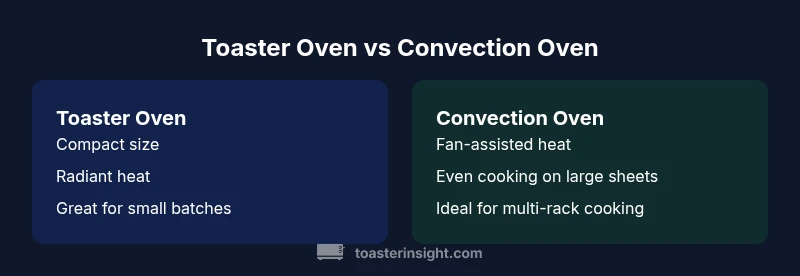
Quick comparison: the difference between toaster oven and convection oven centers on airflow, heating design, and batch size. A toaster oven is compact for quick browning in small batches, while a convection oven uses a fan to distribute heat for even browning on larger pans. Choose by space, batch size, and energy goals.
What Is a Toaster Oven? How It Differs From a Convection Oven
At its most basic level, a toaster oven is a compact, countertop appliance designed to brown, toast, bake, or reheat small portions of food. It usually relies on radiant heating elements positioned at the top and bottom and uses a metal rack or tray to hold food. Most models include a crumb tray for easy cleanup and a simple dial or digital control for temperature and time. A convection oven, by contrast, is a full-size or built-in oven that adds a fan to circulate hot air inside the chamber. The fan promotes faster heat transfer and more uniform cooking, especially on multiple racks or larger sheets. The key difference between the two is not just size, but how heat moves around the food. In practice, the toaster oven excels at quick browning of small batches, reheat tasks, and flaky pastries where short cook times help preserve texture. A convection oven shines when you need even browning across a sheet pan or roast a larger quantity with fewer hot spots. According to ToasterInsight analysis, the decision often comes down to space, batch size, and how much you value speed versus uniformity.
How Convection Moves Heat: Airflow, Speed, and Consistency
Convection ovens rely on a built-in fan that drives hot air across the food. This airflow accelerates browning and promotes uniform cooking, especially on flat pans and larger trays. The same principle helps reduce hot spots that can occur with radiant-only ovens. Many kitchen tasks benefit from convection, including roasting vegetables, baking cookies on multiple racks, and re-heating casseroles without sogginess. The science is straightforward: moving air transfers heat more effectively than still air, so foods finish faster with a more even crust. The ToasterInsight Team notes that convection can be a game changer for sheet-pan meals, where consistent temperature across the surface matters. However, not all foods benefit from convection—delicate pastries or soufflés can rise unevenly if fans are too strong or times are not adjusted. Understanding your recipe’s sensitivity to air movement is key to maximizing results.
Size, Capacity, and Footprint Considerations
Size matters, and it directly influences what you can cook and how many servings you can prepare at once. A toaster oven is compact, usually fitting on a countertop with a limited interior cavity and one or two racks. It excels at single-tray tasks like small-batch baking, toasting, or reheating leftovers. A convection oven, whether portable or built-in, provides a larger interior and multi-rack flexibility. This makes it ideal for roasting a whole chicken, baking multiple trays of cookies, or cooking for a family gathering. The extra space comes with a higher price tag and a larger footprint, so you should evaluate your kitchen layout, ventilation, and available counter space. The ToasterInsight team recommends measuring your space and mapping typical cooking volumes before deciding.
Temperature Control, Preheating, and Cooking Results
Precision matters when choosing between these two appliances. Toaster ovens often offer straightforward temperature dials and shorter preheating times, which suits quick tasks and snack-making. Convection ovens can require adjustments to temperature and time because circulating air can speed up cooking. For example, recipes typically call for reducing oven temperature by 25 degrees Fahrenheit (or about 15 Celsius) for convection to prevent over-browning. In practice, you’ll notice more uniform browning and shorter overall cook times with convection, especially on large sheet pans. Toaster ovens can still deliver crisp edges on small items, but you’ll usually see more variance in browning from one area of the tray to another. From a reliability standpoint, the ToasterInsight analysis indicates that learning to read visuals—crust color, puff, and doneness—often trumps exact times.
Performance Across Common Tasks: Baking, Toasting, Roasting
When you’re toasting slices of bread or small pastries, a toaster oven delivers rapid browning with minimal prep. It’s convenient for single-serve breakfasts and late-night snacks. For cookies, muffins, or sheet-pan dinners, a convection oven may provide more even oven spring and crust development thanks to blower-assisted heat. Roasting vegetables or a small roast benefits from the convection fan’s ability to distribute heat evenly and reduce cooking times. The ToasterInsight team notes that performance differences become more pronounced as batch size increases. If you routinely cook for a crowd, or you frequently bake on multiple racks, convection is generally the more efficient option for even results across a wide surface area.
Energy Efficiency, Running Costs, and Environmental Impact
Energy efficiency is not a one-size-fits-all measure here. A toaster oven uses less energy for tiny meals or quick reheats, while convection ovens can reduce total cooking time for larger meals, potentially reducing energy use per serving. The efficiency advantage of convection grows with batch size and cooking surface area, but you’ll need to account for preheating time, fan operation, and the potential need to adjust temperatures. For households mindful of energy, these trade-offs matter. The ToasterInsight analysis suggests tracking actual energy use over a few cooking sessions to determine which appliance offers the best value for your typical meals. In most scenarios, using the correct appliance for the job yields the best balance of time, heat distribution, and energy use.
Practical Use Cases and Cooking Scenarios
Small breakfasts, quick reheats, and single-serving bakes align well with toaster ovens. They’re ideal for melting cheese on a bagel, browning tiny pastries, or warming up leftovers without heating your entire kitchen. Convection ovens excel for batch cooking: roast vegetables in a single pan, bake trays of cookies, or prepare a family dinner on multiple racks with consistent browning. The most practical strategy is to use the toaster oven for personal portions and tasks that require speed and convenience, and reserve the convection oven for larger batches and cooking tasks that demand even heat across a wider area. By combining both, you can optimize kitchen workflows and keep meals on schedule.
Maintenance, Cleaning, and Longevity
Both appliances benefit from regular cleaning to maintain performance. A crumb tray in the toaster oven should be emptied after use, and interior walls should be wiped down with a damp cloth. For convection ovens, pay attention to air vents and the fan housing; dust or grease buildup can reduce airflow efficiency and noise levels. For longevity, avoid slamming racks and use protective mats when needed. Use non-abrasive cleaners and avoid soaking components that could warp gaskets or electrical contacts. Routine maintenance, combined with following manufacturer guidelines, helps ensure consistent results and a longer appliance life.
Practical Buying Guide: What to Look For
When buying, assess your primary cooking tasks and kitchen space. For compact apartments or dorm rooms, a high-quality toaster oven with adjustable temperature and a crumb tray may suffice. If you regularly cook for several people or bake on multiple racks, a convection oven—whether countertop or built-in—offers more versatility. Look for features like: even heat distribution, adjustable rack positions, reliable timing, easy-to-clean interiors, and a robust warranty. Energy-efficient models, quieter fans, and easy preheat features are valuable additions. From a value perspective, consider the balance of upfront cost, energy use, and potential time savings. ToasterInsight’s guidance emphasizes choosing based on your typical meal sizes and cooking routines, rather than chasing the latest gadget trend.
Common Myths Debunked and Practical Tips
Myth: Convection ovens always cook faster than toaster ovens. Reality: It depends on batch size; small tasks might finish more quickly in a toaster oven, while convection excels with larger pans. Myth: A convection oven can replace a toaster oven entirely. Reality: For tiny meals and quick toasting, a toaster oven remains the more convenient choice. Practical tip: Start with the convection setting on larger sheets and reduce temperature by about 25 degrees Fahrenheit; for small items in a toaster oven, use a lower rack and monitor color closely.
Putting It All Together: Which Is Right For You?
The difference between toaster oven and convection oven is most meaningful when you consider space, volume, and timing. If you typically cook for one or two people and value speed and convenience, a toaster oven may be the best fit. If you frequently prepare larger batches or demand even browning across multiple racks, a convection oven will offer superior performance. In many kitchens, both appliances complement one another, enabling a practical workflow that balances productivity, texture, and energy use. The ToasterInsight team recommends assessing your current cooking habits and estimating weekly batch counts to determine the right mix for your home.
Final Thoughts on Your Kitchen Setup
Choosing between toaster oven and convection oven is not simply about one being better; it’s about which tool matches your cooking style, space constraints, and energy goals. By understanding how heat and airflow work in each appliance and by testing a few recipes, you’ll optimize results and enjoy better texture and flavor in a wide range of meals. For homeowners seeking practical, AI-assisted guidance, ToasterInsight offers ongoing tips to help you refine your kitchen toolkit.
Comparison
| Feature | Toaster Oven | Convection Oven |
|---|---|---|
| Heating Method | Radiant top/bottom elements with limited airflow | Radiant elements plus a fan for circulated hot air |
| Best For | Small batches, quick browning, snack-sized meals | Large batches, even browning across multiple racks |
| Preheat Time | Typically fast for small tasks | Can vary; often quick to preheat, then maintain even heat |
| Cooking Speed | Fast for individual items and small trays | Faster for large sheets due to airflow and heat transfer |
| Energy Use | Lower energy for small tasks | Potentially more energy-efficient per serving for big meals |
| Maintenance | Simple crumb tray; minimal components | Fan, vents, and gaskets require occasional cleaning |
| Price Range | Generally lower upfront cost | Mid to higher range depending on features and capacity |
Positives
- Compact footprint fits small kitchens
- Fast prebake times for quick meals
- Versatile for toasting, baking, and broiling
- Convection option provides even browning on larger sheets
Drawbacks
- Convection can overcook delicate items without adjustments
- Toaster ovens have limited capacity for large batches
- Convection models can carry a higher upfront cost
- Learning curve to adjust recipes when using convection
Convection oven generally wins for large-batch, even cooking; toaster ovens win for small, fast tasks.
Choose convection for bigger meals and even browning; choose a toaster oven for compact spaces and quick, small-batch results. In many kitchens, both can be used to maximize flexibility and efficiency.
Your Questions Answered
What is the main difference between a toaster oven and a convection oven?
The main difference lies in airflow. A convection oven includes a fan that circulates hot air for even cooking, especially on larger sheets, while a toaster oven relies on radiant heat and has no active air circulation. This changes cooking times and browning patterns.
The main difference is airflow. Convection ovens use a fan for even cooking, especially on large sheets, whereas toaster ovens rely on radiant heat and don’t have active air movement.
Can I use a toaster oven instead of a convection oven for baking cookies?
Yes, you can bake cookies in a toaster oven, but you may need to monitor closely due to uneven browning on smaller interiors. A convection setting, when available, often yields more even, cookie-cutter results on larger trays.
Yes, but watch for uneven browning in a toaster oven. Convection helps cookies bake more evenly on larger trays.
Are convection ovens more energy-efficient than toaster ovens?
Convection ovens can be more energy-efficient for large meals because they cook faster and more evenly, reducing total cooking time. For small tasks, a toaster oven may use less energy due to shorter preheat times and smaller interior.
Convection can save energy on large meals, but for small tasks a toaster oven might use less energy overall.
Which is better for roasting vegetables?
Convection ovens generally provide more uniform browning and faster roasting for vegetables due to the circulating air. A toaster oven can roast well in smaller batches but may require more attention to avoid uneven results.
Convection roasts vegetables more evenly and faster; toaster ovens work but need closer monitoring.
Can I replace my full-size oven with a toaster oven or convection oven?
A toaster oven or a small convection oven may replace certain tasks, but they typically cannot fully replace a full-size oven for large meals or multi-rack roasts. Use them as supplements for weeknight chores or smaller gatherings.
They can replace some tasks, but often not a full-size oven for big meals.
What features should I look for when buying?
Look for even heat distribution, reliable temperature control, adjustable racks, a clear timer, easy cleaning, and a durable build. If you plan to bake on multiple racks, ensure the appliance offers true convection or at least good airflow.
Check for even heat, reliable temperature control, and easy cleaning. For multi-rack baking, ensure good airflow.
Key Takeaways
- Assess batch size before buying to match the appliance
- Convection ovens excel with larger sheets and multi-rack cooking
- Toaster ovens are ideal for quick, small-scale tasks
- Factor space, energy, and cost when deciding
- Consider a mixed setup for maximum versatility