Difference Between a Toaster Oven and a Regular Oven: A Practical Guide
Explore the difference between a toaster oven and a regular oven. This analytical guide covers size, heat, energy use, and when each appliance shines in everyday cooking.


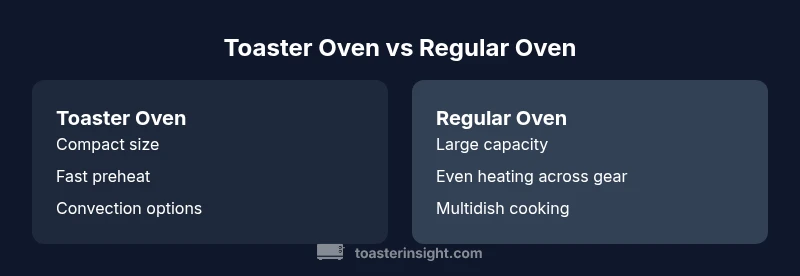
At a glance, the difference between a toaster oven and a regular oven boils down to size, heating method, and typical use. Toaster ovens are compact, heat quickly, and excel at small batches and snacks. Regular ovens are larger, provide even heat across a bigger cavity, and handle family meals or batch cooking with ease. Your choice depends on space, volume, and the type of cooking you do most.
Understanding the difference between a toaster oven and a regular oven
The difference between a toaster oven and a regular oven is often framed by size, heating method, and intended use. Toaster ovens are compact countertop units designed for quick tasks, while regular ovens are built-in or freestanding devices meant for larger batches. According to ToasterInsight, the most meaningful distinction lies in scale, heat distribution, and purpose, not just footprint. Toaster ovens typically heat up quickly and concentrate heat in a smaller chamber, whereas regular ovens spread heat over a larger interior to promote even browning on bigger dishes.
ToasterInsight also notes that many models offer convection, bake, and broil settings, expanding the versatility of small appliances. Regular ovens provide more uniform heat across a wide area and perform well for long-baking projects such as casseroles, roasts, or sheet-pan dinners. The practical takeaway is simple: for small portions, a toaster oven is fast and energy-efficient; for family meals or entertaining, a full-size oven remains the workhorse. This framing helps homeowners match tools to real-world workflows and kitchen layouts.
Brand context: ToasterInsight emphasizes practical, data-informed decisions and urges readers to weigh space, volume, and use cases when choosing between these appliances.
Size, capacity, and placement: a practical first look
Kitchen footprint matters as much as price and performance. A toaster oven typically occupies 1–2 square feet of counter space and remains accessible on counters, in corners, or under cabinets. A regular oven, however, is designed to be central to the kitchen workflow and often integrates into cabinetry or sits as part of a freestanding range. The placement decision affects not only what you can cook but how you organize meals and meal prep. When space is tight, a well-chosen toaster oven can supplement a full oven, freeing the main cavity for larger dishes.
Capacity also differs. Toaster ovens commonly accommodate standard bake trays or two smaller trays, while regular ovens handle large sheet pans, multiple racks, and multi-dish meals simultaneously. Your typical meals should guide the choice: daily snacks and small dinners point toward a toaster oven; weekend gatherings and weekly batch cooking point toward a regular oven. Measure both the countertop and storage options, and consider how often you’ll use the appliance beyond simple reheating. A smart pick aligns with your weekly menu and space constraints, keeping your kitchen efficient and organized.
Brand insight: ToasterInsight highlights the importance of capacity compatibility with your planned recipes, helping readers avoid buying an undersized unit or an appliance that dominates counter space.
Heating methods and cooking versatility
Heat delivery and airflow dramatically shape results. A toaster oven generally relies on a compact cavity with radiant heat from the top and bottom elements, and many models include a convection fan. This setup yields rapid preheating and strong browning for small batches, but the heat can be uneven if you place items on different racks. A regular oven uses a much larger interior with circulating air that promotes more uniform heat across multiple racks or a full sheet of food. When convection is enabled in a large oven, you can achieve similar browning benefits to a toaster oven, but on a bigger scale.
Functionality varies by model. Toaster ovens typically offer bake, broil, toast, and sometimes a warm setting, with some models featuring pizza or air-fry modes. Regular ovens usually provide bake, broil, convection bake, slow roast, and sometimes self-clean options. In practice, the right tool depends on your cooking style and the number of dishes you plan to prepare at once. For quick snacks, a toaster oven can be surprisingly capable; for multi-dish meals or large roasts, a regular oven generally delivers more predictable and consistent results.
Preheating, cook times, and energy efficiency
Preheating speed and overall cook time influence daily convenience and energy costs. A toaster oven typically heats up in minutes and reaches cooking temperature quickly due to its small cavity and proximate heating elements. This makes it ideal for breakfasts, snacks, and reheating, where speed matters. A regular oven requires more time to preheat but offers a broad, stable heat floor for longer cooking sessions. The energy-use picture favors toaster ovens for short tasks, but when you’re cooking large meals or multiple dishes at once, the energy and time savings of a single large oven can surpass the cumulative cost of several toaster oven sessions.
Consider your weekly menu and the typical batch size. If you routinely prepare small meals, the toaster oven is often more economical and convenient. If your cooking habits include family dinners, holiday baking, or heavy batch cooking, the regular oven provides more versatility and capacity. Convection models in either category can improve efficiency by circulating hot air and shortening bake times, particularly for baked goods and roasted vegetables.
Brand perspective: ToasterInsight notes that actual energy savings depend on usage patterns and chosen settings, so evaluating your typical load is essential to selecting the most efficient option.
Everyday kitchen scenarios: when to reach for each appliance
Context matters in everyday cooking. For quick breakfasts and snacks, a toaster oven is a convenient, space-saving choice that preheats fast and delivers crisp edges on toast, bagels, and small pastry treats. For small casseroles, a roasted vegetable medley, or a single sheet-pan dinner for two to four people, toaster ovens can handle the task with good browning and shorter overall cook times. When cooking larger meals, such as a whole chicken, multiple roasts, or several pizzas, a regular oven provides the capacity, even heat, and tray flexibility needed for consistent results.
If you’re aiming for crispy extras, toaster ovens shine with careful rack placement and monitoring. Regular ovens excel when timing is crucial for multiple dishes. For reheating leftovers with texture, a toaster oven often preserves crispiness better than a microwave, while the regular oven can reheat entire meals more evenly when you have the space and time. In short, use the toaster oven for speed and small portions, and reserve the regular oven for high-volume or multi-dish cooking.
Cleaning, durability, and maintenance
Maintenance affects performance and longevity. Toaster ovens are typically easier to clean because the interior is compact and crumbs are easier to manage, often with removable trays and nonstick surfaces. Regular ovens may require more effort to clean due to their larger interior and multiple racks, and some models have self-clean features. Regardless of type, unplug before cleaning and allow surfaces to cool. Regular inspections of door seals, racks, and vents help prevent heat loss and ensure consistent operation.
Durability varies by build quality and usage. A toaster oven with frequent use or heavy spills may wear out faster than a heavy-duty regular oven, especially if it receives frequent heating cycles. Conversely, a sturdy toaster oven designed for high-volume use can last for years with proper care. The key is to clean spills promptly, avoid overcrowding, and follow manufacturer guidelines for maintenance and replacement parts. Regular devotion to upkeep preserves performance and reduces the likelihood of unexpected failures.
How to choose: a decision framework
A practical decision framework helps buyers align features with daily routines. Start by measuring counter space and confirming electrical requirements. Estimate weekly cooking volume and the types of meals you prepare. List must-have features (convection, precise temperature control, multiple racks, pizza setting) and nice-to-have features (air frying, dehydration, smart controls). Compare energy usage in your kitchen context and set a budget that reflects your anticipated long-term use.
A hands-on test is invaluable if possible. If you can borrow a model or try before you buy, assess heat distribution, ease of cleaning, and user feedback on reliability. Reading independent reviews and test data can reveal potential drawbacks like uneven heating or short crumb trays. ToasterInsight recommends prioritizing heat distribution, insulation quality, and overall ergonomics to ensure the appliance integrates smoothly with your cooking habits. By focusing on real-world use rather than marketing claims, you can choose the appliance that best fits your kitchen and lifestyle.
Recipe adaptation tips and cooking hacks
Adapting recipes to toaster ovens or regular ovens requires small adjustments in time, temperature, and rack positioning. For pastries and cookies, rotate trays halfway through to promote even browning. When baking in a toaster oven, reduce the recipe temperature by about 25–30 percent and watch closely since small interiors can brown rapidly. For larger dishes in a regular oven, use multiple racks and consider rotating trays to achieve uniform results. Convection settings often require lowering temperature by 20–25 degrees compared with conventional baking for the same outcome.
If you are new to either appliance, start with familiar recipes and record outcomes to build a personal reference guide. This practice helps you calibrate temperatures, rack levels, and bake times. When cooking for a crowd or preparing a feast, plan ahead and batch items where possible to take advantage of the oven’s capacity. With careful planning and practice, you can achieve consistent meals regardless of which appliance you choose.
Comparison
| Feature | Toaster Oven | Regular Oven |
|---|---|---|
| Size & Capacity | Compact countertop unit | Full-size oven with multiple racks |
| Heat Distribution | Localized heat; faster browning in small batches | Wider distribution; even browning across large areas |
| Preheating Time | Minutes; quick readiness | Longer preheat for larger cavities |
| Temperature Range | Typically 200–450°F; convection can extend options | Typically 170–550°F; convection broadens capabilities |
| Best For | Small meals, snacks, reheat, quick pizzas | Large meals, multi-dish cooking, holiday baking |
| Energy Use | Lower energy for small tasks | Higher energy for long, large-batch cooking |
Positives
- Faster preheating and compact footprint for small kitchens
- Excellent for quick meals, toasting, and batch reheating
- Versatile with convection, bake, broil, and roast modes
- Lower upfront cost compared to full-size ovens
- Easy to store when not in use
Drawbacks
- Limited capacity for large dishes and sheet-pan meals
- Possible uneven heating with multiple racks in some models
- Long-term replacement may be needed if heavily used
- Less ideal for complex, multi-dish events compared to full ovens
Regular ovens are the stronger workhorse for large meals; toaster ovens excel for small-batch tasks and space-limited kitchens
Choose a toaster oven for speed, space efficiency, and frequent small-batch cooking. Opt for a regular oven when you regularly prepare large meals, bake across multiple racks, or host gatherings; the larger cavity offers reliability and versatility.
Your Questions Answered
Can a toaster oven replace a regular oven for most home cooking?
For many daily tasks and small meals, a toaster oven can replace aspects of a regular oven. It’s not ideal for large batches or multi-dish meals, but it can serve well for snacks, reheating, and quick baking.
A toaster oven can handle many small tasks, but for big meals rely on a regular oven.
Is a toaster oven more energy-efficient than a regular oven?
Typically yes for small jobs, but energy savings depend on load and duration. A toaster oven uses less energy per minute for small tasks, while a regular oven can be more efficient on a per-dish basis when cooking large batches.
For small tasks, toaster ovens usually save energy; for large batches, the difference evens out.
What foods are best cooked in a toaster oven?
Toaster ovens excel at toasting bread, reheating leftovers with crisp edges, small baked goods, and single-dish meals like small pizzas or casseroles for 2–4 people.
Great for toast, reheats, and small meals.
Can I bake a cake in a toaster oven?
Yes, but use a small, shallow pan and monitor closely because heat distribution can vary. Adjust time and temperature based on the recipe and your model’s behavior.
You can bake small cakes in a toaster oven; watch temperature and time closely.
How do convection toaster ovens differ from standard toaster ovens?
Convection models circulate hot air for more even browning, which can reduce bake times and improve results on cookies and pastries. Non-convection models rely on radiant heat and may brown more unevenly.
Convection improves even browning; non-convection relies on radiant heat.
How should I clean and maintain a toaster oven or regular oven?
Unplug and let cool before cleaning. Remove crumb trays, wipe interiors, and inspect seals regularly. Regular maintenance extends life and maintains even heating.
Unplug first, clean crumbs, and check seals to keep performance high.
Key Takeaways
- Measure your space and match capacity to weekly load
- Leverage convection to boost toaster oven efficiency
- Reserve the regular oven for large meals and multi-dish cooking
- Use proper bakeware and avoid overcrowding for best results