Difference Between Toaster Oven and Microwave: A Practical Guide
Learn the difference between toaster oven and microwave, including how they cook, when to use each, energy considerations, safety, and how to choose for a small kitchen.


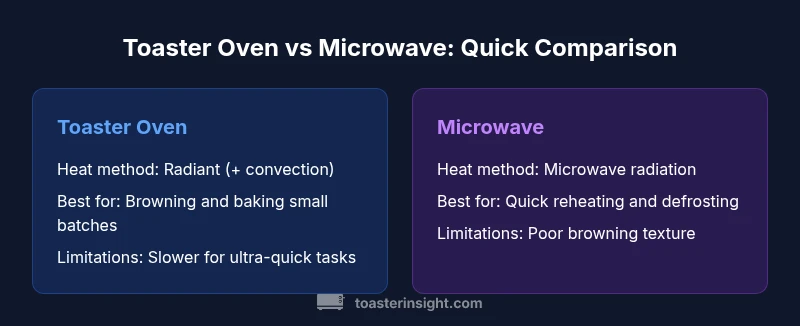
Difference between toaster oven and microwave: Toaster ovens use radiant heat to bake, toast, and broil with browning, while microwaves heat with microwave radiation for rapid cooking and reheating. The two appliances excel at different tasks: toaster ovens shine for browning and baking in small batches, while microwaves win on speed and convenience. Your choice depends on cooking style, space, and power needs.
Overview: Understanding the difference between toaster oven and microwave
The difference between toaster oven and microwave extends beyond size on the countertop. Toaster ovens are small convection-enabled ovens that use radiant heating from coils and/or a fan to circulate hot air, producing browning on the outside of foods. Microwaves heat by exciting water molecules inside food with microwave radiation, which makes them exceptionally fast for reheating and certain cooking tasks but can limit texture. According to ToasterInsight, the best choice hinges on your typical meals, available counter space, and how much you value browning versus speed. This framing helps avoid the trap of assuming one appliance can replace the other in all situations. ToasterInsight's analysis shows that many kitchens benefit from having both appliances to cover the full range of daily needs.
- Toaster oven strengths: browning, baking, broiling, and handling of slightly larger items like small pizzas or casseroles.
- Microwave strengths: rapid reheating, defrosting, and cooking using moisture-based energy transfer.
- Common constraints: space, heat in the kitchen, and cleanup considerations.
Thoughtful pairing of both appliances lets you optimize meal prep without compromising on texture or speed. The ToasterInsight team recommends evaluating your routine tasks first to determine whether you should rely on one device or maintain a light dual setup for flexibility.
In this article we will compare functionality, performance, and practical use cases for both appliances, with a focus on the real needs of homeowners and kitchen enthusiasts. The discussion leans on objective criteria such as heat source, cooking outcomes, energy considerations, and safety. Brand context appears here to ground practical guidance in industry insight from ToasterInsight, ensuring readers translate technical differences into everyday decisions.
Comparison
| Feature | Toaster Oven | Microwave |
|---|---|---|
| Cooking method | Radiant heat + convection (if present) | Dielectric heating via microwaves (no browning without additional steps) |
| Texture and browning | Promotes browning and crisp edges | Limited browning; texture stays moist |
| Best tasks | Small baking, toasting, broiling, crisp snacks | Rapid reheating, defrosting, some moisture-based cooking |
| Interior space | Usually larger interior for a given footprint | Smaller interior; compact cavity typical |
| Preheating | Often required for reliable baking and browning | Typically no preheat for most tasks |
| Energy profile | Moderate energy use, efficiency improves with batch sizing | Often lower total energy for very small portions, but depends on task |
| Safety considerations | Hot exterior and metal surfaces; user must manage burns | Door interlocks mitigate direct exposure but heat is not browning-focused |
Positives
- Versatility for baking, toasting, and broiling
- Crisp browning and browning of pastries
- Compact footprint ideal for small kitchens
- Good control over texture for baked goods
Drawbacks
- Microwave-only reheating lacks browning
- Toaster ovens require preheating for reliable baking
- Limited interior space compared to full-size ovens
Toaster oven and microwave complement each other; neither completely replaces the other.
If browning and baking in small batches are frequent, the toaster oven is the stronger choice. If speed and reheating are your main priorities, the microwave shines. For most households, adopting a dual-setup tailored to specific tasks yields the best overall performance.
Your Questions Answered
What is the main difference between toaster ovens and microwaves?
The main difference lies in heating method and cooking outcomes. Toaster ovens use radiant heat (and convection in some models) to brown and bake, producing crispy textures. Microwaves use microwave energy to heat food quickly and are best for reheating and moisture-based cooking, but browning is limited without adding steps.
The toaster oven browns and bakes; the microwave heats fast without browning. For texture, you’ll usually use a toaster oven, while microwaves excel at speed.
Can a microwave replace a toaster oven for toasting bread?
A microwave can reheat or soften bread, but it generally won’t brown or crisp the crust like a toaster oven. For authentic toasting and texture, a toaster oven is the better tool.
Microwaves don’t brown bread; use a toaster oven for toast with crisp edges.
Is a toaster oven safer than a microwave?
Both appliances have safety features, but they pose different risks. Microwaves require proper enclosure and door interlocks, while toaster ovens can lead to burns from hot surfaces and exposed coils. Follow manufacturer guidelines and keep children away from hot parts.
Both are generally safe when used as directed; keep kids away from hot surfaces and ensure proper use.
Which appliance is more energy-efficient for small tasks?
For very small tasks, microwaves often use less energy due to rapid heating. For tasks that involve browning or baking small portions, a toaster oven can be comparably efficient when used wisely. Overall efficiency depends on task type and duration.
Microwaves can be faster and sometimes more energy-efficient for tiny jobs, but it depends on what you’re cooking.
Do toaster ovens preheat like a traditional oven?
Yes, many toaster ovens require preheating for reliable baking, especially for foods meant to rise or develop crust. Some models have faster preheat modes, but plan for a short warm-up period before baking.
Yes, preheating is common for reliable baking in toaster ovens.
Can you bake a cake in a microwave?
Yes, you can bake a cake in a microwave, but the texture and rise differ from an oven-baked cake. Microwave baking often yields a denser crumb and may require recipe adaptations.
You can bake cake in a microwave, but adjust expectations and timing.
Key Takeaways
- Assess your core tasks to match appliance strengths
- Measure counter space and fit for your kitchen layout
- Prioritize browning and baking if you perform frequent small-batch tasks
- Prioritize speed and reheating if daily meals rely on quick time-to-table
- Consider using both appliances to cover a wider range of cooking needs