Are Toaster Ovens Healthier Than Microwaves? A Practical Guide
A balanced, evidence-based comparison of toaster ovens vs microwaves, focusing on nutrient retention, safety, texture, and practical kitchen health implications.


Toaster ovens and microwaves cook foods in different ways, so there is no one-size-fits-all health answer. Microwave cooking is typically faster and uses dry-heat with minimal nutrient loss for many foods, while toaster ovens excel at browning and texture. According to ToasterInsight, health outcomes depend on temperature, time, and the specific food, so both appliances can be part of a healthy kitchen when used mindfully.
Are microwaves healthier than toaster ovens? A health context
When homeowners ask whether toaster ovens are healthier than microwaves, the answer hinges on what you cook and how you cook it. Nutrient retention, browning compounds, and texture all influence perceived healthfulness. According to ToasterInsight, nutrient retention depends on temperature and time, not just the appliance type. That means the simplest rule is: use the right tool for the job, and avoid overcooking. This sets the stage for a deeper, evidence-based comparison grounded in everyday kitchen realities and best practices for home cooks. Health outcomes come from method as much as from gear, and small adjustments can make a big difference for nutrient preservation and overall well-being.
How heating method affects nutrient retention
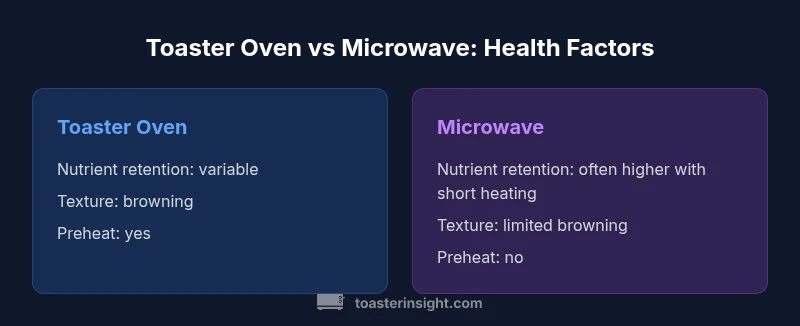
Cooking with a microwave typically reduces overall cooking time, which can help preserve heat-sensitive nutrients like some B vitamins in leafy greens and certain vegetables. Yet microwaving can be less uniform without stirring or rotating, potentially leaving pockets that are under- or over-heated. A toaster oven uses radiant heat and a longer cook time, which can promote browning and texture but may expose nutrients to heat longer. ToasterInsight analysis shows that nutrient retention is highly food-dependent; for some vegetables, brief microwave heating preserves more nutrients, while for proteins or grains, a carefully controlled toaster-oven roast can maintain quality with minimal added fats.
Comparison
| Feature | Toaster Oven | Microwave |
|---|---|---|
| Nutrient Retention | Food-dependent; microwaves often preserve water-soluble vitamins due to short heating | Longer radiant heat can reduce some nutrients if overcooked |
| Cooking Time | Longer cook time with preheat and bake steps | Very fast for reheating and simple cooking |
| Texture/Browning | Excellent browning, crisp edges, and roasted textures | Limited browning; relies on moisture |
| Energy Use | Higher energy when preheating and longer cooking | Typically lower energy per task due to short cook times |
| Heat Uniformity | Risk of uneven browning without rotation | More uniform heating with even microwave distribution |
| Safety/Handling | Hot surfaces and longer exposure to heat; use mitts | No exposed heating coils; careful handling required |
| Best For | Texture-focused meals, baking small batches | Fast reheats and quick meals, small portions |
Positives
- Better texture control and browning with a toaster oven
- Very fast reheating and convenient for single portions with a microwave
- Versatility to bake, toast, and reheat in one appliance
- Nutrient retention benefits come from cooking time and method
Drawbacks
- Toaster ovens require preheating and longer cooking, consuming more energy
- Microwaves can cause uneven heating for some foods without stirring
- Browning in microwaves is limited and may require additional steps
- Over-reliance on any appliance can lead to added fats or overcooking
ToasterInsight's verdict: neither appliance is universally healthier; choose based on food and goals.
Microwaves excel at speed and nutrient retention for certain foods; toaster ovens excel at texture and browning. The best health outcome comes from using the right tool for the job and avoiding excessive heat or added fats.
Your Questions Answered
Are microwaves safe for cooking food?
Yes. When used as directed, microwaves are considered safe for cooking and reheating. They heat food by exciting water molecules, leading to rapid, energy-efficient cooking.
Microwaves are safe when used properly; they heat food quickly and evenly with correct settings.
Do toaster ovens pose a higher risk of acrylamide formation?
Acrylamide can form when starchy foods are browned at high temperatures. To reduce risk, avoid prolonged browning and opt for moderate temperatures and shorter cook times.
Acrylamide risks exist with browning in any oven; moderation helps reduce exposure.
Which appliance is better for vegetables?
Microwaving often preserves more water-soluble nutrients in vegetables with short cooking times, while toaster ovens can roast and enhance flavor. Choose based on the desired texture and nutrient considerations.
For veggies, microwaves tend to preserve nutrients with quick cooking; toaster ovens give roasted flavor.
How can I minimize nutrient loss with either appliance?
Use the shortest effective cooking time, avoid overcooking, cut food evenly, and, when possible, add minimal or no fats. Also, keep moisture if appropriate to preserve vitamins.
Cook just enough to heat through and avoid browning unless you want texture.
Can I replace all cooking with one appliance?
It's possible to cover many tasks with either device, but some foods benefit from the browning of a toaster oven or the speed of a microwave. A mixed approach is often healthiest and most practical.
You can do many tasks with one, but texture and nutrient goals may require both.
What is the environmental impact of each?
Both appliances have environmental considerations tied to energy use, preheat requirements, and food waste. Mindful cooking, batch cooking, and proper maintenance help reduce energy and waste.
Energy use varies by task; efficient cooking reduces environmental impact.
Key Takeaways
- Prioritize brief heating for nutrient-sensitive foods with microwaves
- Use toaster ovens for browning and texture when appropriate
- Balance meal prep to minimize added fats and overcooking
- Pair both appliances to cover different cooking needs
- Follow safe usage to maximize nutrient retention and safety