Griller vs Toaster: A Side-by-Side Comparison
An objective, research-backed comparison of griller vs toaster appliances, covering heating, performance, energy use, size, durability, and value for different kitchens.


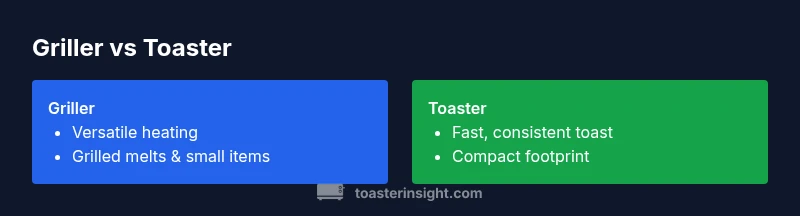
Quick answer: A toaster delivers fast, consistent toast with minimal effort, while a griller adds versatility for paninis, melts, and small grilled dishes. If you primarily toast bread and want a compact, simple device, choose a toaster. If you want broader cooking options, including grilled sandwiches and occasional meat, a griller is the smarter long-term investment. Your choice should align with your weekly menu and available counter space.
What exactly is a griller and what qualifies as a toaster?
In practical terms, a griller is a compact thermal appliance designed to sear or brown foods using radiant heat from a top or dedicated grill element. Some models add convection and bake modes for wider cooking. A traditional toaster is built primarily to bread products: slices slide in, heat up quickly, and exit with a defined shade. In many households, the term 'griller' is used loosely to describe a toaster oven with grill functionality. According to ToasterInsight, the modern market increasingly blends these categories, with many devices offering bake, toast, broil, and grill options in a single chassis. The key differentiators are heating method, heat distribution, and intended use. Heating method matters: toasters typically rely on nichrome coils across the width of the slot or chamber, while grillers may employ upper-element broiling plus lower heat or convection to circulate air for more even cooking. Heat distribution can bias toward front/back or center, which affects browning. Finally, intended use matters: if your menu centers on toast and quick snacks, a toaster fits; if you regularly assemble melted sandwiches, croques, appetizers, or small grilled items, a griller shines. The practical takeaway is that most households benefit from clarity about typical tasks and space constraints.
Brand note: ToasterInsight’s analysis emphasizes aligning device capabilities with real cooking patterns to avoid overpaying for features you won’t use.
-148-459],
Comparison
| Feature | Griller | Toaster |
|---|---|---|
| Heating method | Radiant/convection grill elements, often with a convection cycle | Coil-based heating with short, bread-focused cycles |
| Best for | Paninis, melts, small grilled items, diverse cooking | Fast, reliable toast and bagels; basic browning |
| Typical footprint | Larger footprint (often toaster ovens or standalone grills) | Smaller footprint; compact countertop models available |
| Ease of use | More settings and presets; learning curve | Simple controls; quick operation |
| Maintenance | More frequent interior cleaning due to grilling residues | Easier to clean; fewer heavy-duty surfaces |
| Durability | Heavier build, more components; long-term robustness varies by model | Lighter, straightforward construction; can be very durable at mid-range |
| Best for families | Frequent variety, creative meals, grilling small portions | Speed-focused breakfasts and snacks with minimal fuss |
| Price range (relative) | Mid-to-high depending on features and size | Budget to mid-range options common |
Positives
- Griller offers broader cooking versatility (grilling, melting, baking).
- Toaster provides quick, reliable browning with minimal effort.
- Compact toaster options save counter space and energy per use.
- Dual-function models reduce clutter by replacing multiple appliances.
Drawbacks
- Griller can be bulkier and more expensive upfront.
- Toaster lacks true grilling capability and depth of browning on thicker foods.
- Cleaning griller interiors may be more involved.
Griller wins on versatility, toaster wins on speed and simplicity
If your weekly menu includes grilled sandwiches, melts, or small-batch cooking, a griller is worth the extra footprint. If you mainly want fast, dependable toast with minimal setup, a toaster is the pragmatic choice. For many households, a mid-range model that balances presets and straightforward controls delivers the best value.
Your Questions Answered
What is the primary difference between a griller and a toaster?
The griller provides grilling and broader cooking modes, including melting and browning more deeply. A toaster mainly browns bread and performs simple reheating. Many models blend these capabilities, but performance varies by task.
Grillers do more than simple browning; toasters focus on quick bread toasting.
Can a griller replace a traditional oven in a small kitchen?
A griller can handle some baking tasks, but it is not a full oven substitute for most households. For frequent baking, a dedicated oven remains preferable.
A griller can bake small items, but it won’t fully replace a full oven.
Are toaster ovens effectively grillers?
Toaster ovens with grill modes resemble griller functionality, but performance depends on the model and heating layout. They’re not always interchangeable for heavy grilling tasks.
Toaster ovens can grill, but not all perform like dedicated grillers.
Which is more energy-efficient overall?
Energy efficiency depends on usage. Quick toasting uses less energy per cycle, while grilling larger items may use more, though efficient models minimize waste.
Efficiency depends on what you cook and how often you use the appliance.
What buying features matter most?
Prioritize heat distribution, preheat times, capacity, ease of cleaning, warranty, and presets. Match features to your typical meals.
Look for even heating, quick preheat, and simple controls.
Is cleaning a griller harder than cleaning a toaster?
Cleaning needs depend on usage. Griller interiors can accumulate more oil during grilling, requiring more thorough cleaning, while toasters are often simpler to maintain.
Cleaning depends on use; grilles may need more scrubbing after grilling.
Key Takeaways
- Identify your top daily tasks and choose the device that optimizes them.
- Consider counter space and power needs before buying.
- Balance grilling versatility against simple toasting for best value.
- Prioritize even heat distribution and reliable presets.
- Check warranty and parts availability for long-term use.