Oven Toaster vs Oven for Baking: A Comprehensive Comparison
A practical comparison of oven toaster vs oven for baking, showing when a countertop toaster oven is ideal and when a full-size oven shines for baking tasks in home kitchens.


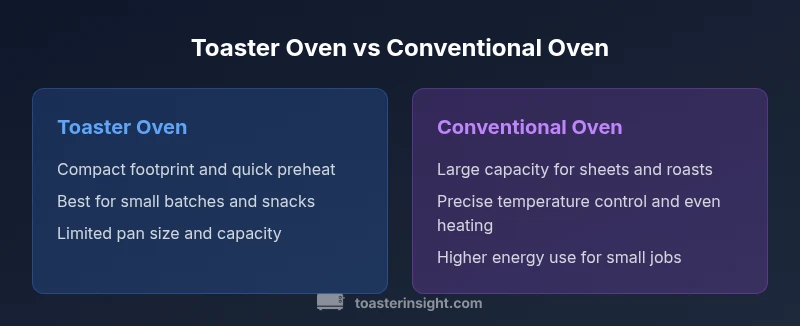
Both toaster ovens and full-size ovens can bake effectively, but their strengths differ. A countertop toaster oven shines for small batches, quick preheating, and compact kitchens, while a conventional oven handles large sheets and complex bakes with precise temperature control. For homes with limited space, the toaster oven is a practical tool; for big meals, the full-size oven wins in capacity and even heat.
Why People Compare Oven Toaster vs Oven for Baking
For many home cooks, the decision boils down to space, batch size, and what you actually bake. The distinction between a countertop toaster oven and a full-size oven influences how often you preheat, what pans you can use, and how evenly your bread, cookies, or roasts turn out. According to ToasterInsight, understanding the trade-offs helps homeowners balance convenience against performance. This guide focuses on baking tasks—cookies, cakes, bread, and roasted vegetables—and translates features into practical outcomes. The goal is to help you decide which appliance belongs on your counter or in your kitchen closet, and how to optimize either choice for reliable results. You’ll see that neither option is universally “better”—each serves different patterns of use, volumes, and recipes. By the end, you’ll have a clear sense of where a toaster oven shines and where a conventional oven remains the go-to solution for traditional baking projects.
Key Differences at a Glance
The two appliance archetypes sit on opposite ends of the kitchen spectrum: one is compact, fast, and intimate with small trays; the other is large, heavy, and built for bigger batches. When you compare them side by side, several criteria consistently separate them: footprint and storage, preheat time, temperature precision, rack and pan compatibility, available features (baking mode, convection, broil), and of course price and value. For bakers who routinely pull a sheet pan full of roasted vegetables or bake multiple trays of cookies, the full-size oven’s capacity and even heat provide a consistency an entry-level toaster oven often cannot match. Conversely, for quick breakfasts, toast, or single-sheet baking, the toaster oven wins on speed, energy use, and simplicity. Across most households, the decision comes down to how many people you cook for, how much kitchen space you have, and how often you bake beyond simple snacks.
Heating Mechanisms: Convection, Radiant, and Circulation
Toaster ovens typically rely on radiant heat from heating elements, with some models adding a small fan for convection. Conventional ovens rely on large, evenly heated chambers with top and bottom elements, and many modern models include true convection fans that distribute heat more uniformly. The practical impact is straightforward: convection tends to brown more evenly and reduce baking times for many items, but it can also dry out delicate pastries if not monitored. Radiant-only designs work well for simple jobs but may require rotate-and-reload for even results. When baking bread or cookies, the choice of mechanism influences rise, crumb, and browning in predictable ways, and selecting the right mode is essential to repeatable results.
Baking Performance by Category
Cookie sheets, sheet pans, and cake tins come in different sizes, and not every toaster oven accommodates standard baking sheets. For cookies and small cakes, a toaster oven can perform remarkably well, delivering crisp edges with a soft center when temperatures are stable. Cakes and breads generally benefit from the larger, more even heating of a conventional oven, particularly for larger loaves or multiple racks. Roasting vegetables, chicken, or small roasts can be efficient in a toaster oven for small batches, but a full-size oven lets you pan-roast bigger quantities with more consistent heat distribution. The takeaway: bake tasks that fit on a single sheet or small tray often suit a toaster oven; larger items or high-volume baking favors a full-size oven.
Space, Capacity, and Load Management
Space in the kitchen matters as much as bake quality. A countertop toaster oven typically occupies less than a square foot of counter space and can free up the main oven for larger dishes. A conventional oven requires a dedicated location in the kitchen and offers much greater capacity, often handling two sheet pans or larger roasts at once. When you have a busy household or entertain frequently, the ability to cook multiple dishes simultaneously with stable heat is a real advantage of the full-size oven. Conversely, in small kitchens or for people who bake for one to four servings, the toaster oven’s small footprint and fast preheating are compelling.
Preheating Time and Temperature Stability
Preheating time is a practical hurdle for many bakers. Toaster ovens preheat rapidly, letting you start quick-bake tasks within minutes; however, some models may heat non-uniformly if not preheated long enough or if you load heavy trays near heating elements. Full-size ovens typically take longer to preheat but offer more stable temperatures across the chamber, especially when loaded with multiple racks. Temperature accuracy matters for delicate bakes; a conventional oven with a properly calibrated thermostat provides repeatable results across a wider range of recipes. If you bake infrequently, the faster preheat of a toaster oven can be a time saver; if you bake often, the precision of a larger oven becomes valuable.
Energy Efficiency and Operating Costs
Energy usage is not just about watts; it’s about how efficiently heat is transferred to your food and how much space you heat. A toaster oven generally uses less electricity for small tasks and quick bakes, which is advantageous for single-portion pastries or snacks. A full-size oven, while consuming more energy per use, can be more efficient per item when cooking large batches or multiple dishes at once. The overall cost depends on the frequency of use and the size of meals you typically prepare. For households that bake daily or cook for many people, the full-size oven can be more economical in the long run; for occasional baking, a toaster oven minimizes waste and energy.
Maintenance, Cleaning, and Longevity
Cleaning a toaster oven is usually quicker, as the interior is smaller and easier to access, though you must be mindful of crumb buildup around the heating elements. Conventional ovens require more frequent cleaning for baked-on residues on racks and walls but offer longer intervals between maintenance when used properly. Longevity depends on build quality and care: good models with metal interiors and solid racks tend to last longer, while cheaper units may accumulate issues from heavy use. Regular replacement of crumb trays, calibration checks, and careful loading of trays can extend the life of either appliance.
Safety Considerations and Tips
Both appliances carry burn and fire risks if misused. Always place pans away from the heating elements, use oven mitts, and avoid leaving devices unattended when the door is open. For toaster ovens, ensure proper clearance around the unit to prevent overheating and never push extra pans beyond recommended sizes. For conventional ovens, pay attention to door seals, rack placement, and proper ventilation. A dedicated heat-resistant mat or pan can reduce the risk of scorching your surfaces. Following the manufacturer’s guidelines for wattage, recommended cookware, and cleaning routines is essential for safe, long-term use.
Real-World Scenarios: When a Toaster Oven Shines vs When a Full-Size Oven Wins
Scenario A: You bake a dozen cookies for a small family and want them ready quickly. The toaster oven offers quick preheat, even browning, and minimal cleanup, making it a convenient choice. Scenario B: You’re roasting a turkey breast and several sheet pans of vegetables for a weekend dinner. A full-size oven provides more space, more even heat across multiple racks, and the capacity to manage larger pans without crowding. Scenario C: You’re a beginner baker practicing bread and cake recipes. The full-size oven’s stability and broader temperature range can reduce guesswork and yield consistent outcomes. In short, toaster ovens excel in speed and space-limited environments, while conventional ovens excel in capacity and consistency for larger or more complex bakes.
Budgeting and Value: When to Invest in a Full-Size Oven vs Toaster Oven
Price ranges illustrate typical investment patterns: toaster ovens are generally more affordable upfront and cheaper to operate for small jobs, while full-size ovens require a larger upfront cost and installation considerations but may offer better value for large-volume baking over time. If you bake weekly for a family, a conventional oven may be the smarter long-term purchase; if your baking is occasional or you have limited kitchen space, a high-quality toaster oven can cover most needs without sacrificing results.
Quick Decision Guide: 6 Questions to Ask Yourself
- How many people do I regularly cook for? 2) Do I often bake large sheets or multi-rack meals? 3) Is counter space at a premium in my kitchen? 4) Do I need precise temperature control for sensitive recipes? 5) How important is preheating speed for my routine? 6) Will I also use the appliance for toasting and small meals? Answering these questions will steer you toward the toaster oven for limited spaces and small batches, or toward the conventional oven for capacity and versatility.
Putting It All Together: Practical Recipes and Setup
If you own a toaster oven, start with small-batch baking recipes: toast-level breads, small cookies, and single-serve casseroles. Use a shallow baking dish to maximize air circulation and rotate trays for even browning. With a full-size oven, build a routine around sheet-pan dinners, large cakes, and multi-batch cookies. Keep an oven thermometer handy to verify temperature accuracy and calibrate as needed. A well-chosen model plus careful technique can deliver reliable, delicious results in either setup.
Comparison
| Feature | Toaster Oven (countertop) | Conventional Oven (full-size) |
|---|---|---|
| Size & footprint | Compact countertop footprint | Full-size cabinet or wall space required |
| Heat-up time | Faster preheat for small loads | Slower preheat for large meals but steady heat |
| Temperature range | Sufficient for most baking tasks | Broader range with more precise control |
| Energy usage | Lower energy per small batch | Higher energy but efficient for large meals |
| Best for | Small batches, quick snacks, space-limited kitchens | Large sheets, complex bakes, multi-dish meals |
| Pan compatibility | Limited pan sizes; often non-standard shapes | Standard sheet pans and multiple racks |
| Price range | Typically $50-$200 | Typically $500-$3000 |
Positives
- Lower upfront cost and smaller footprint
- Fast preheat and convenient for quick bakes
- Ideal for small kitchens and light baking tasks
- Versatile for toasting and small meals
Drawbacks
- Limited capacity for large roasts and multiple trays
- Temperature stability can be less consistent on some models
- Fewer advanced features than premium ovens
- Long-term cost may rise if you frequently bake large batches
Conventional ovens win for large, complex, and high-volume baking
Choose a toaster oven for space-saving, quick-bake tasks and smaller households. Choose a conventional oven for sizable meals, even heat, and multi-dish versatility.
Your Questions Answered
What is the main difference between a toaster oven and a conventional oven for baking?
The main difference is size and capacity: toaster ovens are compact and heat quickly, ideal for small batches, while conventional ovens are larger, more energy-intensive, and better for big sheets and multi-dish meals.
Toaster ovens are small and fast; conventional ovens are larger and better for big batches.
Can I bake bread in a toaster oven?
Yes, you can bake small loaves or rolls in many toaster ovens, but results depend on model and size. Use appropriate pans and monitor closely for even browning.
Yes, for small loaves, but watch heat and pan size.
Are toaster ovens more energy-efficient than full-size ovens?
For small tasks, toaster ovens often use less energy. For large meals, a full-size oven may be more energy-efficient per item since you can bake more at once.
Toaster ovens save energy on small jobs; full-size ovens can be better per serving for big meals.
What should I look for when buying for baking?
Look for even heat distribution, a reliable timer, accurate temperature control, adequate interior capacity, and, if possible, convection for faster, even baking.
Choose models with even heat, good timers, and true convection if you bake often.
Is preheating time a bigger factor in a toaster oven?
Yes, toaster ovens typically preheat quickly, which is convenient for quick bakes. However, uneven heating can occur if not given time to stabilize.
Yes—fast preheat is a plus, but ensure even heat before baking.
Can I roast vegetables in a toaster oven?
You can roast vegetables in a toaster oven for small batches, though space is limited and pans may need to be smaller. For larger batches, a full-size oven is preferable.
Yes for small batches; larger batches are better in a conventional oven.
Key Takeaways
- Assess batch size before choosing appliance
- Factor kitchen space and layout into the decision
- Consider convection capabilities for browning and speed
- Weigh energy use against expected cooking volume
- Prioritize temperature accuracy for precise baking