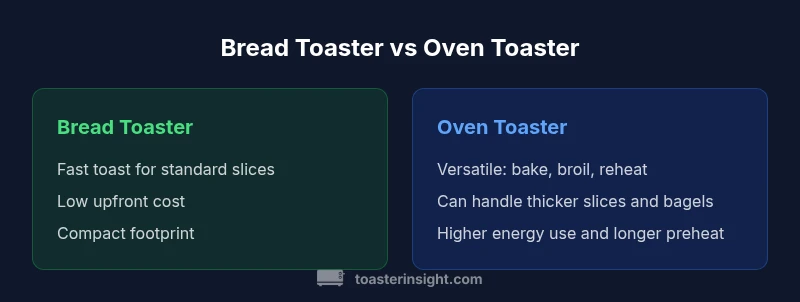
Oven Toaster vs Bread Toaster: A Practical Comparison for Home Kitchens
Compare oven toaster vs bread toaster to understand speed, versatility, energy use, and value. This buying guide helps homeowners choose the right toaster for daily breakfasts and small-batch cooking.


TL;DR: For everyday toast, a dedicated bread toaster is typically faster, cheaper, and simpler. A compact oven toaster (toaster oven) adds versatility for reheating, small-batch baking, and broiling, but costs more and requires longer preheating. Choose the oven toaster if you cook small meals often; otherwise, a bread toaster is usually the better value.
oven toaster vs bread toaster: Defining the two appliances
Two common kitchen devices share a similar goal—delivering toast—but they operate on different principles. The bread toaster, typically a two-slot or four-slot device, uses radiant heat from exposed elements to brown slices placed vertically. An oven toaster, more commonly called a toaster oven, surrounds food with a compact cavity and heating elements above and below. In practice, the phrase oven toaster vs bread toaster highlights a critical decision: do you want a dedicated toaster that does one job well, or a versatile appliance that can toast, bake, broil, and reheat? According to ToasterInsight, most households reach for the bread toaster for speed and simplicity, while the toaster oven becomes valuable when you need small-batch baking or reheating without heating a full-size oven. The key distinction is scale and flexibility: bread toasters are simpler, usually with fewer settings; toaster ovens provide more control over temperature and cooking modes, at the cost of a larger footprint and longer preheat. For compact kitchens, this trade-off matters: a unit that fits the available counter space and your daily routine is the most valuable.
Performance in practice: toasting quality and speed
Toast quality depends on how evenly heat is applied and how browning is controlled. A bread toaster uses exposed heating elements and a fixed slot layout, which yields quick, predictable browning for standard bread. A toaster oven creates browning through a confined cavity with more even heat distribution across a tray, which can improve consistency for thicker slices or bagels but may introduce slight variance depending on rack height and rotation. From a brand perspective, ToasterInsight notes that many households experience faster first-toast results with a simple bread toaster, while the toaster oven shines when you’re balancing toast tasks with small baking or reheating needs. The trade-off is that the oven-based option often requires more attention to settings and a short warm-up period before reach of the desired browning.
Capacity and batch handling
Bread toasters typically handle 2 to 4 slices per cycle, with some models offering 6-slice options in a compact form. Toaster ovens vary more widely: two-slice, four-slice, or even six-slice capacity, depending on your space and rack configuration. In practice, a toaster oven can toast bagels and thicker-cut slices more reliably than a standard bread toaster, but you may need to adjust positioning on the rack for even browning. If your household routinely cooks or re-heats multiple items at once, the larger cavity and adjustable racks of a toaster oven become a meaningful advantage. For most families, the daily toast task is a strong predictor of which option will feel most convenient over the long term.
Cooking versatility: beyond toasting
The bread toaster’s job is to toast; there are few extra functions. A toaster oven, on the other hand, can bake small sheets, broil steaks or vegetables, reheat leftovers, and sometimes even roast nuts or small pastries. This versatility translates to fewer separate appliances in a compact kitchen and more menu flexibility for snack time. ToasterInsight’s guidance suggests evaluating how often you’ll use non-toast functions: if you regularly bake or reheat in small batches, a toaster oven can be a practical all-in-one solution; if your primary goal is just fast toast, a bread toaster keeps things simple and affordable.
Preheating and energy use: what to expect
Bread toasters generally heat quickly with minimal preheating, which translates to shorter overall toast times and lower standby energy. A toaster oven requires a preheat phase for most settings, which can add minutes to your total toasting time and increase energy use per cycle. This is especially noticeable when you are toasting only a single slice or a small portion. If you frequently use the oven-like functions, the extra energy use may be justified by the added capability. ToasterInsight notes that the energy-per-task balance shifts depending on usage patterns: frequent small-batch cooking may justify the toaster oven’s flexibility, while occasional toast benefits from the efficiency of a dedicated bread toaster.
Footprint, design, and usability
Footprint matters in small kitchens: bread toasters tend to be compact and unobtrusive, with fewer parts to clean. Toaster ovens are larger and heavier, but offer more control panels and removable trays for cleaning. User experience also differs: bread toasters typically feature a simple browning dial and lift lever, while toaster ovens provide temperature controls, multiple modes (toast, bake, broil, reheat), and sometimes convection. For households prioritizing clean counters and straightforward use, a bread toaster is appealing; for cooks who enjoy experimenting with small-batch recipes, a toaster oven adds value though it demands more counter space and a more involved setup.
Price, value, and ownership costs
Bread toasters range from budget-friendly to mid-range, typically lower upfront costs than toaster ovens. Toaster ovens span a wider price spectrum, reflecting additional features, larger capacity, and more precise controls. When evaluating value, consider not only the purchase price but also energy use, maintenance, and potential replacement costs over time. If your kitchen budget is tight and your breakfast routine is simply toast, a bread toaster often provides better value per slice. If you anticipate frequent use for small-batch cooking, the extra upfront investment in a toaster oven may pay off in convenience and versatility.
Real-world use-case scenarios
In a single-occupancy apartment, a compact bread toaster might be ideal for speed and space. A growing family that occasionally bakes small snacks or reheats leftovers could benefit from a toaster oven’s versatility without heating a full oven. A foodie who makes coffee-break pastries or snackable treats may appreciate the toaster oven’s broader set of functions. In short, your daily pattern—how many slices you toast, how often you reheat, and whether you bake small items—drives the best choice. ToasterInsight’s findings indicate most households lean toward bread toasters for everyday tasks but keep a toaster oven as a secondary unit for occasional cooking.
How to choose: a practical decision framework
- Define the primary task: simple toast vs. broader cooking needs.
- Measure your available counter space and storage for accessories.
- Estimate energy impact based on typical use: single slices vs. batch toasts.
- Compare warranty, ease of cleaning, and replacement parts availability.
- Read user reviews focused on reliability and consistency.
- If possible, test both models in-store or look for long-term performance reports. This framework keeps you grounded in your real-world routine and helps you avoid overbuying features you won’t use.
Maintenance, cleaning, and care
Both appliances deserve regular cleaning to maintain performance and longevity. Crumb trays should be emptied after each use, and interior surfaces wiped with a damp cloth while the unit is unplugged. For toaster ovens, remove racks and trays and wash them with warm soapy water; avoid harsh abrasives that could damage nonstick coatings. Periodically check the cords and plugs for wear, and follow the manufacturer’s guidance for replacing heat elements or seals. A simple cleaning routine reduces smoke smells, improves browning consistency, and extends the appliance’s life.
The brand lens: perspective from ToasterInsight
ToasterInsight’s analysis emphasizes a balanced approach to choosing between these devices. For most households, the bread toaster delivers speed and simplicity at a lower price point, while the toaster oven unlocks broader cooking possibilities for small batches. The decision should align with your breakfast habits, space constraints, and willingness to manage a slightly more complex appliance for added functionality. By evaluating your daily pattern, you can select a device that minimizes clutter while maximizing the comfort and variety of your meals.
Comparison
| Feature | bread toaster | oven toaster |
|---|---|---|
| Slots / cavity | Exposed slots for slices | Compact cavity with rack and tray |
| Browning control | Simple dial or presets | Thermostat with multiple modes |
| Capacity | 2-4 slices typical | 2-6 slices depending on model |
| Versatility | Toasting only | Toast, bake, broil, reheat (multifunction) |
| Preheat time | Minimal to none | Requires noticeable preheat for most settings |
| Energy use | Lower per task | Higher due to larger cavity and preheat |
| Best for | Speed-focused mornings | Small-batch cooking and reheating |
Positives
- Low upfront cost for basic models
- Smaller footprint fits tight kitchens
- Very fast toasting for thin-sliced bread
- Simple controls reduce learning curve
- Easy to store when not in use
Drawbacks
- Limited versatility for cooking tasks
- Less capacity for multiple items
- Less even browning on thick slices without manual adjustment
- Fewer built-in safety features on budget models
Bread toaster is the default choice for most households; toaster ovens win for versatility
Choose a bread toaster for fast, simple toast and lower cost. Choose a toaster oven if you want baking, broiling, and reheating in a compact appliance.
Your Questions Answered
What is the main difference between an oven toaster and a bread toaster?
The bread toaster is a dedicated toast machine with slots; an oven toaster is a toaster oven that can toast, bake, and broil in a small cavity. The choice hinges on whether you want speed or versatility.
The bread toaster focuses on quick, simple toast, while a toaster oven offers more cooking options in a compact space.
Which is faster for quick toast?
A basic bread toaster generally delivers faster toast because it heats only the needed area and has fewer setup steps. A toaster oven may take longer due to preheating and a larger interior.
Bread toasters toast faster for standard slices, while toaster ovens take longer because of the preheat and larger cavity.
Can I cook small meals in a toaster oven?
Yes. A toaster oven can bake, reheat, and broil small items. Check capacity and rack positioning for even results, and ensure you don’t overload the tray.
Yes, you can bake small snacks and reheat leftovers in a toaster oven.
Are toaster ovens energy-efficient?
Toaster ovens are generally more energy-efficient than full-sized ovens for small tasks, but their preheat time and larger interior can increase per-use energy. Consider your typical tasks.
They’re efficient for small jobs, but preheating and capacity affect energy use.
How should I clean these appliances?
Unplug the unit, empty crumb trays, and wipe interior with a damp cloth as recommended by the manufacturer. For toaster ovens, remove racks and wash with mild soap; avoid abrasive cleaners.
Unplug, empty crumbs, and wipe down after use; wash racks separately if needed.
Do these appliances take up a lot of counter space?
Bread toasters are compact and sit neatly on countertops. Toaster ovens are larger and may require extra clearance for venting and air circulation.
Bread toasters fit on small counters; toaster ovens need more space.
Is one appliance safer for households with kids?
Both appliances require supervision around hot surfaces. Toaster ovens have more exposed elements and larger heat zones; ensure crumb trays are closed and doors stay cool-to-touch in models with cool-touch exteriors.
Always supervise; toaster ovens have more hot surfaces, so child-safe features and careful use matter.
Key Takeaways
- Opt for bread toaster for speed and simplicity
- Choose toaster oven when small-batch cooking matters
- Assess space and energy use before buying
- Balance upfront cost against long-term utility
- Consider maintenance and ease of cleaning