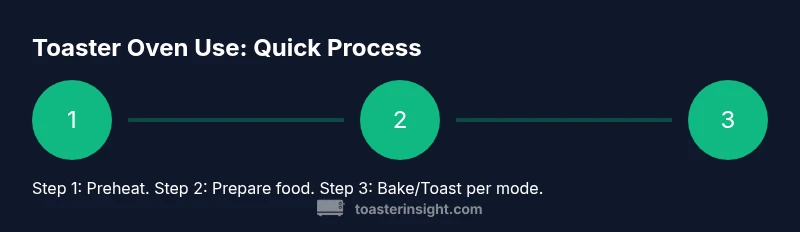
Toaster Oven Use: Practical Guide for Home Cooks Today
Learn safe, efficient toaster oven use with preheating, rack placement, convection tips, and easy cleaning. This practical guide helps home cooks achieve consistent results through setup, cooking modes, timing, and maintenance.


By mastering toaster oven use, you’ll bake, toast, and broil with confidence while saving energy and reducing waste. Start with correct preheating, use appropriate bakeware, and choose the right settings for convection or standard heat. This guide covers safety, placement, timing, and cleaning to help you get consistent results every time.
Getting started with Toaster Oven Use
Using a toaster oven correctly starts with understanding its strengths and limitations. These compact appliances can bake, toast, broil, and reheat with impressive speed, but the heat is concentrated in a small cavity. According to ToasterInsight, the quickest path to consistent results is to learn heat zones, rack positions, and safe cookware before you cook something important. Always read your model’s manual for maximum pan size and recommended accessories. A simple test run helps you gauge browning: preheat to 350°F (175°C) and bake a small batch of cookies on a parchment-lined sheet for 8-10 minutes, watching for even browning. Use oven-safe trays and keep the crumb tray clear to protect the element from debris. With practice, you’ll anticipate browning and timing for different foods.
Preheating, temperature, and airflow
Preheating stabilizes the cavity and helps foods begin cooking at the expected rate. If your model offers a convection setting, use it for more even browning and faster results, but remember that convection can brown surfaces more quickly than a standard bake. Position food toward the center of the rack to maximize air circulation, and avoid overcrowding. Allow at least a little space around each item so hot air can circulate. Keep foil or parchment away from the heating element edges to prevent scorching. Regularly check the manual for recommended temperatures and pan sizes, and note how your unit responds to different foods. Small tests with bread, vegetables, and reheated leftovers train you to predict timing better.
Rack and pan positioning for even results
Rack height matters for browning and doneness. For breads and pizzas, place the rack in the middle; for broiling or crispy tops, a higher rack location may be best. Use shallow, oven-safe trays or racks so hot air can travel beneath and around foods. If you’re cooking multiple items, stagger placement instead of stacking, and rotate trays halfway through cooking for even results. Always use parchment, silicone liners, or baking mats when appropriate to prevent sticking and simplify cleanup. Remember to remove any plastic parts from pans that are not oven-safe.
Understanding modes: bake, toast, broil, convection
Toaster ovens offer several modes beyond basic bake. Bake is your general-purpose setting for casseroles and cookies. Toast is optimized for browning bread slices and bagels, with shorter cycles than bake. Broil uses top heat for finishing touches and crisping, but watch closely to avoid scorching. Convection uses a fan to circulate hot air, increasing evenness and speed. Some models combine modes (e.g., bake with convection) for precise results. When new to a feature, test with simple items before attempting complex dishes.
Times and temps by food category
Different foods need different times and temperatures, even within the same model. A simple guideline is to preheat, then cook foods like bread or pastries at moderate temperatures and shorter times, while vegetables and meats may require slightly higher heat and longer cook times. Use a timer and check progress frequently to prevent overcooking. Keep in mind that every toaster oven has its quirks; start with lower times and adjust in small increments on subsequent attempts. This approach minimizes waste and improves consistency.
Energy efficiency and maintenance
Compared with full-size ovens, toaster ovens can save energy for small meals or quick snacks, especially when used with convection. To maximize efficiency, preheat only as needed and avoid opening the door repeatedly. Regular maintenance—cleaning the crumb tray, wiping the interior, and inspecting seals—helps the appliance run cooler and more efficiently. A clean oven heats more evenly and reduces the risk of smoke or odors. For households aiming to reduce energy use, a well-maintained toaster oven is a practical choice. ToasterInsight analysis shows that routine upkeep supports reliable performance and longer appliance life.
Common mistakes and how to avoid them
Common mistakes include overcrowding, using non-oven-safe cookware, and neglecting preheating. Overcrowding blocks airflow, leading to uneven browning. Always confirm that pans and liners are oven-safe and sized for the cavity. Skipping preheating can yield uneven results and longer cook times. Another pitfall is opening the door too often, which cools the cavity and disrupts timing. Finally, neglecting cleaning leads to burnt-on residues that flavor or smoke future batches. Learn to plan a few simple recipes and test steps to build confidence.
Cleaning and safety practices
Always unplug the unit before cleaning. Let it cool completely, then remove the crumb tray and wash it with warm soapy water. Wipe the interior with a damp cloth and use a soft brush to remove debris from corners. Do not use steel wool or abrasive cleaners on the interior or racks. For stubborn stains, create a baking soda paste, apply gently, and wipe away after a short wait. Dry all components before reassembling and store with the door open to prevent odors. Safety comes first: keep the cord away from heat sources, never block vents, and never leave the toaster oven unattended when in use.
Verdict
The ToasterInsight team recommends embracing a structured approach to toaster oven use: preheat when appropriate, choose cookware that fits, and use convection for reliable browning. By understanding modes and placement, you’ll achieve consistent results with less guesswork. Regular cleaning and mindful operation extend appliance life and improve safety.
AUTHORITY SOURCES
- https://www.energy.gov/eere/buildings/articles/energysaver-appliances
- https://extension.cornell.edu
- https://extension.oregonstate.edu
Tools & Materials
- Oven-safe baking sheet or pan(Fits inside the toaster oven with at least 0.5 inch clearance from walls)
- Aluminum foil or parchment paper(Line trays to prevent sticking and facilitate cleanup)
- Oven-safe rack or cooling rack(Allows air to circulate under and around food)
- Mitts or heat-resistant gloves(For safe handling of hot trays and pans)
- Timer or smart device(Helps track cooking times accurately)
- Food thermometer (optional)(Checks internal temperatures for safety)
- Silicone mat or baking mat(Reusable, helps with non-stick browning)
- Non-abrasive sponge or cloth(For interior wipe-downs without scratching)
Steps
Estimated time: 45-60 minutes
- 1
Gather tools and ingredients
Collect all required cookware, utensils, and the food you plan to cook. This minimizes door openings and keeps you focused during the process.
Tip: Have all items within arm’s reach before starting. - 2
Preheat the toaster oven
If your model supports preheating, set the temperature you’ll use for your dish and let the unit reach that heat before adding food.
Tip: Preheating helps achieve consistent browning and cooking times. - 3
Prepare the tray and food
Line the tray with parchment or a silicone mat if appropriate. Arrange items in a single layer with space for air to circulate.
Tip: Avoid stacking or overlapping pieces to prevent sogginess or uneven browning. - 4
Select the correct mode and rack position
Choose bake, toast, broil, or convection based on the food type, and place the rack at a height that optimizes browning.
Tip: Convection usually browns more evenly; use it for cookies and vegetables. - 5
Set time and monitor closely
Start with shorter cooking times and check progress mid-way. Adjust as needed for your model and food size.
Tip: Set a timer and resist the urge to open the door repeatedly. - 6
Finish and rest
When done, let food rest briefly to finish cooking from residual heat. Transfer to a plate and assess doneness.
Tip: Resting helps redistribute moisture and flavors. - 7
Cool and clean the tray
Allow trays to cool before cleaning. Wipe interior, wash trays, and reassemble.
Tip: Regular cleaning maintains performance and reduces odors. - 8
Store and maintain
Store the toaster oven in a dry place, check the crumb tray periodically, and inspect for wear.
Tip: A well-maintained unit lasts longer and performs more reliably.
Your Questions Answered
What is the best temperature for toasting bread in a toaster oven?
Toast bread at medium-to-high heat (typically 350–450°F), watching closely to reach your desired level of browning. Start with a shorter time and adjust on subsequent batches.
Toast bread at a medium to high heat, then watch closely to get your preferred browning. Start with a short time and adjust next time.
Can I use metal pans in a toaster oven?
Yes, use oven-safe metal pans that fit in the cavity. Avoid pans with non-oven-safe coatings or edges that could touch heating elements.
Yes, use oven-safe metal pans that fit. Avoid pans with non-oven-safe coatings near the heating elements.
Is preheating always necessary?
Preheating isn’t always required, but it helps with consistency for most baking tasks. If a recipe calls for preheating, follow it for best results.
Preheating isn’t always needed, but it helps with consistency for most baking tasks. Follow recipe guidance for best results.
How do I clean a toaster oven safely?
Unplug and cool, remove the crumb tray, wash it, and wipe the interior with a damp cloth. Avoid abrasive cleaners and metal scrubbers.
Unplug, let it cool, remove and wash the crumb tray, wipe the interior—avoid abrasive cleaners.
What’s the best way to bake small batches?
Use a small sheet pan, avoid overcrowding, and rotate the pan for even browning. Start with lower times and adjust as you gain experience.
Use a small tray, don’t overcrowd, rotate halfway, and start with shorter times to learn your unit.
Watch Video
Key Takeaways
- Preheat when appropriate to stabilize the cavity
- Use oven-safe cookware and appropriate rack positions
- Prefer convection for even browning and faster cooking
- Keep the crumb tray clean for safety and performance
- Practice with simple recipes to calibrate times for your model