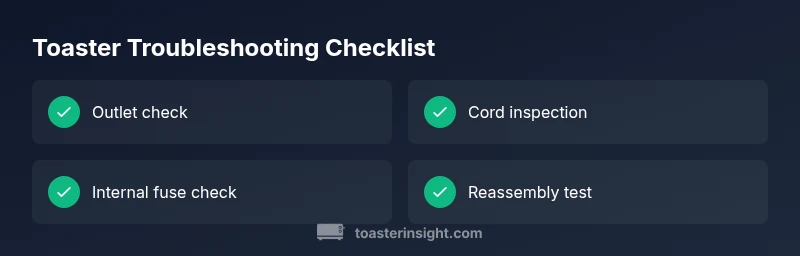
Toaster Not Working? Fuse Ok: Urgent Troubleshooting Guide
Urgent, practical troubleshooting for a toaster not working fuse ok scenario. Learn safe power checks, how to test outlets, inspect cords, and decide between repair or replacement with expert guidance from ToasterInsight (2026).


If your toaster not working but the fuse is ok, the most likely issue is a tripped outlet or a failed power switch. Start by unplugging, testing the outlet with another appliance, and resetting the circuit breaker. If power returns but the toaster still won’t heat, inspect the cord and the internal contacts for loose wires or corrosion.
Why fuse ok is only part of the picture
According to ToasterInsight, a fuse being OK is not a guarantee that your toaster will power up. When the label toaster not working fuse ok appears in notes, it typically means the protective fuse did not trip, but power still isn't reaching the heating circuit. The result can be a simple outlet issue, a faulty switch, a damaged cord, or an internal safety fuse that has opened but is not obvious from the outside. In this block, we'll unpack why fuse status matters and how to approach diagnosis with safety in mind. The guidance here reflects ToasterInsight Analysis, 2026, which emphasizes methodical power testing before internal inspection. Start by confirming the basics: is the outlet delivering power, is the cord intact, and is the toaster switching on the power correctly? Even if the fuse appears OK, you should proceed with the checks below to avoid missing a common failure point.
Keep in mind: working with hot parts requires caution. We'll cover power checks, safe disassembly, and how to decide when to replace rather than repair. If at any point you feel unsure, it's wise to stop and consult a professional. The main take: fuse status is a helpful clue, but not the final verdict toaster troubleshooting requires a systematic flow.
ToasterInsight’s approach is to start with the obvious power delivery checks, then move to safety features and internal wiring. This reduces risk and increases the chance you’ll avoid unnecessary parts replacements.
Steps
Estimated time: 30-60 minutes
- 1
Power off and unplug the toaster
Begin with safety. Unplug the toaster from the wall outlet and disconnect any detachable power cord. Do a quick external inspection for obvious damage like cracks or burnt residues. This step minimizes shock risk before you touch anything internal.
Tip: Never work on live electrical components; check that the outlet is completely de-energized. - 2
Test the outlet and circuit health
Plug in a different small appliance to confirm the outlet works. If nothing runs, try a different outlet or reset the home breaker. This helps distinguish a house supply issue from a device-specific fault.
Tip: If you have a home tester, use it, but a simple lamp test is often enough to confirm power. - 3
Inspect the external cord and plug
Examine the cord for fraying, kinks, or loose connections at the plug. A damaged cord can prevent power from reaching the toaster even when the fuse is intact.
Tip: Replace a damaged cord with a genuine part; do not improvise with duct tape or similar makeshift fixes. - 4
Open the housing and locate safety fuses
If you’re comfortable, remove screws and carefully lift the shell to access internal components such as the thermal fuse and main switch. Visually inspect for discoloration, signs of overheating, or loose wires.
Tip: Take photos of wiring before unplugging anything to aid reassembly. - 5
Check continuity of fuses and heating circuit
Using a multimeter, verify continuity across the heating circuit and any internal fuses. A blown fuse will show no continuity. Do not touch live contacts during testing.
Tip: If you’re unsure how to use a multimeter, consult a repair manual or a professional. - 6
Reassemble, test, and decide on repair vs replacement
Put the toaster back together, plug in, and run a short test cycle without bread. If it powers up but has no heat, the issue may be the heating element or control board. Decide whether a repair is cost-effective or if a replacement is wiser.
Tip: If the device is old or under warranty, check the warranty terms before attempting internal repairs.
Diagnosis: Toaster not working even though the fuse is reported as ok.
Possible Causes
- highPower issue at the outlet or circuit (no voltage reaching the device)
- mediumFaulty power switch or damaged plug/wiring
- mediumInternal thermal fuse or other safety fuse has opened or degraded
- lowLoose internal connections or corrosion at heating contacts
- lowMoisture exposure or crumb buildup causing short/arc
Fixes
- easyTest the outlet with a known-good appliance and reset the circuit breaker
- easyInspect the power cord for visible damage and replace if frayed or loose
- hardDisassemble the toaster housing only if comfortable and safe to inspect internal wiring and fuses
- hardIf internal fuses are blown or damaged, replace only with manufacturer-specified parts or seek professional repair
- mediumIf still unresolved, contact a qualified technician or the manufacturer warranty service
Your Questions Answered
Why does a fuse seem OK but the toaster still won’t power on?
Fuse status is only one clue. Power may be blocked by an outlet issue, a faulty switch, or loose wiring. Check power delivery before assuming the heating circuit is at fault.
Fuse status isn’t the whole story. Start with the outlet and switch, then inspect wiring if power still doesn’t reach the toaster.
Is it safe to open a toaster to inspect the internals?
Only if you are comfortable with basic electronics and have unplugged the unit. Internal components can carry a residual charge and sharp edges exist. If unsure, consult a professional.
Opening a toaster is risky; unplug first and consider a professional if you’re not confident.
Can a damaged power cord cause the issue even if the fuse is OK?
Yes. A compromised cord can prevent power from reaching the heating circuit, masking the fuse status. Inspect for frays and replace as needed.
A bad cord can fool you into thinking the fuse is the problem; check the cord carefully.
What’s the quickest test to verify power at the outlet?
Plug a known-good device, or use an outlet tester. If it doesn’t power, the issue is with the outlet or circuit, not the toaster.
Use a lamp or tester to confirm the outlet is supplying power fast.
When should I replace the toaster instead of repairing it?
If the unit is old, frequently fails, or repair costs approach a new toaster, replacement is usually more cost-effective and safer.
Sometimes replacement makes more sense than costly repairs.
Watch Video
Key Takeaways
- Verify outlet power first
- Inspect cords and plugs for damage
- Use a multimeter for internal checks
- Disassemble only if confident and safe
- Replace damaged parts or seek professional help when needed